Condo rental management in Phuket starts before a tenant or guest enters the apartment. The owner first needs to decide how the property will be rented, confirm building restrictions, define who controls access, document the unit condition, and agree how income, repairs, utilities, and tenant issues will be handled.
Problems usually begin when a manager is appointed with a vague instruction to “manage everything.” Long-term tenants and short-term guests require different workflows, while overseas owners also need evidence that work was completed. The rental model determines every management step that follows.
Quick Check: Before appointing a provider, choose condo rental management in Phuket that verifies rental rules, records apartment condition, controls repair approvals, and provides traceable owner reporting.
Condo Rental Management in Phuket: Legal Terms
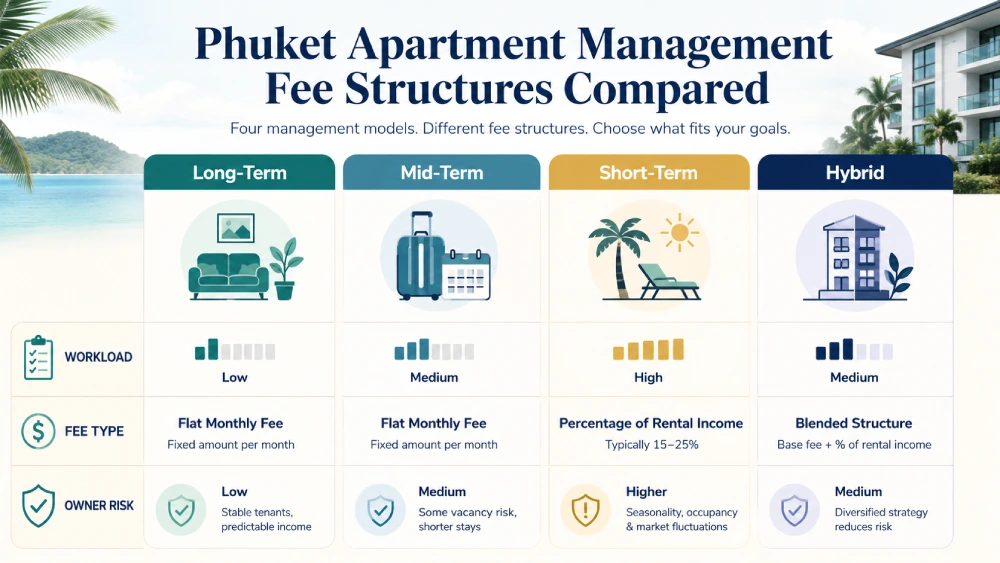
Legal and building controls should be checked before listings, bookings, or tenant handovers begin. The first task is to establish the intended rental model and make sure the building’s procedures, access arrangements, reporting duties, and management responsibilities match it.
Rental Compliance Control Table
| Control | Long-Term Rental | Short-Term Rental Where Applicable | Management Evidence |
| Rental model | Lease-based occupancy | Booking-based occupancy | Written rental scope |
| Building rules | Confirm tenancy requirements | Confirm guest/short-stay restrictions | Current building rules |
| Occupant details | Tenant records | Guest records | Occupancy file |
| Building access | Keys/cards/registration | Guest access and arrival process | Access checklist |
| Apartment condition | Move-in baseline | Turnover inspection | Dated condition record |
| Foreign occupant reporting | Assign responsibility where applicable | Assign responsibility where applicable | Submission evidence |
| Owner-use dates | Incorporated into lease planning | Blocked from availability | Owner-use calendar |
| Emergency responsibility | Tenant/manager contact route | Guest/manager response route | Escalation procedure |
| Rental records | Lease and rent history | Booking and stay history | Central rental record |
Decide the Rental Model Before Marketing
Long-term rental and holiday rental management should not be treated as interchangeable.
For a long-term tenancy, the main controls normally centre on tenant selection, lease dates, rent, move-in condition, utilities, building rules, repairs, and move-out. Short-term operation, where legally and operationally permitted, adds booking calendars, repeated arrivals, turnovers, guest access, cleaning, and faster issue handling.
The Phuket short-term rental management operations become relevant only when the apartment is genuinely intended and permitted for that use.
An owner using the property as an investment should also define the property management solution for investors before selecting services. Paying for booking-channel management makes little sense when the actual strategy is a stable long-term lease.
Check Building Rules Before Taking Bookings
A privately owned apartment can still sit inside a building with its own access, occupancy, visitor, parking, noise, moving, and registration requirements.
The management file should therefore include the latest rules affecting:
- Tenant registration
- Guest registration
- Keys and access cards
- Lift access
- Parking
- Visitors
- Pets where applicable
- Shared facilities
- Move-in procedures
- Move-out procedures
- Short-stay restrictions
A proper condo house-rule compliance management process prevents the manager from discovering a restriction only after a tenant has arrived.
This matters in buildings using controlled lift access, security registration, or facial-recognition systems. The manager should test the actual arrival procedure rather than assuming that possession of a room key provides full building access.
Assign Foreign-Occupant Reporting Responsibility
Where the applicable immigration rules require TM30 notification for a foreign national staying at the property, the management agreement should identify who files it and who keeps the evidence.
Thailand Immigration’s current online guidance states that house owners, landlords, possessors, or hotel managers accommodating foreign nationals temporarily must notify the relevant immigration authority within 24 hours of arrival. The official system explicitly covers apartments and rental houses. (TM30)
For an owner, the practical management questions are straightforward:
- Who holds the required information?
- Who completes the submission?
- Who checks it was accepted?
- Where is the evidence stored?
- Who acts when the responsible person is unavailable?
The responsibility should be written down rather than assumed.
Record Tenant Condition Before Possession
Tenant disputes become much harder when the apartment has no documented starting condition.
Before move-in, record:
- Dated room photographs
- Existing scratches or damage
- Furniture
- Appliances
- Air-conditioning operation
- Water meter
- Electricity meter
- Keys
- Access cards
- Parking devices
- Existing maintenance faults
The condo move-in move-out inspection management should use the same record again when the tenancy ends.
Where a deposit is involved, damage-deposit verification at check-in should connect the opening condition with any later claim. A deduction supported only by memory creates an avoidable dispute.
Define Who Handles the Tenant
“Tenant management” needs a precise scope.
The Phuket condo tenant handling process can include:
- Initial handover
- Building registration
- Rent follow-up
- Repair requests
- Access problems
- Contractor coordination
- House-rule issues
- Tenant complaints
- Lease renewal
- Move-out scheduling
The agreement should also state what remains with the owner.
Broader property rental management services in phuket can coordinate those functions for owners who are not available locally, but each responsibility should still be documented individually.
Build an Emergency Escalation Route
A tenant may report a leak, electrical fault, air-conditioning failure, lock problem, broken appliance, or building-access issue.
The Phuket property-management emergency response should answer:
- Who receives the report?
- Is there an immediate safety or damage risk?
- Does the fault belong to the private unit or building?
- Does the CJP need notification?
- Can the manager approve work?
- When must the owner approve the cost?
- How is completion verified?
An emergency process is most useful before the emergency occurs.
Condo Rental Management in Phuket: Fee Structure
Rental income should never be assessed from the headline rent alone. Owners need a clear path from gross income through management charges, common costs, cleaning, repairs, utilities, approved deductions, and the final amount transferred to them.
Rental Cost and Reporting Structure
| Cost or Record | What It Relates To | Management Control |
| Gross rent | Tenant or guest revenue | Record income before deductions |
| Management fee | Agreed management service | Show calculation separately |
| Common-area/CAM fee | Building ownership cost | Keep separate from management |
| Cleaning | Apartment preparation | Record frequency and invoice |
| Repairs | Fault correction | Link to approval and evidence |
| Utilities | Water/electricity | Reconcile readings and bills |
| Platform costs | Short-term channels where applicable | Record separately |
| Damage deduction | Tenant/guest damage | Link to condition evidence |
| Tax records | Owner’s rental-income records | Retain supporting documents |
| Net payout | Amount due to owner | Reconcile back to gross income |
Separate CAM From Rental Management Costs
A common-area or building fee is not the same as a private rental-management charge.
Owners should be able to distinguish:
- Building common-area charges
- Private management
- Tenant placement
- Cleaning
- Maintenance
- Repairs
- Utilities
- Short-term operational costs where applicable
Combining everything into one “management cost” makes the property difficult to evaluate.
The supplied research also shows that real owners discuss both CAM and management charges when assessing rental performance. The useful takeaway is cost separation, not another owner’s personal fee or return.
Track Rent From Gross to Net
A monthly owner report should make every major deduction traceable.
The rental income and expense reporting should show:
Gross rental income
↓
Management charge
↓
Cleaning where applicable
↓
Utilities charged to owner
↓
Approved maintenance
↓
Approved repairs
↓
Other documented costs
↓
Net owner payout
The owner should not need to compare bank transfers, messaging apps, and contractor invoices to understand one month’s result.
Keep Rental Tax Records Separate
The Thai Revenue Department currently classifies income from letting property as assessable income for personal income tax purposes. The actual tax position depends on the owner’s circumstances, so management records should support professional tax review rather than assuming one universal rate. ( กรมสรรพากร)
A useful rental file can retain:
- Rent received
- Management invoices
- Repair invoices
- Relevant expense records
- Withholding documentation where applicable
- Owner statements
- Supporting payment records
The management company should not present ordinary rental reporting as personalised tax advice unless that service is specifically provided by someone qualified to give it.
Reconcile Utilities at Both Ends
Utility disputes often begin because nobody recorded the starting position.
The condo utility reconciliation management process should record:
- Opening electricity reading
- Opening water reading
- Billing period
- Bills received
- Payments made
- Tenant responsibility
- Owner responsibility
- Final readings
- Unpaid balance
Final utility reconciliation should be connected with move-out rather than treated as an unrelated accounting task.
Keep a Rent and Occupancy Record
Long-term apartment management needs one reliable record of who is occupying the unit, under which agreement, for what period, and at what rent.
The rent-roll use in property management can support:
- Tenant details
- Lease start
- Lease end
- Rent
- Deposit
- Payment status
- Renewal date
- Occupancy status
This is particularly useful when one owner has several managed properties.
The information should connect with the owner’s financial statement rather than sit in a separate record that never gets reconciled.
Set Repair Approval Limits
Repairs create friction when the manager either approves too much or waits for the owner on every small problem.
A management agreement can define:
- Routine spending authority
- Owner approval threshold
- Emergency authority
- Preferred contractor procedure
- Evidence required
- Invoice requirements
- Completion confirmation
The Phuket property management responsibility scope should make this distinction clear.
A manager can coordinate work without receiving unlimited spending authority.
Calculate Performance From Real Costs
Advertised rental return and actual owner payout are different measures.
Actual performance should account for the costs that genuinely apply to that property, such as vacancy, management, common fees, cleaning, repairs, utilities, and applicable tax obligations.
Do not use an isolated Reddit return or an agent’s quoted yield as a Phuket benchmark. The research contains personal return claims, but those describe individual properties, not a reliable market-wide result.
Condo Rental Management in Phuket: Operations
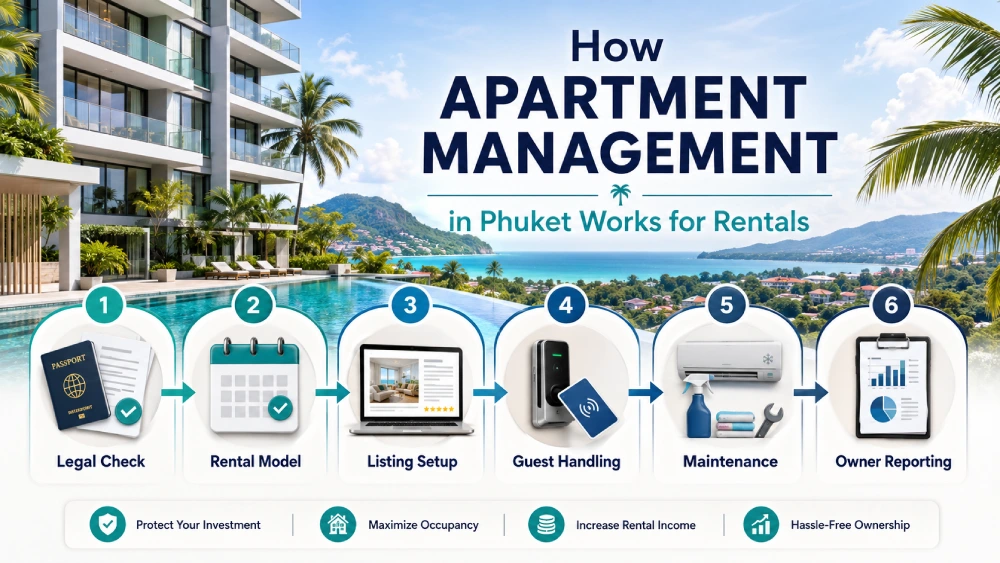
Daily operations determine whether the rental continues to work after the contract is signed. Apartment condition, tenant communication, access, cleaning, maintenance, inventory, booking calendars, repairs, and reporting all need a defined sequence and someone responsible for closing each task.
Rental Operations Control Table
| Rental Stage | Core Control | Evidence |
| Pre-rental | Property inspection | Condition report |
| Tenant selection | Appropriate checks | Tenant file |
| Move-in | Inventory, meters and access | Handover record |
| Occupancy | Rent, issues and repairs | Tenant log |
| Maintenance | Condition-based checks | Inspection record |
| Short-term booking | Availability control | Calendar record |
| Turnover | Cleaning and condition check | Readiness checklist |
| Repair | Approval and completion | Repair file |
| Move-out | Condition comparison | Exit inspection |
| Reporting | Income, costs and open issues | Owner report |
Inspect the Apartment Before Renting
The rental file should start with the physical apartment.
Check:
- Water leaks
- Air conditioning
- Electrical items
- Appliances
- Bathrooms
- Kitchen
- Locks
- Doors and windows
- Furniture
- Humidity or mould signs
- Visible pest evidence
- Existing damage
The Phuket rental-property protection controls should connect these inspections to maintenance follow-up rather than simply creating photographs that nobody reviews.
Move From Reactive to Planned Maintenance
Rental properties should not wait for a tenant complaint before every inspection.
Phuket conditions can make moisture, air-conditioning, leaks, and apartment closures particularly important to monitor. The schedule should be based on the property’s actual condition, occupancy, equipment, and history, not one universal maintenance interval.
Each visit should record what was checked and what needs action.
For owners abroad, the management record should show:
- Date
- Condition
- Fault
- Required action
- Contractor where needed
- Approval
- Completion
- Remaining issue
Control Short-Term Calendars Where Applicable
For apartments genuinely operated as short-term rentals, availability has to remain accurate.
Airbnb multi-platform calendar management becomes important where several channels are active.
The manager should block:
- Confirmed bookings
- Owner stays
- Maintenance periods
- Repair closures
- Unavailable dates
A calendar should never show the apartment as available simply because the booking platform has not yet received an internal update.
Where this model is legally and operationally appropriate, airbnb management for vacation rentals in phuket may also involve booking coordination, guest communication, listing control, turnovers, and issue handling.
Control Every Guest Turnover
For short-term stays, one departure can be followed quickly by another arrival.
The guest-turnover housekeeping management workflow should follow a fixed sequence:
Departure → condition check → cleaning → linen → inventory → maintenance check → final readiness check → release
The apartment should not be marked ready simply because housekeeping has left.
Check Cleaning Quality Separately
Cleaning completion and cleaning quality are different controls.
Housekeeping quality-control management should verify the areas that affect the next occupant, including:
- Bathrooms
- Kitchen
- Bedding
- Floors
- Surfaces
- Odour
- Visible damage
- Missing items
- Consumable setup where applicable
For vacation units, vacation rental housekeeping in phuket can support cleaning and turnover preparation, but technical faults should remain with maintenance staff or the correct specialist.
Keep Furnished Inventory Accountable
Furnished apartments lose small items gradually when inventory is not recorded.
The housekeeping inventory management process can separate:
Durable property
- Furniture
- Appliances
- Remote controls
- Kitchen equipment
Operating stock
- Linen
- Towels
- Guest consumables
- Replacement supplies
Damage, normal wear, missing stock, and normal consumption should not be recorded as the same thing.
Handle In-Stay Problems to Closure
A guest or tenant reporting a fault needs more than an acknowledgement.
For short-term stays, Airbnb guest issue management during stays may cover problems such as access, appliances, air conditioning, water, noise, or maintenance during an active booking.
For long-term tenants, the same basic control still applies:
Report → assess → assign → approve → repair → verify → close
The manager should know which issues require the CJP, which belong inside the unit, and which require an external specialist.
Keep the Whole Rental Record Together
A property-management centralization structure should connect:
- Rental agreement
- Tenant details
- Access
- Inventory
- Inspections
- Utilities
- Repairs
- Invoices
- Building notices
- Owner approvals
- Income
- Payouts
This is particularly important for overseas owners. A management history should survive a staff change, tenant change, or contractor change.
Phuket Apartment Rental Coverage
Rental apartment management can be coordinated across Bang Tao, Rawai, Nai Harn, Kamala, Surin, Patong, Chalong, Kata, Karon, Mai Khao, Laguna, Kathu, Thalang, Cherng Talay, Choeng Thale, and surrounding areas in Phuket.
The actual workflow should still be property-specific. A long-term apartment in Kathu does not need the same booking and turnover system as a holiday rental in Patong, while a remotely owned unit in Bang Tao may require stronger inspection and reporting controls.
Put the Rental Workflow Under One Manager
Apartment rental management works best when one clear process connects occupancy, condition, access, repairs, money, and owner approval. PEARL Phuket Property provides condo rental management in phuket for owners who need local rental oversight and documented follow-up. The scope can be agreed around the actual rental model rather than a vague “full management” promise. We manage. You relax.
FAQs
Can Condo Rental Management Handle Owner-Stay Dates?
Yes, condo rental management can include owner-use periods if those dates are recorded before the property is offered to tenants or guests. For short-term rentals, the dates should be blocked across every active calendar. For longer leases, owner-use expectations need to fit the tenancy agreement rather than interrupt an active lease. The management scope should identify who records changes and confirms availability.
What Happens If the CJP and Manager Disagree on a Repair?
When condo rental management identifies a fault that may involve both a private unit and a common building system, the manager should document the visible problem before assigning the cost. Photographs, contractor findings, and CJP communication can help establish responsibility. The owner should avoid approving a complete private repair until it is reasonably clear whether common pipework, building structure, or another shared component is involved.
How Should a Rental Extension Be Managed?
A condo rental management process should flag the lease expiry early enough for the owner and tenant to discuss renewal. The manager can review payment history, unresolved repairs, proposed dates, rent terms, building-registration requirements, and any updated rules before preparing the next tenancy period. Renewal should also trigger a check of contact information and any records that have changed during the existing tenancy.
Should CAM Fees Appear in Rental Performance Reports?
For an owner analysing actual performance, condo rental management reporting can show CAM or common-area fees separately from private management charges. That makes it easier to distinguish building ownership costs from costs caused by rental operations. Whether CAM is shown monthly or in another reporting period depends on how the owner wants performance measured, but it should not be silently combined with a management commission.
What If Building Access Uses Facial Recognition?
Where condo rental management involves a building with facial-recognition or another controlled-access system, the manager should confirm the current registration procedure before the occupant arrives. A room key may not provide lift or entrance access. The handover record should therefore cover registration, security notification, access-card status, parking where applicable, and the contact procedure if the tenant’s access fails.
How Should a Manager Handle a Missing Access Card?
A condo rental management record should show how many keys and access devices were handed over at the start of the tenancy. If one is lost, the manager should confirm the building’s replacement procedure, security implications, replacement charge, and whether the missing device must be deactivated. The final cost should be supported by the building’s or supplier’s actual charge rather than an arbitrary deduction.
What Should an Overseas Owner See After a Repair?
Good condo rental management reporting should allow an overseas owner to connect the original fault with the completed work. Depending on the repair, that can include the reported problem, photographs, contractor diagnosis, quotation, approval, invoice, completion evidence, and confirmation that the equipment or affected area was checked afterwards. The report should also identify any unresolved issue requiring a second visit.