Owning a beachfront villa in Phuket sounds simple until bookings, salt air, staff, guest issues, TM30 reporting, and maintenance bills start moving at the same time. The serious action is to manage the villa like a small hospitality asset, not a spare home, with pricing control, guest systems, scheduled inspections, clean reporting, and a clear manager agreement.
The experienced solution is to place the property under a team that can prove real bookings, protect the villa from coastal wear, and turn guest stays into controlled income instead of daily owner stress.
How Does Beachfront Villa Management in Phuket Work?
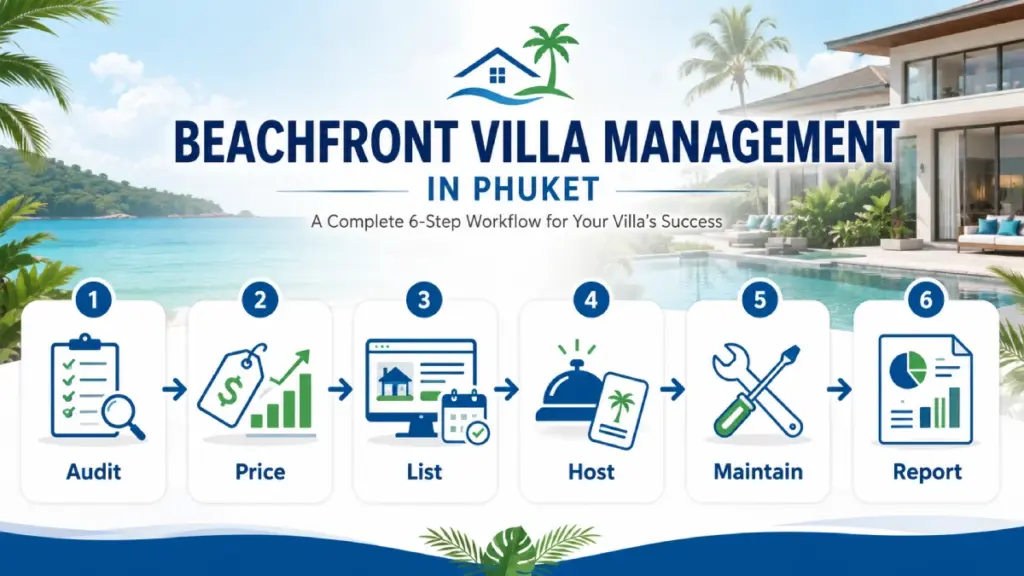
Beachfront Villa Management in Phuket works by converting a private coastal villa into a controlled rental operation. A manager connects bookings, guest care, staff, inspections, maintenance, legal reporting, and owner payouts. The owner receives income visibility without handling every daily problem.
Full-service hosting can include listing setup, pricing, calendar control, booking administration, guest messaging, onsite support, cleaning, and maintenance. These responsibilities should be clearly divided between the property owner and management team.
| Management Area | What Happens | Why It Matters |
| Villa setup | Audit, inventory, photographs, rules, systems | Makes the villa rental-ready |
| Pricing | Seasonal rates, demand checks, discounts | Prevents weak income assumptions |
| Guest handling | Enquiries, check-in, support, complaints | Protects guest satisfaction |
| Maintenance | AC, pool, garden, salt-air care, repairs | Protects the beachfront asset |
| Reporting | Income, expenses, repairs, payouts | Keeps owner control transparent |
A serious manager does not only hand over keys. The team operates the villa as a serviced product with booking discipline, guest standards, and property protection.
Owners who need one accountable team can use villa management in Phuket to connect inspections, maintenance, rental operations, staff coordination, and owner reporting.
Step 1: Audit the Villa Before It Earns
The first serious step is not marketing. It is checking whether the villa can handle paying guests. Beachfront villas need a stronger inspection because constant coastal exposure can increase wear on exterior finishes, equipment, metal components, and outdoor areas.
A proper setup begins with inventory, access control, utility mapping, safety checks, and photographic documentation. The manager records furniture, appliances, linen, artwork, keys, Wi-Fi details, pool equipment, and owner-only areas. This prevents confusion when damage, missing items, or repair disputes appear later.
The villa should also be checked for guest readiness. Air conditioning, drainage, hot water, pool pumps, locks, lighting, kitchen equipment, Wi-Fi, and outdoor furniture must work before launch. Owners who skip this stage may receive complaints before the property has a fair chance to perform.
Owners can use the guide to guest-ready villa preparation in Phuket to review room condition, supplies, access, safety points, cooling systems, and outdoor presentation before accepting bookings.
The Initial Audit Should Record
- Furniture and appliance condition
- Keys, remotes, and access cards
- Air-conditioning performance
- Water pressure and hot water
- Pool pumps and filtration
- Drainage and exterior surfaces
- Fire and security equipment
- Kitchen and laundry equipment
- Linen and towel inventory
- Owner-only storage areas
A dated inspection report gives the owner a baseline against which future wear, repairs, missing items, and guest damage can be assessed.
Step 2: Price the Villa by Demand, Not Hope
Price is where many owners lose money quietly. A beachfront villa may look premium, but demand changes by month, guest type, school holidays, weather, amenities, reviews, and local competition. The manager must price from market behaviour, not owner emotion.
High season, shoulder periods, and lower-demand months require different tactics. Peak periods may support stronger rates and longer minimum stays. Lower-demand periods may need flexible stay lengths, targeted offers, improved listing presentation, and stronger direct-agent relationships.
A good manager should show occupancy, average daily rate, booking lead time, discounts, cancellations, and monthly net income. Advertised rental prices alone do not prove what comparable villas actually achieve.
Pricing Control Should Include
- Seasonal rate calendars
- Weekend and holiday adjustments
- Minimum-stay rules
- Booking-gap analysis
- Comparable-listing checks
- Length-of-stay discounts
- Owner-use calendar blocks
- Cancellation monitoring
- Platform-fee calculations
- Net-income reporting
Airbnb allows authorised co-hosts to manage pricing, seasonal adjustments, discounts, availability, booking requests, and reservations according to their access level.
The manager should explain how the villa compares with nearby alternatives in location, beach access, privacy, bedroom capacity, pool quality, views, staffing, and included services.
Step 3: Turn Guests Into a Managed Operation
Guests do not judge only the sea view. They judge reply speed, arrival experience, cleanliness, privacy, problem-solving, and check-out handling. A villa that rents at a premium must behave like a private hospitality unit.
The guest process starts before arrival. The manager confirms guest numbers, arrival time, applicable house rules, transport needs, bedding arrangements, food requests, and special requirements. This reduces last-minute pressure on the owner and villa staff.
During the stay, communication must be fast and calm. Problems such as weak Wi-Fi, air-conditioning faults, water-pressure issues, noise, access failures, or pool concerns should be handled before they become public complaints.
Professional Airbnb management in Phuket can connect listing control, guest messages, calendars, pricing, cleaning, check-ins, maintenance, and review management.
Delayed flights and late arrivals may require 24-hour check-in in Phuket with clear access instructions, key coordination, and responsive local support.
The Guest Operation Should Cover
- Enquiry and booking responses
- Guest-number confirmation
- Pre-arrival instructions
- Airport-transfer coordination
- Access and key handover
- House-rule communication
- During-stay support
- Emergency contacts
- Check-out instructions
- Departure inspection
Hosting teams may manage preparation, listing details, guest communication, reservation issues, reviews, cleaning, and maintenance on behalf of an owner.
A controlled guest process protects the stay, the villa, and the owner’s time.
Step 4: Protect the Coastal Wear Points
Beachfront villas age differently from inland homes. Salt air, humidity, sand, heavy rain, wind, and strong sunlight can affect exterior coatings, metalwork, glass, air-conditioning units, outdoor furniture, drainage, and pool systems.
Coastal salt exposure can accelerate corrosion, while southwest-monsoon conditions bring substantial rain to Thailand’s southern west coast. These conditions support a more frequent inspection and maintenance schedule for Phuket beachfront properties.
The core schedule should include air-conditioning cleaning, pool testing, pest control, drainage checks, roof and gutter checks, glass cleaning, outdoor-metal inspection, garden care, and appliance testing. The villa should also be checked after strong rain or wind.
Sand is another hidden problem. It can scratch flooring, enter drains, increase cleaning demands, and affect pool filtration. A manager should establish entrance mats, outdoor rinse points, cleaning routines, and pool-area controls.
Regular pool cleaning in Phuket can support water testing, chemical balance, filtration checks, debris removal, tile cleaning, and guest-ready pool presentation.
Scheduled Gardening and maintenance in Phuket can control rapid plant growth, keep drains accessible, inspect irrigation, clear storm debris, and maintain safe outdoor pathways.
Owners can also review why Phuket property management matters for villas for broader guidance on tropical maintenance, inspections, security, and remote supervision.
Coastal Maintenance Priorities
| Wear Point | Required Control |
| Exterior metalwork | Cleaning, corrosion checks, protective coating |
| Air-conditioning | Filter, drain, coil, and outdoor-unit checks |
| Pool systems | Water balance, pumps, filters, overflow control |
| Glass and frames | Salt and sand removal |
| Roof and gutters | Debris, seal, and drainage inspections |
| Outdoor furniture | Fastener, fabric, and corrosion checks |
| Garden drainage | Leaf, sediment, and blockage removal |
| Interior humidity | Airflow, cooling, and moisture monitoring |
Maintenance is not only about fixing failures. It is about protecting the guest experience before guests notice a problem.
Step 5: Control Staff, Vendors, and Standards
Staff quality can make a villa feel premium or careless. Housekeepers, gardeners, pool technicians, drivers, chefs, maintenance workers, and guest contacts all affect the stay. The manager must control timing, standards, communication, and accountability.
A beachfront villa needs clear task lists. Housekeeping staff should understand linen rules, towel counts, guest privacy, room presentation, and damage reporting. Pool and garden teams should follow documented schedules instead of arriving only after complaints.
Reliable Housekeeping services in Phuket can manage turnover cleaning, linen, bathrooms, kitchens, floors, guest supplies, outdoor areas, and final arrival checks.
Staff should also know how to work around premium guests. Privacy, quiet service, correct arrival timing, appropriate communication, and respect for owner-only areas all matter.
Vendor control is equally important. A cheap repair can create repeat faults, owner disputes, and guest refunds. A manager should maintain trusted vendors, obtain comparative quotations for larger work, and document completed repairs with photographs and invoices.
Staff and Vendor Controls
- Written service schedules
- Room and area checklists
- Linen and towel counts
- Attendance records
- Privacy standards
- Backup staffing plans
- Repair-approval limits
- Contractor quotations
- Completion photographs
- Invoice records
The manager should remain accountable for quality even when individual tasks are completed by specialist contractors.
Step 6: Keep Legal and Financial Records Clear
A managed villa must be clear on money and administration. Owners need to know what came in, what went out, and what remains as the net payout. They also need guest records and local operational obligations to be handled correctly.
Monthly reports should separate gross rent, platform fees, cleaning, utilities, maintenance, management commission, taxes where applicable, and owner payouts. Repair invoices should be attached or recorded clearly.
Foreign-guest reporting also requires attention. Thailand Immigration states that the relevant owner, household head, landlord, or hotel manager must notify immigration within 24 hours when accommodating a foreign national temporarily. The management agreement should state who prepares and submits the information.
These operational procedures do not replace legal, accounting, tax, licensing, or insurance advice. Owners should obtain advice for their specific ownership and rental structure.
Owners living abroad can review how Phuket villa management helps overseas owners for more detail about reporting, inspections, rental support, and local decision-making.
The Monthly Owner Report Should Show
- Gross booking income
- Occupied nights
- Average nightly rate
- Platform deductions
- Cleaning and laundry expenses
- Utility bills
- Pool and garden costs
- Maintenance invoices
- Management fees
- Owner payout
- Outstanding repairs
- Items awaiting approval
A message saying that everything is fine is not a management report. Owners need figures, photographs, invoices, pending actions, and clear explanations.
Step 7: Separate Achieved Rent From Asking Rent
Many owners overestimate income because they focus on advertised prices. Asking rent is not the same as achieved rent.
Real performance depends on booked nights, discounts, cancellations, platform fees, cleaning, utilities, vacant periods, maintenance, management charges, and other operating costs.
A strong manager should explain realistic nightly rates, likely monthly ranges, lower-demand strategies, and estimated net returns. They should not promise that every beachfront villa will perform like the strongest property in the area.
Owners should request a sample statement before signing. The statement should show income, deductions, repair handling, and payout timing.
Evidence Owners Should Request
- Historical occupancy where available
- Average achieved nightly rate
- Average booking lead time
- Discount history
- Cancellation rate
- Cleaning and turnover costs
- Utility expenditure
- Maintenance costs
- Platform deductions
- Net owner payout
The correct comparison is not only how much rent was advertised. It is how much income remained after every real operating cost.
Step 8: Use Low Season as a Strategy Test
Low season is not automatically a failure. It tests pricing, listing quality, flexibility, property presentation, and manager effort.
The villa may need longer-stay offers, family positioning, remote-work suitability, improved photographs, clearer descriptions, updated amenities, or stronger direct-agent outreach.
Rain, construction activity, beach-access limitations, road work, or nearby development may also affect stays. The manager should monitor local conditions and communicate relevant limitations honestly.
Guests may spend more time inside the villa or around the private pool during wet weather. This makes interior comfort, entertainment, Wi-Fi, housekeeping, pool condition, and covered outdoor areas particularly important.
The Thai Meteorological Department identifies the southern west coast as a high-rainfall area during the southwest monsoon, with the regional rainfall peak commonly occurring around September.
A strong low-season plan protects reviews while testing which offers, guest groups, and listing improvements create genuine demand.
Step 9: Choose a Manager by Proof, Not Promises
The wrong manager can cost more than a high commission. Poor guest replies, weak maintenance, unclear reports, and unsuitable pricing can reduce income and damage the property’s reputation.
Ask how the company handles inspections, pricing, guest complaints, staff, emergency repairs, owner statements, and platform listings. Ask what is included in the fee and which services cost extra.
Owners can use what makes a good Phuket property manager today as a checklist for contracts, reporting, local staff, maintenance controls, communication, and financial transparency.
A beachfront villa is not managed like a small city apartment or a unit with shared building systems. The manager must understand pools, gardens, private access, outdoor structures, corrosion risks, staffing, and premium guest expectations.
Owners with separate residential properties may need House management in Phuket for inspections, bills, cleaning, maintenance, security checks, and vacant-property supervision.
For mixed portfolios, Condominium management in Phuket may be more suitable for units involving juristic-office communication, shared facilities, access cards, and building-specific rules.
The manager should provide a written agreement covering responsibilities, fees, repair approvals, emergency limits, owner-use dates, reporting frequency, contractor selection, and termination procedures.
Final Decision: When Owners Should Get Help
Owners should get help when the villa needs income control, guest handling, maintenance supervision, or transparent reporting. The need becomes more urgent when the owner lives overseas or the property is directly exposed to coastal conditions.
The best setup starts with an inspection, realistic income planning, and a clear agreement. The manager then builds listings, controls pricing, prepares staff, handles guests, maintains the villa, and reports monthly.
If the villa already has maintenance problems, begin with inspections, repairs, cleaning, and reporting before pushing for more bookings. If the villa is ready but underperforming, focus on pricing, listing accuracy, photographs, guest communication, and calendar control.
The guide to how remote property management works in Phuket explains how local operations, digital reporting, owner approvals, and preventive maintenance can work together.
FAQs Owners Ask Before Handing Over a Villa
1. How much control does the villa owner keep?
The owner should retain control over personal-use dates, major repairs, pricing direction, and financial visibility. The manager handles daily operations within the limits written into the management agreement.
2. Can a beachfront villa be managed from overseas?
Yes, but it requires a reliable local team, scheduled inspections, repair records, photographs, monthly statements, and a clear approval process. Distance becomes risky when no one is responsible for physically checking the villa.
3. What is the biggest hidden beachfront-villa cost?
Delayed maintenance is often one of the largest hidden costs. Salt exposure, humidity, pool faults, air-conditioning problems, drainage failures, and exterior deterioration can become expensive when inspections are postponed.
4. Do expensive beachfront villas always attract premium guests?
No. Price alone does not create suitable demand. The villa also needs accurate photographs, clear rules, reliable service, good maintenance, appropriate targeting, and a consistent guest experience.
5. Should owners accept every booking request?
No. The manager should confirm the guest count, stay purpose, property suitability, house-rule acceptance, and any unusual risks within applicable laws and platform rules. Protecting the property is part of protecting rental income.
6. What should a beachfront management agreement include?
It should define guest handling, inspections, housekeeping, pool and garden care, emergency response, repair approvals, reporting, fees, owner-use dates, and termination procedures. The agreement should also state who coordinates guest records, access, insurance documentation, and specialist compliance support.