Villa rental management in phuket depends heavily on what happens between a booking confirmation and the guest leaving the property. Unclear visitor rules, missing arrival information, unfinished housekeeping, lost maintenance requests, and poor access control can quickly turn a routine stay into an owner problem.
A reliable guest-management process assigns each task before the guest arrives and keeps responsibility clear throughout the stay. For owners outside Thailand, those records also show what happened at the villa without relying on verbal updates. The real test is whether every guest, staff member, and property task stays connected.
Quick Check: Before appointing a provider, choose villa rental management in Phuket that records guest access, staff responsibilities, maintenance escalation, and booking handovers before the first stay begins.
Why Is Guest Management Important for Phuket Villas?
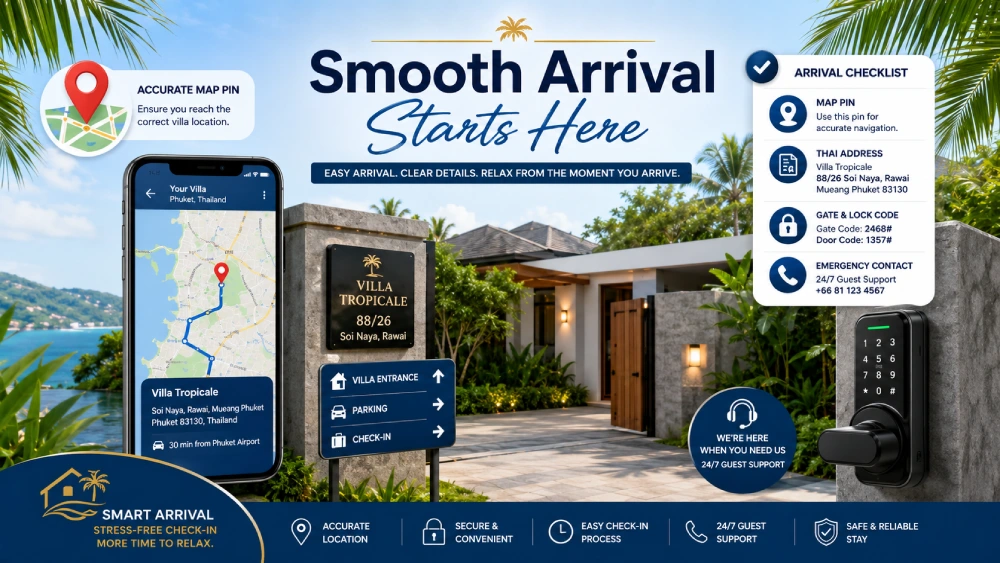
Guest management starts with people knowing exactly what they are responsible for. The villa may involve reservation support, check-in staff, housekeeping, maintenance contractors, security, and guest assistance, but overlapping roles create gaps unless one process connects them.
Guest Management Responsibility Map
| Guest Stage | Main Responsibility | Control Needed |
| Before booking | Confirm property and guest rules | Written booking information |
| Before arrival | Confirm guests, access and timing | Pre-arrival record |
| Villa preparation | Cleaning and readiness | Final inspection |
| Check-in | Access and property briefing | Handover record |
| During stay | Requests and problems | Guest issue log |
| Maintenance fault | Assess and escalate | Repair record |
| Visitor request | Check property rules | Visitor/access record |
| Checkout | Condition and access return | Departure inspection |
| Turnover | Cleaning, linen and repairs | Readiness checklist |
| Owner reporting | Record incidents and actions | Stay summary |
Give One Person Control of Each Guest Task
Guest service breaks down when everybody is involved but nobody owns the outcome. A housekeeper may notice a leaking tap, tell someone verbally, and assume the problem has been passed on. The guest then reports the same fault later because nobody closed the task.
A controlled process assigns the request to a named role, records its status, and confirms completion. The centralized villa check-in and concierge management approach is particularly useful when arrival information, guest requests, staff schedules, and property issues have to move between several people.
For overseas owners, Phuket villa management for overseas owners also needs a clear reporting line. The owner should know who handled a guest problem, what was done, and whether further work is still required.
Confirm Guest Rules Before Arrival
One of the most practical guest-management failures is discovering property rules only after the guest reaches the villa.
Before arrival, the guest should receive the rules that actually apply to that property. These may cover registered occupants, additional visitors, security access, parking, shared estate facilities, noise, keys, access devices, and any property-specific restrictions.
Do not rely on assumptions about what “most villas” allow. The correct rule is the one applying to that booking and property.
A reliable pre-arrival record should contain:
- Booked guest names
- Confirmed occupant count
- Arrival information
- Approved additional requests
- Villa access instructions
- Relevant visitor procedure
- Property contact
- Emergency contact
- Current villa rules
Where language differences may create problems, multilingual guest check-in management can help make the same access and property instructions understandable to the guest rather than relying on an unclear verbal exchange at arrival.
Control Arrival Information Early
Guest management should know when the guest is expected before housekeeping, transport, security, or villa staff commit to a schedule.
The guest arrival and flight-tracking management process becomes useful when actual travel timing affects transfers, staffing, key handover, or villa readiness.
A delayed flight may give housekeeping more time. An early arrival may create a conflict if the previous guest has only recently left. The operational team needs the change before the guest reaches the villa.
Where late arrivals are part of the agreed service, a 24 hour check-in service villa in phuket can support access coordination outside normal arrival periods. The important point is to confirm what the property actually provides rather than promising unrestricted arrival without checking staffing and access.
Keep Staff Answers Consistent
A guest should not receive one answer from reservations, another from security, and a third from housekeeping.
The property should maintain one current operating record for:
- Occupancy
- Visitor access
- Check-in
- Property rules
- Approved requests
- Housekeeping
- Maintenance contacts
- Emergency escalation
Changes should be passed to everyone who needs them.
This is especially important where guest access involves an estate entrance, security desk, private road, villa key, access card, or another controlled point. Written confirmation reduces the chance that the guest reaches the property with an expectation that local staff cannot fulfil.
Protect Keys and Staff Access
Guest management also controls who can enter the villa while it is occupied.
Keys and access devices should be assigned according to role. Housekeeping may need scheduled entry. Maintenance contractors may need temporary access. Emergency work may require another procedure.
Unrestricted access creates poor accountability.
The wider Phuket villa asset-protection management process should connect guest occupancy, staff access, inventory, maintenance visits, damage evidence, and security controls.
Keep Housekeeping Accountable
A cleaning team saying “finished” is not the same as confirming that the villa is guest-ready.
Housekeeping quality-control management should verify the areas that matter before arrival, including bedrooms, bathrooms, kitchen condition, floors, linen, visible marks, rubbish, amenities, and any issue housekeeping noticed.
For actively rented villas, vacation rental housekeeping in phuket can support cleaning and turnover preparation. Technical faults still need to move to maintenance rather than remaining on a housekeeping checklist.
Control Linen Separately
Linen problems often appear when turnover is tight.
The linen and laundry logistics management process should make sure the correct linen is available before the next villa preparation begins.
That means tracking what leaves for laundry, what returns, what needs replacement, and what stock remains available for the next stay. The required quantity depends on the property and booking pattern, so there is no reason to invent one universal stock level.
Villa Rental Management in Phuket: Tropical Care
Guest management and maintenance overlap whenever the physical villa affects the stay. Heat, moisture, heavy rain, equipment use, pool systems, air conditioning, water, and electrical faults require fast identification without turning every minor issue into an uncontrolled repair.
Guest Fault Escalation Table
| Guest-Reported Issue | First Check | Management Action | Evidence |
| Air conditioning fault | Unit and symptoms | Arrange appropriate technician | Repair record |
| Water leak | Source and damage risk | Limit damage and escalate | Photos/report |
| Electrical fault | Safety and affected circuit | Qualified technical response | Work record |
| Access problem | Guest identity/device | Restore authorised access | Access log |
| Internet issue | Local equipment | Escalate if unresolved | Issue record |
| Pool problem | Visible condition/use risk | Arrange pool assessment | Maintenance record |
| Broken appliance | Confirm failure | Repair or replacement decision | Approval/invoice |
| Door or lock fault | Security and access | Locksmith/repair response | Completion check |
Inspect the Villa Before the Guest Does
Good guest management finds problems before check-in whenever possible.
The pre-arrival check should confirm:
- Air conditioning operates
- Water is available
- Lighting works
- Doors and locks operate
- Appliances needed by the guest work
- Bedrooms and bathrooms are ready
- Visible leaks are absent
- Housekeeping is complete
- Relevant pool conditions are acceptable
- Outstanding maintenance has been resolved or disclosed
The Phuket rental-home protection controls help connect inspections with actual follow-up. Photographs alone do not protect the property if a reported defect stays open.
Reliable villa rental management in phuket should therefore treat the readiness check as an operational release point. The villa is ready when the required checks are complete, not simply when the cleaner leaves.
Turn Guest Complaints Into Maintenance Tasks
A guest may describe a maintenance fault differently from a technician.
“Bedroom too hot” could mean an air-conditioning fault, incorrect settings, a power issue, or another cause. “Pool looks wrong” could need a qualified pool check rather than an immediate assumption about chemicals or equipment.
Guest management should record the symptom first.
Then use:
Guest report → initial assessment → responsible trade → owner approval where required → repair → functional check → guest update
This avoids ordering unnecessary work based only on a brief message.
Escalate Emergencies Without Losing Control
Urgent problems require speed, but they still need records.
The Phuket property-management emergency response can define who responds when a guest reports a major water leak, electrical risk, access failure, equipment breakdown, or another urgent issue.
The first decision is whether people or property face an immediate risk.
The next decisions are:
- Who needs to attend?
- Does the owner need immediate notification?
- What spending authority exists?
- Does estate management need involvement?
- What evidence should be recorded?
- When is the issue considered closed?
A fast response without documentation creates another problem when the invoice arrives.
Track Each Problem Until Closure
“We are checking” should never be the final status.
Every active guest issue needs:
- Time reported
- Description
- Priority
- Assigned person
- Current status
- Contractor if needed
- Owner approval where required
- Completion
- Guest confirmation
- Follow-up requirement
The in-stay guest issue management process is especially important for short-stay villas because there may be little time to correct the problem before the guest leaves.
A closed task should mean that someone has confirmed the result, not simply that a technician attended.
Identify Repeating Villa Faults
Repeated complaints should not remain isolated guest-service records.
If three separate stays report the same bedroom air-conditioning problem, the management record should connect them. Repeated complaints about water pressure, internet, access, cleaning, or pool condition can reveal a deeper property or operating problem.
That information helps separate a one-off guest request from a fault requiring corrective work.
It also strengthens villa rental management in phuket because the manager can show the owner a pattern rather than repeatedly paying for disconnected call-outs.
Record Damage Before and After Every Stay
Guest management should protect both sides of a damage discussion.
Before arrival, record relevant existing condition. At departure, compare the same areas rather than relying on memory.
The damage-deposit verification at check-in process should connect:
Starting condition → inventory → occupancy → checkout inspection → new damage → evidence → repair cost
This avoids treating normal wear, existing damage, missing inventory, cleaning, and genuine guest damage as one category.
Control Villa Inventory
Furnished rental villas contain many items that can disappear or become damaged gradually.
Housekeeping inventory management can separate:
Fixed or durable inventory
- Furniture
- Appliances
- Remote controls
- Kitchen equipment
- Decorative items where tracked
Operating inventory
- Linen
- Towels
- Guest consumables
- Replacement supplies
The management process should record missing or damaged items when they are discovered rather than waiting several stays and then trying to identify responsibility.
Connect Maintenance With Owner Protection
Guest management is partly an asset-control function.
A guest may be the first person to notice an equipment fault, but the manager needs to determine whether it is urgent, whether continued use could cause further damage, and whether the repair requires owner approval.
For owners abroad, those decisions should be visible.
The manager should provide:
- Problem description
- Useful photographs
- Urgency
- Proposed action
- Quotation where appropriate
- Approval
- Invoice
- Completion evidence
That gives the owner a usable maintenance history rather than a sequence of unexplained deductions.
Villa Rental Management in Phuket: Booking Control

Booking systems determine who is arriving, when the villa must be ready, and how much turnover time staff have. Guest management becomes harder when availability, arrival data, property rules, housekeeping, and stay issues operate in separate systems.
Verify the Property Before the Stay Begins
Guest management starts before arrival because trust starts before payment.
The luxury Phuket villa rental verification topic is relevant where guests need confidence that the property, booking contact, payment process, and advertised villa genuinely correspond.
Managers should keep property information current rather than allowing old photographs, changed facilities, outdated access information, or unavailable dates to remain online.
The same principle protects owners. Accurate listing information reduces disputes caused by promises the villa can no longer meet.
Keep Every Booking Calendar Aligned
A booking confirmed on one channel should not leave the same dates open elsewhere.
Multi-platform booking calendar management should account for:
- Confirmed stays
- Owner occupancy
- Maintenance closures
- Unavailable dates
- Turnover requirements
- Other booking-channel reservations
No system should be described as completely eliminating double bookings. Management still needs controls for manual changes, owner requests, maintenance blocks, and platform errors.
Where the villa is genuinely operated as holiday accommodation, airbnb hosting and management in phuket may connect listing administration, booking communication, guest support, and turnover work.
Match Booking Information to Real Occupancy
A booking record should not stop at the name of the person who paid.
Guest management may need the confirmed number of occupants, relevant guest details, arrival timing, special requests, property access requirements, and departure information.
The villa-owner short-stay management support becomes useful when the owner needs local control over these operational steps rather than managing every booking remotely.
For properties operating under a short-stay model, Phuket short-term rental management operations can place bookings, arrivals, housekeeping, maintenance, guest support, and departures into one process.
Keep Guest Expectations Within the Real Service Scope
Villa listings can create problems when they promise more than the operating team can deliver.
Before offering:
- Early arrival
- Late departure
- Extra sleeping arrangements
- Child equipment
- Private chef support
- Driver arrangements
- Additional housekeeping
- Special villa setup
the reservation team should confirm feasibility.
The process should be:
Request → operational check → cost where applicable → approval → assignment → guest confirmation
This prevents the guest arriving with a promise that local staff never received.
The wider luxury Phuket villa management scope can help owners distinguish core property operations from optional guest or concierge services.
Protect Turnover Time
Departure time affects the next guest.
A delayed checkout may compress:
- Damage inspection
- Housekeeping
- Laundry
- Restocking
- Maintenance
- Pool checks
- Final villa inspection
- Next arrival preparation
The late-checkout and next-guest scheduling management process should therefore check the next booking before approving a late departure.
A request that looks simple to one guest may affect several staff teams and the incoming booking.
Use a Fixed Turnover Sequence
The guest-turnover housekeeping management process should follow a controlled order:
Confirmed checkout → condition inspection → housekeeping → linen → inventory → maintenance → final readiness inspection → release
Skipping the first condition check can make damage harder to attribute.
Skipping the final inspection can leave the next guest discovering the problem.
Guest management works best when the villa remains unavailable until the final responsible person confirms readiness.
Keep Guest Information Connected
One booking can generate:
- Reservation messages
- Passport or registration information where applicable
- Arrival data
- Transport requests
- Access instructions
- Guest requests
- Maintenance incidents
- Damage records
- Checkout information
These should not live only in individual staff messages.
A clear rental record helps the next shift understand what has happened and what remains open.
This is one reason villa rental management in phuket should be treated as a complete stay workflow rather than a collection of isolated services.
Manage Foreign-Guest Reporting Responsibility
Where applicable, foreign-guest residence reporting needs an assigned person and retained evidence.
The operating procedure should state who collects required guest information, who submits the applicable notification, who confirms completion, and who takes over if the normal staff member is unavailable.
Do not assume that a booking platform, property owner, villa staff member, or another party automatically handles the requirement.
The responsibility should be established before check-in.
Areas Covered for Villa Guest Management
Guest-management support can be organised across Bang Tao, Rawai, Nai Harn, Kamala, Surin, Patong, Chalong, Kata, Karon, Mai Khao, Laguna, Kathu, Thalang, Cherng Talay, Choeng Thale, and surrounding areas in Phuket.
The operating setup should still match the actual villa. A staffed luxury villa in Laguna can require a different arrival and housekeeping structure from a smaller holiday villa in Rawai, while an overseas-owned property may need stronger reporting controls regardless of area.
Villa Rental Management in Phuket: Next Step
Guest management works when the booking, guest, staff, villa condition, maintenance, and checkout records stay connected from arrival planning through departure. PEARL Phuket Property provides villa rental management in phuket for owners who need local control of guest stays and documented property follow-up. Define the exact scope before the first booking so staff know what they own, what needs approval, and what must be reported. We manage. You relax.
Villa Rental Management in Phuket: FAQs
How Does Villa Rental Management Handle Lost Keys?
Villa rental management should treat a lost key or access device as both a guest-service and security issue. The manager should confirm which item is missing, determine whether it can be deactivated or replaced, notify relevant security staff where required, and document the actual replacement cost. Access records should also be updated so an old device is not mistakenly treated as active after checkout.
Can Villa Rental Management Deal With Lost Property?
Yes. Villa rental management can include a lost-property procedure after checkout, but the exact service should be agreed in advance. Housekeeping should record the item when found, note where it was located, store it securely, and notify the guest through the approved contact route. Any return delivery or collection arrangement should also be documented so valuable belongings do not disappear between staff members.
How Does Villa Rental Management Handle Staff Handover?
Villa rental management needs a clear shift or staff-handover record whenever an unresolved guest issue continues after one person’s working period ends. The handover should identify the guest, villa, outstanding request, action already taken, contractor status where relevant, and next required step. This prevents the incoming staff member from asking the guest to explain the entire problem again.
What If a Guest Refuses Villa Rules?
Villa rental management should first confirm the exact rule, the booking terms, and what occurred rather than escalating from an assumption. The manager can communicate the requirement clearly, record the guest response, and involve security, estate management, the booking channel, or the owner when the situation requires it. The response should follow the property’s actual terms rather than an invented Phuket-wide penalty.
How Does Villa Rental Management Handle Owner Stays?
Villa rental management should treat owner-use dates as controlled occupancy rather than leaving them outside the booking system. Confirmed dates should be blocked from rental availability, housekeeping should know the required preparation standard, and maintenance work should be scheduled around arrival where possible. After the owner leaves, the villa may also need a turnover check before it becomes available to paying guests again.
How Should Villa Rental Management Protect Guest Data?
Villa rental management may involve identity details, contact information, booking records, arrival information, and other data required for operational or legal purposes. Access to those records should be limited to people who genuinely need them for their role. Staff should avoid circulating passport copies, contact details, or other sensitive information through unnecessary channels simply because several teams are involved in the stay.
What If a Complaint Arrives After Checkout?
Villa rental management should still record a post-checkout complaint if it identifies a genuine property or operating issue. The manager can compare the complaint with housekeeping, maintenance, and checkout records, then investigate whether corrective work is needed before the next stay. A late complaint should not automatically be accepted as proof of damage or failure, but it should not be ignored when it reveals a repeat problem.