A pool can look clear while the filter is already carrying a heavy debris load. That is why pool filter cleaning in Phuket should not depend only on water appearance or one fixed calendar date. Filter type, pressure, water flow, tropical debris, rainfall, vegetation, and pool use all affect when cleaning is actually needed.
For many Phuket pools, 2–4 weeks is a useful inspection and cleaning reference, but rental use or storm conditions can bring that forward. The practical approach is to identify the filter type, record its normal clean pressure, watch circulation, and clean when the system shows increasing resistance.
Quick Check: Before choosing a pool maintenance company in Phuket, check that the provider monitors filter pressure, water flow, backwashing or cartridge cleaning needs, debris load, and post-storm filtration performance.
Pool Filter Cleaning in Phuket: 2–4 Week Rule
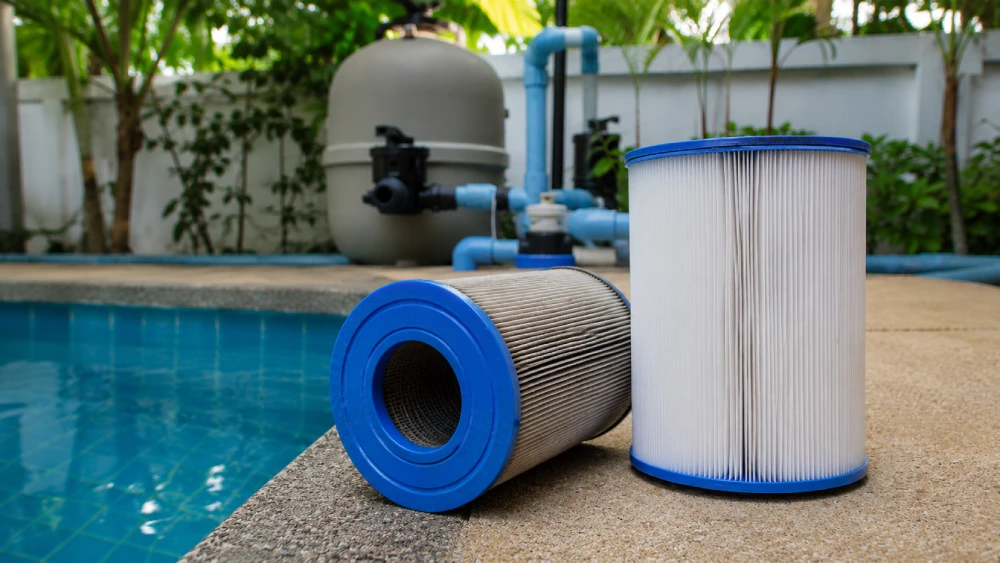
A useful starting point for pool filter cleaning in Phuket is an inspection every few weeks, but different filter systems require different cleaning methods. Cartridge, sand, glass-media, and D.E. filters should not be maintained as though they are interchangeable.
Pool Filter Cleaning Schedule by Type
| Filter Type | Research Cleaning Reference | Main Cleaning Method | Clean Sooner When |
| Cartridge | About every 2–4 weeks | Remove and rinse between pleats | Pressure rises, flow falls, heavy use, storm debris |
| Sand | About every 2–4 weeks | Backwash, then rinse | Pressure rises or circulation weakens |
| Glass media | About every 2–4 weeks | Backwash, then rinse | Debris load or pressure increases |
| D.E. | Around every 4–6 weeks for backwashing | Backwash and follow system-specific recharge procedure | Pressure rises or performance falls |
These are working references rather than automatic deadlines.
A filter serving a lightly used private villa may remain close to its normal pressure for longer than a filter serving a busy short-term rental. A pool surrounded by tropical planting can also load the filtration system faster than an open pool with little debris.
The correct schedule combines time with actual pressure, flow, debris, and usage.
Cartridge Filters Need Proper Rinsing
Cartridge filters trap fine material between pleats.
When cleaning is required, the cartridge should be removed so water can reach debris inside those folds. Spraying only the visible outer surface may leave contamination deeper inside the cartridge.
Heavy swimmer use can also add:
- sunscreen
- body oils
- cosmetics
- fine dirt
- organic contamination
This is where short-term rental pool maintenance becomes relevant. A pool serving changing groups of guests may place a greater load on the filter than a lightly used private pool.
Do not assume that one four-week interval works equally well during every occupancy period.
Sand Filters Need Backwashing
Sand filters are cleaned differently.
The media stays inside the filter while water flow is reversed through it to remove accumulated material through the waste line. This process is called backwashing.
After backwashing, the system should follow its normal rinse procedure before returning to filtration.
That rinse helps settle the filter media again and reduces the chance of residual dirty water entering the pool.
Backwashing should respond to pressure and performance.
Doing it automatically on every visit without checking whether the filter is actually loaded can waste water and makes the maintenance process less precise.
Glass-Media Filters Follow Similar Logic
Glass-media filters are generally cleaned through backwashing and rinsing in the same broad way as sand systems.
The important maintenance question is still whether resistance through the filter has increased.
A filter may reach its cleaning point sooner when:
- heavy rainfall adds debris
- nearby trees shed material
- the pool receives high swimmer use
- baskets have been overloaded
- circulation begins weakening
Cleaning should therefore respond to the condition of the system rather than the date alone.
D.E. Filters Need Their Own Procedure
D.E. filtration should not be maintained using a sand-filter routine.
The supplied research gives a longer backwashing reference for D.E. systems and notes that deeper internal cleaning may also be required periodically.
The exact procedure depends on the equipment design.
If the owner does not know whether the system is cartridge, sand, glass-media, or D.E., identify the filter type before attempting maintenance.
Pool Filter Cleaning in Phuket: Pressure Signals
Pressure is one of the most useful ways to understand whether a filter is becoming restricted. A pressure gauge gives much more useful information when the owner knows what the system normally reads immediately after proper cleaning.
Pool Filter Pressure and Flow Signals
| Signal | What It Can Mean | Practical Response |
| Normal clean pressure | Filter operating at reference condition | Record this reading |
| Pressure rises around 8–10 PSI above baseline | Filter may be heavily loaded | Clean or backwash appropriately |
| Return flow becomes weaker | Filter or circulation restriction | Inspect full water path |
| Pressure changes after storm | Debris may have increased loading | Inspect before normal cleaning date |
| Cloudy water develops | Filtration, chemistry, or circulation issue | Check more than one system |
| Pressure remains abnormal after cleaning | Problem may extend beyond filter dirt | Inspect valves, media, plumbing, pump |
Record the Clean Baseline Pressure
The most useful pressure number is the reading taken when the filter is freshly cleaned and operating normally.
That is the clean baseline pressure.
A number such as 12 PSI or 18 PSI has limited meaning on its own because different pool systems operate at different normal pressures.
The supplied research uses a rise of around 8–10 PSI above the clean baseline as a practical cleaning signal.
For example, if a system normally runs at 10 PSI after cleaning and later reaches 18–20 PSI, that increase provides much more useful information than treating 18 PSI as universally high.
Good pool maintenance performance tracking can therefore record:
- clean baseline pressure
- current pressure
- previous cleaning date
- reason for cleaning
- water-flow changes
- storm conditions
- repeat restrictions
- pressure after cleaning
That turns filter servicing into a measurable maintenance process.
Weak Flow Does Not Always Mean Pump Failure
Weak return-jet flow can make owners suspect the pump.
A restricted filter can produce similar symptoms.
Before assuming pump failure, check:
- Pool water level
- Skimmer basket
- Pump basket
- Filter pressure
- Filter condition
- Valve position
- Visible plumbing restrictions
- Pump operation
A heavily loaded filter increases resistance through the circulation system.
If proper cleaning restores normal flow, the pump may not have been the cause.
If circulation remains weak afterward, the wider system needs inspection.
Pool Filter Cleaning in Phuket: Local Conditions
Phuket pools do not operate under perfectly stable conditions. Tropical rain, vegetation, guest turnover, heat, and periods of vacancy can all change how quickly material reaches the filtration system.
Monsoon Rain Can Bring Cleaning Forward
A filter working normally before a major storm may need inspection immediately afterward.
Heavy rain can add:
- leaves
- flowers
- insects
- dirt
- organic debris
- runoff
- overflow-related contamination
The filter then has more material to capture.
Do not automatically dismantle or backwash every filter after every shower.
Instead, check:
- skimmer basket
- pump basket
- pressure gauge
- return flow
- water clarity
- visible debris
If pressure remains near the clean baseline and circulation remains normal, immediate cleaning may not be necessary.
If pressure rises significantly or flow falls, bring the cleaning forward.
Trees Can Increase Filter Load
Pools surrounded by palms, mature trees, flowering plants, or dense tropical landscaping may experience higher debris loading.
Leaves and flowers may be captured first by skimmers and pump baskets, but smaller particles eventually reach the filter.
That makes garden maintenance service in Phuket useful as part of preventive pool care.
Trimming overhanging branches and controlling heavy vegetation close to the pool can reduce how much material reaches the filtration system.
This does not eliminate filter cleaning.
It reduces unnecessary debris load.
Rental Occupancy Changes Filter Demand
A short-term rental pool may remain quiet for several days and then receive heavy use during a full booking.
That change matters.
More swimmers can introduce:
- sunscreen
- cosmetics
- body oils
- dirt
- hair
- organic material
Using rental occupancy calendar management can help identify periods when extra inspection makes sense.
For example, a high-occupancy week may justify checking pressure and circulation sooner than the normal calendar date.
That is more precise than automatically cleaning the filter after every checkout.
Housekeeping Can Report Visible Problems
Technical filtration work should remain with the appropriate pool-maintenance person.
However, professional housekeeping services in Phuket can still report obvious changes such as:
- cloudy water
- unusual debris
- low or high water level
- reduced visible circulation
- unusual pool condition
This creates another observation point between technical maintenance visits.
Guest Arrivals Can Reveal Problems
Sometimes the first warning comes from a guest.
A guest may report that:
- the pool looks cloudy
- return flow appears weak
- debris is collecting
- circulation seems different
- the water condition looks unusual
Where a property uses a 24 hour check-in service villa in Phuket, these visible issues can be escalated quickly.
The technical decision should still rely on filter pressure, flow, baskets, and equipment condition rather than guest observation alone.
Pool Filter Cleaning in Phuket: Avoidable Problems
Cleaning too late can restrict circulation, while cleaning too frequently can waste time and water. A good process focuses on filter condition, not routine activity performed only because it appears on a checklist.
Neglected Filters Can Increase Other Work
A filter left heavily restricted can affect wider circulation.
That can contribute to:
- weaker return flow
- greater strain on the circulation system
- reduced filtration performance
- longer corrective maintenance
- recurring cloudy-water problems
This is where preventive property maintenance cost control has a legitimate connection.
The goal is not to clean excessively.
It is to prevent a straightforward filter-maintenance task from becoming a larger pool-equipment problem.
Clear Water Does Not Prove the Filter Is Clean
Owners sometimes judge filter condition only from water appearance.
That is unreliable.
A pool can remain visually clear while filter pressure is already rising.
Use water appearance alongside:
- pressure
- return flow
- cleaning history
- debris conditions
- storm exposure
- pool usage
Visual clarity is useful information, but it does not replace equipment monitoring.
Cloudy Water Does Not Prove the Filter Is Dirty
The opposite mistake also happens.
Cloudiness does not automatically mean the filter is the only problem.
It can involve:
- filtration
- circulation
- water chemistry
- sanitizer
- pump performance
- heavy contamination
Check the filter pressure and circulation while also checking the wider pool condition.
A clean filter cannot correct every chemistry problem.
More chemicals cannot correct every filtration problem either.
Pool Filter Cleaning in Phuket: Cleaning vs Repair
Routine cleaning and filter repair are different jobs. A filter that needs backwashing or cartridge rinsing does not automatically need new media, new cartridges, or replacement equipment.
Cleaning Is Not Replacement
Sand and glass-media filters can usually be backwashed repeatedly during their normal service life.
Cartridge elements can also be cleaned multiple times.
Replacement becomes a separate issue when there is physical deterioration such as:
- torn cartridge material
- damaged pleats
- cracked housing
- broken internal components
- failed valves
- persistent poor filtration after correct cleaning
- abnormal pressure that remains after maintenance
Do not replace a filter simply because it became dirty.
Cartridge Cleaning Should Reach the Pleats
A cartridge should be cleaned thoroughly enough to remove contamination trapped between folds.
The visible exterior is only part of the element.
If deposits remain deep inside the pleats, pressure may not return close to the normal clean baseline even after rinsing.
That is useful feedback.
If the cartridge has been cleaned correctly and pressure remains abnormal, inspect whether the cartridge or another part of the system has deteriorated.
Sand Filters Should Not Be Over-Backwashed
Backwashing when needed is normal.
Backwashing without a reason is not necessarily better maintenance.
Use:
- pressure increase
- reduced flow
- debris conditions
- recent storms
- equipment performance
as decision points.
A maintenance record that says only “pool cleaned” gives the owner little useful information.
A better record says why the filter was cleaned.
Pool Filter Cleaning in Phuket: Rental Pools
Rental pools deserve special attention because the maintenance load can change from one booking period to another.
Higher Use Can Shorten Inspection Intervals
A full villa with frequent swimming can load the filter faster than the same pool during vacancy.
This does not mean every busy rental needs the filter dismantled after every guest stay.
It means the system deserves closer observation.
Check:
- pressure
- flow
- debris
- basket condition
- clarity
- occupancy level
The filter should be cleaned when those conditions show increased loading.
Where airbnb property management and cleaning in Phuket is coordinated, pool-readiness reporting can help identify unusually heavy use or visible problems between technical visits.
Avoid Using Occupancy Alone
Booking information is a useful trigger for inspection, not proof that cleaning is necessary.
A heavily booked week can justify checking the filter.
The pressure gauge and flow still determine whether the filter has actually become restricted.
That distinction prevents both under-maintenance and unnecessary cleaning.
Pool Filter Cleaning in Phuket: Shared Pools
Private villa pools and shared development pools can have different maintenance responsibility.
The technical filtration principle is similar, but the person responsible for deciding, recording, and paying for maintenance may be different.
Shared Pool Responsibility Must Be Clear
A private house owner generally controls their own filtration equipment.
In a condominium or managed development, there may be separate responsibility for:
- private plunge pools
- common-area pools
- pump rooms
- filter servicing
- technician contracts
- shared maintenance budgets
This makes shared pool maintenance responsibilities relevant when filtration belongs to a communal facility rather than one private villa.
Owners should establish who controls the filtration equipment before arranging work independently.
For individual homes, house management services in Phuket can include visible pool-equipment checks within broader property oversight.
For condominiums, condo property management services in Phuket can help clarify whether the filter belongs to the individual unit or the common-area system.
Pool Filter Cleaning in Phuket: Remote Owners
Owners outside Thailand cannot personally read the pressure gauge or feel whether return flow has changed.
That makes measurable reporting more useful than photographs alone.
What a Filter Record Should Show
A useful maintenance record can include:
| Record | What to Log |
| Filter type | Cartridge, sand, glass media, or D.E. |
| Clean baseline pressure | Normal pressure after proper cleaning |
| Current pressure | Reading during inspection |
| Cleaning date | When cleaning or backwashing happened |
| Cleaning trigger | Pressure rise, weak flow, storm, heavy use |
| Post-clean pressure | Whether pressure returned toward baseline |
| Flow condition | Normal, weak, or abnormal |
| Debris condition | Light, moderate, heavy |
| Follow-up | Repair or further inspection needed |
Owners using broader property management services in Phuket should ask whether this level of pool reporting is actually included.
For a private villa, villa management & maintenance in Phuket can connect pool-filter observations with wider maintenance reporting.
The useful point is consistency.
A photograph showing blue water does not reveal whether the pressure gauge has climbed steadily over several weeks.
Pool Filter Cleaning in Phuket: Areas Covered
Pool-filter checks and pool care can be coordinated across Bang Tao, Rawai, Nai Harn, Kamala, Surin, Patong, Chalong, Kata, Karon, Mai Khao, Laguna, Kathu, Thalang, Cherng Talay or Choeng Thale, plus Ya Nui, Friendship Beach, Saiyuan, and surrounding Phuket areas.
The location itself does not create one universal filter-cleaning schedule.
What matters is the individual pool environment.
A heavily landscaped Rawai villa may collect more organic debris than an open pool elsewhere.
A high-turnover Patong rental may experience greater swimmer load than a lightly used private residence.
A shared condominium pool may operate under a completely different maintenance structure from a private villa.
The schedule should therefore follow filter type, clean pressure, debris, occupancy, storms, and actual circulation performance.
Clean the Filter When the System Shows It
For many Phuket pools, 2–4 weeks is a useful starting reference for inspection and cleaning, while some D.E. systems may follow a longer backwashing interval.
The calendar should never replace pressure and flow monitoring.
If filter pressure rises, circulation weakens, storm debris increases, or heavy rental use adds more contamination, bring the inspection forward.
If you want the process monitored consistently, a pool maintenance company in Phuket should be able to record pressure, filter condition, cleaning actions, circulation changes, and post-storm observations instead of relying only on visual cleaning.
The best schedule follows what the filter is actually doing.
Pool Filter Cleaning FAQs
Can sunscreen make pool filter cleaning more frequent?
Yes. Pool filter cleaning may need to happen sooner during periods of heavy swimmer use because sunscreen, body oils, cosmetics, and other contaminants enter the water and eventually reach the filtration system. This is especially relevant to rental villas with changing occupancy. The better approach is closer inspection of pressure and flow rather than assuming every rental pool requires the same fixed cleaning interval.
Can clear water mean pool filter cleaning can wait?
Not necessarily. Pool filter cleaning should not be delayed only because the water remains visually clear. A filter can accumulate debris and show increasing pressure before the pool develops obvious cloudiness. Recording the clean baseline pressure and checking circulation provide better evidence of filter condition than appearance alone.
How can overseas owners verify pool filter cleaning?
Overseas owners can verify pool filter cleaning through maintenance records instead of relying only on photographs. Useful details include filter type, cleaning date, clean baseline pressure, pressure before cleaning, pressure afterward, reason for cleaning, flow observations, and storm-related checks. These records reveal whether maintenance responds to actual filter condition.
Does pool filter cleaning mean replacing the media?
No. Pool filter cleaning and replacement are separate maintenance tasks. Sand and glass-media filters can normally be backwashed repeatedly, while cartridge elements can be washed multiple times. Replacement becomes relevant when media, cartridges, housings, valves, or internal parts are damaged or no longer perform correctly after proper cleaning.
Can pool filter cleaning help with cloudy water?
It can when filtration restriction contributes to the problem. Pool filter cleaning may improve circulation and removal of suspended material when the filter is heavily loaded, but cloudy water can also involve chemistry, sanitizer, pump performance, or other circulation faults. Filter pressure, water flow, and water testing should be considered together.
Do trees increase pool filter cleaning frequency?
They can. Pool filter cleaning may be required sooner where leaves, flowers, insects, and organic debris frequently enter the water. How much sooner depends on surrounding vegetation, weather, basket performance, and actual filter pressure. More frequent inspection is usually better than applying one automatic cleaning interval to every landscaped property.
Should pool filter cleaning happen after every monsoon storm?
Not automatically. Pool filter cleaning should be considered after significant monsoon weather because storms can increase debris and filtration load. Check pressure, return flow, baskets, and water clarity first. If pressure remains near the normal clean baseline and circulation remains strong, immediate cleaning may not be needed. If pressure rises or flow falls, bring cleaning forward.