An apartment can lose rental momentum, develop hidden moisture problems, or enter a tenant dispute while an owner remains unaware abroad. Professional action requires a local system that controls occupants, repairs, records, building communication, and legal duties before small failures become expensive.
Apartment property management combines rental management, asset maintenance, and financial oversight within an accountable structure.
Quick Check: Before appointing a provider, choose condo property management services in Phuket that clearly covers unit inspections, tenant coordination, maintenance follow-up, utility control, and owner reporting.
What Is Apartment Property Management in Phuket?

Apartment property management starts by defining which jobs concern the privately owned unit and which belong to the condominium or building management. The manager should then document exactly which rental, maintenance, financial, and tenant responsibilities they will take over.
Apartment Management Responsibility Map
| Management Area | Apartment Manager May Handle | Owner Should Confirm |
| Unit inspections | Check private-unit condition | Frequency and evidence |
| Tenant handling | Communication and tenancy issues | Exact included duties |
| Move-in/out | Condition and inventory records | Handover procedure |
| Repairs | Coordinate private-unit work | Approval limits |
| Utilities | Readings, bills and reconciliation | Who pays each bill |
| Cleaning | Private-unit preparation | Frequency and scope |
| Rental listings | Maintain property information | Approved channels |
| Building rules | Pass relevant rules to occupants | Current building requirements |
| Owner reporting | Condition, costs and rental records | Reporting frequency |
| Common areas | Usually building/CJP responsibility | Escalation procedure |
Separate Building Duties From Apartment Duties
A condominium building may manage shared areas, security, lifts, common facilities, building contractors, and other communal matters. That does not automatically mean building staff will inspect a privately owned apartment, coordinate an internal AC repair, reconcile a tenant’s utility use, or prepare the owner’s rental statement.
The Phuket condo management responsibility scope helps explain this division. An apartment manager should know when to act directly and when a problem must be escalated to building management.
The wider Phuket property management responsibility scope is also useful when an owner needs inspections, contractor coordination, tenant support, and reporting beyond the building’s responsibilities.
Define Private-Unit Inspections
An apartment can appear fine from the corridor while developing problems inside.
A useful inspection may check:
- Air conditioning
- Water leaks
- Plumbing
- Electrical items
- Appliances
- Bathrooms
- Kitchen
- Doors and locks
- Windows
- Furniture
- Humidity or mould signs
- Visible damage
The schedule should reflect the apartment’s condition, occupancy, equipment, and previous problems rather than one invented Phuket-wide frequency.
Inspection records should show what was checked and what action followed. “Property checked” is not enough for an overseas owner who needs to know whether a fault was found.
Control Tenant Move-In and Move-Out
Apartment property management should establish the starting condition before a tenant takes possession.
The condo move-in move-out inspection management process can record:
- Room condition
- Existing marks
- Furniture
- Appliances
- Keys
- Access devices
- Water reading
- Electricity reading
- Existing faults
The same record becomes useful at move-out.
Where a deposit is involved, damage-deposit verification at check-in should connect the opening condition with later evidence. Existing wear, cleaning, missing inventory, and new damage should not be treated as the same issue.
Keep Building Rules Connected to the Tenant
Apartment tenants may need to follow rules covering access, parking, visitors, pets, noise, moving procedures, and shared facilities.
A condo house-rule compliance management process gives the tenant the current requirements before problems occur.
If a rule changes, the manager should update the tenant rather than assuming the building has already communicated it.
This becomes particularly important when the owner lives overseas. The owner may never see a notice posted locally unless somebody is responsible for monitoring and forwarding relevant information.
Reconcile Apartment Utilities
Utility responsibility should be written into both the rental arrangement and management scope.
Do not assume that the owner always pays or that the tenant always pays. The actual arrangement may differ by property and tenancy.
Condo utility reconciliation management can connect:
Opening meter reading → bills → payments → final reading → outstanding balance
This is especially useful at move-out, when a final bill may arrive after keys have already been returned.
Define What “Management” Includes
Owners should not accept a vague promise that the provider will “handle everything.”
Broader property management services in phuket may include local inspections, tenant coordination, maintenance follow-up, bills, contractors, and owner reporting. The agreement still needs to state each included task.
Before appointment, check the Phuket property-manager selection criteria against the actual apartment.
Look for clear answers on:
- Inspection process
- Tenant communication
- Repair approval
- Emergency handling
- Reporting
- Utility management
- Keys and access
- Rental marketing where relevant
- Contract termination
- Record handover
Condo property management services in phuket: Risks
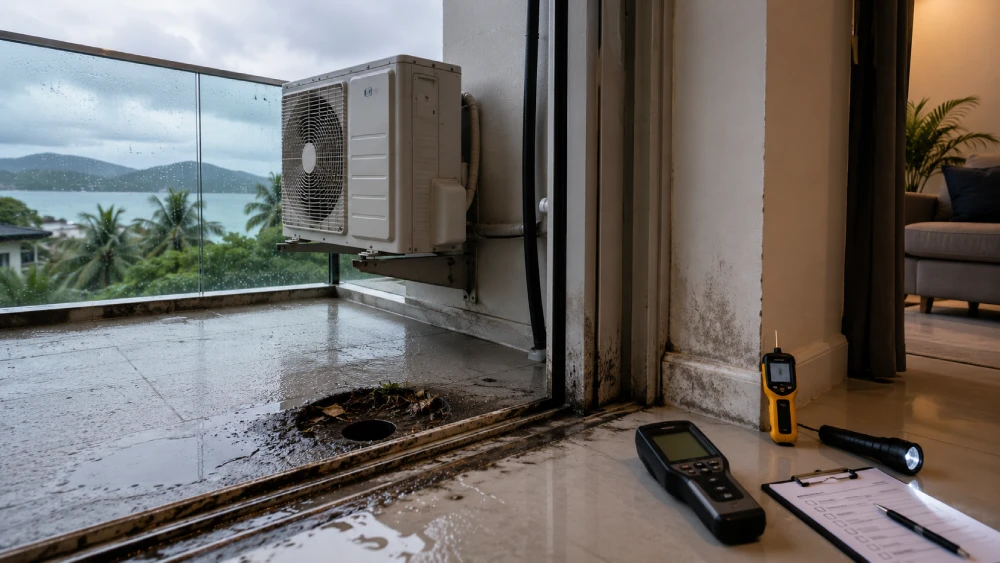
Phuket apartment management needs to account for the property itself as well as how it is represented to tenants. Tropical conditions, remote ownership, inconsistent rental listings, unclear repair costs, and poor records can all create problems that ordinary rent collection will not solve.
Property Risks and Management Controls
| Real Risk | Management Control | Owner Evidence |
| Water leak | Inspect and escalate quickly | Photos and repair record |
| AC fault | Track condition and repair history | Contractor record |
| Moisture signs | Inspect affected areas | Condition report |
| Stale listing | Audit active channels | Current listing record |
| Different rental prices | Use approved pricing record | Channel comparison |
| Unknown agent | Record authorised representatives | Agent register |
| Unclear repair charge | Quote and approval process | Invoice |
| Owner lacks visibility | Regular reporting | Owner statement |
| Tenant issue unresolved | Track issue to closure | Communication log |
| Lease expiry missed | Renewal calendar | Tenancy record |
Manage Phuket Climate Risks Practically
Heavy rain, moisture, and frequent air-conditioning use can affect an apartment differently from a property in a cooler or drier location.
Apartment property management should therefore watch actual conditions rather than waiting for the tenant to discover every fault.
For example, an AC problem should be recorded when performance changes. A moisture mark should be investigated before somebody simply paints over it.
There is no good reason to claim that every apartment needs AC servicing at one fixed interval. Condition, usage, manufacturer guidance, maintenance history, and the specific unit should determine the plan.
Keep Repairs Transparent
Repair costs become difficult to trust when an owner sees only a deduction.
Use a simple control:
Fault → inspection → quotation → approval → contractor → invoice → completion
The owner’s approval threshold should be established in advance.
Small routine work may be handled within agreed authority. Larger or non-urgent work may need owner approval, while an urgent issue may need an emergency procedure.
The management agreement should also state whether contractor coordination creates any additional fee. A charge should never appear unexpectedly simply because maintenance was outsourced.
Keep Rental Listings Accurate
Reddit discussions supplied in the research show renters using a mixture of property sites, Facebook Marketplace, Telegram communities, agents, and other channels. That creates a genuine management problem: one apartment can develop several versions of the same listing.
Apartment property management should maintain one master record containing:
- Current availability
- Approved rent
- Current photos
- Furnishings
- Amenities
- Deposit terms
- Utilities
- Contact details
- Authorised representatives
Every active rental channel should match that record.
If an apartment is rented, its availability should be updated. If furniture changes, old photographs should not continue promising something the tenant will not receive.
Protect Listing Trust
Real renters also expressed concern about questionable listings and agents.
That does not mean one platform or one nationality of agent is inherently safe or unsafe. It means renters need enough information to confirm that the property and representative are genuine.
Apartment managers can reduce uncertainty by keeping:
- Consistent contact details
- Current unit photographs
- Clear payment terms
- Authorised-agent records
- Correct availability
- Clear deposit terms
Multiple agents advertising the same unit at different prices can weaken trust even when the property itself is genuine.
Keep Housekeeping Standards Separate
Cleaning may form part of apartment property management when the unit is prepared for an owner, tenant, or short-term guest.
Professional housekeeping services in phuket can support private-unit preparation, but cleaning should not be confused with technical maintenance.
Where housekeeping is included, housekeeping quality-control management should check whether the work meets the agreed standard.
For a furnished unit, housekeeping inventory management can also track items such as linen, kitchen equipment, guest supplies, or replacement stock where relevant.
Give Overseas Owners Useful Evidence
A remote owner needs more than messages saying “everything is okay.”
Useful apartment property management reporting should show:
- Current occupancy
- Unit condition
- Open maintenance
- Repairs completed
- Costs incurred
- Rental income where applicable
- Tenant issues
- Building notices affecting the unit
- Next required action
That gives the owner enough information to make decisions without being physically present.
Condo property management services in Phuket: Rentals
The right apartment management structure depends heavily on how the unit is used. A long-term tenant, a two-month renter, and a short-term holiday guest create different workloads, so owners should choose the rental model before deciding which services they need.
Short, Medium and Long-Term Management
| Rental Model | Main Management Focus | Typical Operational Difference |
| Short-term | Booking, arrivals, cleaning, guest issues | Frequent turnover |
| Medium-term | Monthly terms, utilities, access, condition | Sits between nightly and annual models |
| Long-term | Tenant, rent, maintenance, renewal | Fewer handovers |
| Owner occupied | Inspections and maintenance | No active tenant workflow |
| Vacant | Condition and security checks | Focus on property preservation |
No universal percentage, return, or maintenance cost should be attached to these categories without a property-specific quotation.
Match Management to the Stay Length
A recent Reddit discussion in the supplied research came from someone trying to decide how to arrange a two-month Phuket stay.
That is a useful management issue because medium-term occupancy does not always fit a nightly holiday model or a conventional annual lease.
For a monthly or medium-term apartment, define:
- Minimum stay
- Rental period
- Deposit
- Utility responsibility
- Cleaning arrangement
- Extension procedure
- Building access
- Move-in condition
- Move-out procedure
The Phuket apartment rental management process provides the more detailed operational sequence for a rented apartment.
Treat Short-Term Management as Conditional
Short-term apartment use requires additional controls only where that rental model is appropriate for the property and current building requirements.
The Phuket short-term rental management operations can involve bookings, arrivals, guest support, housekeeping, maintenance, and departures.
Where a unit is specifically managed through short-stay platforms, a property management service for airbnb in phuket may also coordinate listing activity, guest communication, availability, and turnovers.
Do not present Airbnb management as a standard component of every apartment-management agreement.
Control Short-Term Guest Turnover
For a short-term rental, the unit may need to move from one guest to another quickly.
The guest-turnover housekeeping management process should follow:
Departure → condition check → cleaning → inventory → maintenance → final readiness check
A late departure can affect that whole sequence.
Late-checkout and next-guest scheduling management becomes useful when housekeeping, repairs, and the next arrival are competing for the same time window.
Handle Language Problems at Check-In
Language differences can turn a simple access or building-rule explanation into a practical problem.
Where short-term international guests are part of the rental model, multilingual guest check-in management may help with arrival instructions, registration, property access, and rule communication.
This is conditional support. A long-term local tenancy may not require the same check-in system.
Keep Long-Term Tenancy Records Current
Long-term apartment property management should track more than rent payments.
The management file should contain:
- Tenant details
- Lease start
- Lease end
- Payment status
- Deposit
- Utility arrangement
- Building-access records
- Maintenance history
- Renewal date
Lease expiry should be identified early enough for the owner to decide whether to renew, change terms, or prepare for move-out.
If the tenant leaves, condition evidence, utility readings, inventory, keys, and any supported deductions should be closed before the tenancy record is considered complete.
Separate Every Cost
The Phuket property management fee structure is useful when owners need to understand what they are actually paying for.
Keep separate records for:
- Private management
- Building/CAM obligations
- Cleaning
- Utilities
- Repairs
- Tenant placement where applicable
- Other agreed rental costs
Avoid publishing one percentage as the normal Phuket rate unless it comes from a current, specific quotation.
The management fee should be judged against its actual deliverables. Those may include inspections, tenant communication, repair control, financial reporting, rental administration, or other agreed tasks.
Apartment Property Management Across Phuket
Apartment property management can be coordinated across Bang Tao, Patong, Surin, Kamala, Rawai, Nai Harn, Mai Khao, Chalong, Kata, Karon, Kathu, Thalang, Laguna, Cherng Talay, Choeng Thale, and surrounding areas in Phuket.
The process should still be based on the actual unit and rental model. A long-term apartment in Kathu may need a different management structure from a short-term furnished unit in Patong or a remotely owned apartment in Bang Tao.
Put Apartment Responsibilities in Writing
Good apartment management starts with a written division of responsibility covering the private unit, tenant or guest, maintenance, utilities, rental records, and owner reporting. PEARL Phuket Property provides condo property management services in phuket for owners who need clear local oversight of their unit. Agree the exact scope, approval limits, and reporting process before management begins. We manage. You relax.
FAQs
What Does Apartment Property Management Include for a Vacant Unit?
Apartment property management for a vacant unit can focus on condition checks, leaks, air conditioning, utilities, access, building notices, visible humidity problems, and maintenance follow-up. There may be no active tenant to report problems, so responsibility for checking the private unit needs to be clear. The exact inspection schedule should reflect the apartment’s condition and agreed management scope rather than a universal Phuket timetable.
Can Apartment Property Management Work Without Renting the Unit?
Yes. Apartment property management does not have to involve rental activity. An owner may need local oversight while using the property personally or leaving it vacant for part of the year. Management can be limited to inspections, contractor access, maintenance follow-up, utility administration, building communication, owner-arrival preparation, and reporting. The agreement should exclude rental duties if the owner does not need them.
How Does Apartment Property Management Handle Duplicate Listings?
Apartment property management should maintain one approved property record containing the current rent, availability, photographs, furnishings, terms, and authorised representatives. Active rental channels can then be compared against that source. If several agents advertise the apartment, the manager should identify outdated or conflicting information and request corrections where possible so prospective tenants are not receiving different versions of the same property.
Does Apartment Property Management Include CAM Fees?
Apartment property management may help an owner track common-area or CAM obligations, but those charges should not automatically be treated as the private management fee. Building-level costs and private-unit management are different categories. Owner reporting should show them separately so the owner can distinguish the cost of owning within the development from the cost of managing the apartment, tenant, repairs, or rental operation.
How Does Apartment Property Management Handle Lease Extensions?
Apartment property management should track the tenancy end date before the lease expires. The manager can ask whether the tenant wants to renew, obtain the owner’s instructions, record proposed terms, prepare required documentation, and update relevant access or occupancy records. The process should also identify unresolved repairs or payment issues before renewal so an old problem is not simply carried into a new tenancy period.
Can Apartment Property Management Handle a Two-Month Rental?
Yes, apartment property management can be structured around a two-month or other medium-term stay if the property, building rules, and management arrangement support that rental model. The manager should define rent, deposit, utilities, cleaning, access, move-in condition, extension terms, and move-out controls. Medium-term management should not automatically copy either nightly holiday-rental procedures or a full annual-lease structure.
What Records Should Apartment Property Management Give an Overseas Owner?
Apartment property management reporting for an overseas owner should make the unit understandable without requiring the owner to be in Phuket. Useful records can include occupancy status, apartment condition, open maintenance, repair quotations, approvals, invoices, utility information, rental income where relevant, management deductions, building notices, and the next action required. The goal is a traceable management history rather than scattered updates across messages.