Utility disputes rarely start with a large invoice. They start with a missing meter photograph, a bill sent to the wrong person, or a move-out figure taken after cleaners have used the unit. Condo utility reconciliation management in Phuket creates a reliable record from check-in to final settlement by matching meters, billing periods, rates, invoices, receipts, and responsibility.
Without that chain, owners may pay twice, tenants may inherit earlier usage, and overseas owners may discover arrears only after a payment deadline or deposit dispute. The practical question is simple: can every final figure be traced back to evidence?
Quick Check: Before appointing a provider, choose get condo utility reconciliation management in Phuket with dated meter records, separate utility ledgers, verified receipts, and clear owner approval limits.
Condo Utility Reconciliation Management in Phuket
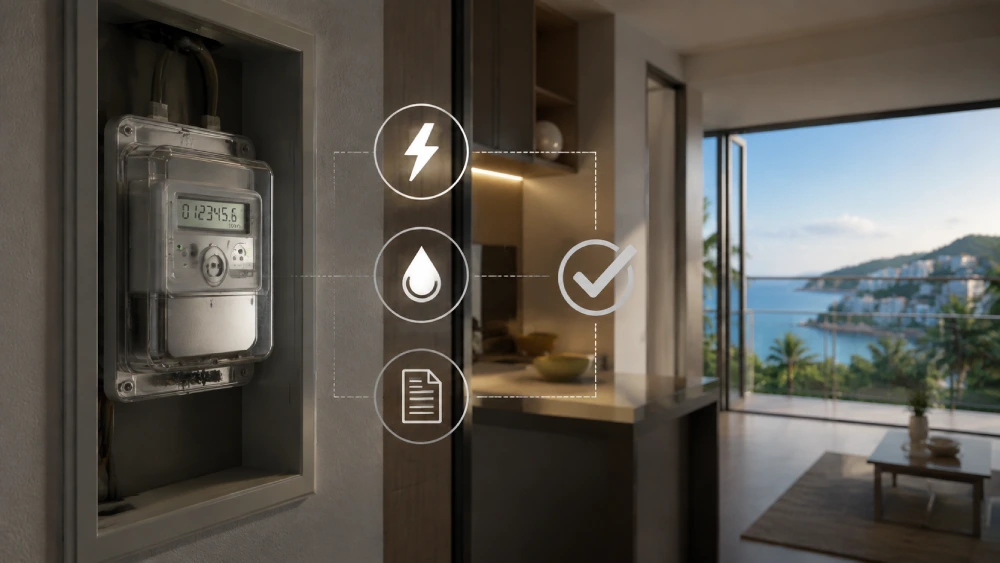
A reliable process starts before the tenant receives the keys. It records the correct meters, assigns payment responsibility, checks each bill, preserves proof of payment, investigates unusual usage, and closes the account with an itemised statement.
Utility Reconciliation Control Map
| Reconciliation stage | Main risk | Required control | Evidence retained |
| Account setup | Wrong account or billing source | Identify issuer and account holder | Account register |
| Check-in | Earlier consumption reaches new tenant | Record opening readings | Dated meter photographs |
| Monthly billing | Rate or period is unclear | Verify bill details | Original invoice |
| Payment | Bill is missed or paid twice | Match one payment to one invoice | Receipt and transaction reference |
| Usage review | Leak or meter fault goes unnoticed | Compare consumption with earlier periods | Variance record |
| Checkout | Later cleaning usage reaches tenant | Take immediate closing readings | Handover photographs |
| Final calculation | Charges are combined or vague | Itemise each category | Reconciliation worksheet |
| Dispute handling | Parties rely on different figures | Share source documents | Dispute record |
| Account closure | Balance remains unresolved | Issue a final statement | Completed account summary |
The wider Phuket condo management inclusions should connect utility records with tenant accounts, inspections, maintenance expenses, common charges, payments, and owner reporting.
Owners comparing condominium financial management for utility reconciliation in phuket should check whether every figure can be traced from the original meter or invoice to the final owner statement.
Identify Every Account First
Electricity, water, internet, common-area charges, parking, access cards, and maintenance costs may arrive through different sources. They should not be placed in one general “property expenses” balance.
The manager should record:
- Utility or charge type
- Account holder
- Account number
- Property and unit
- Billing issuer
- Direct or building-issued arrangement
- Meter identification
- Bill recipient
- Payment responsibility
- Approved payment method
- Due date
- Owner approval requirement
The Phuket property management responsibility scope should identify who receives bills, checks charges, follows up tenants, obtains approval, pays accounts, and reports the final expense.
Separate Direct and Building Billing
A direct electricity account and a building sub-meter arrangement are not the same. With a direct account, the utility provider issues the bill. With internal billing, the juristic office or building management may calculate the unit’s amount from its own meter system.
The manager should confirm:
- Who owns or controls the meter
- Whether the reading appears on an original bill
- Whether the building supplies a separate calculation
- Which rate or charge appears on the statement
- Whether additional charges are listed separately
- Who receives payment
- How an incorrect reading can be reviewed
A good property management company operating workflow keeps meter records, invoices, payment approvals, receipts, tenant charges, and owner balances together rather than storing them across unrelated messages.
Define Responsibility in Writing
The lease or handover record should state who pays electricity, water, internet, common charges, and any building-issued utilities. It should also explain what happens when the final bill arrives after the tenant has left.
The Phuket property management contract structure should define:
- Who receives each invoice
- Who checks the amount
- Who makes the payment
- Which charges belong to the tenant
- Which costs remain with the owner
- How sub-meter charges are calculated
- How delayed bills are handled
- Whether a temporary amount may be retained
- How the final adjustment is issued
- Who resolves a dispute
Utility responsibility should not be decided after checkout. By that stage, both parties may already be relying on different assumptions.
Utility Reconciliation Management: Meter Records
Opening and closing readings provide the most important evidence in a tenant account. The photographs must identify the correct meter, unit, reading, date, and handover stage so the figures can be compared without relying on memory.
Record the Opening Position
At check-in, photograph the complete electricity and water meters. A close-up of the numbers alone may not prove which unit or meter was recorded.
The record should include:
- Full meter
- Serial or identification number
- Current reading
- Date and time
- Unit number
- Person taking the photograph
- Existing unpaid balance
- Tenant acknowledgement
- Owner or manager copy
A 24 hour check-in service for utility meter handover in phuket should complete these records even when the tenant arrives late at night or outside normal juristic-office hours.
The rental property inspection checklist should also include leaking taps, running toilets, air-conditioning operation, damaged appliances, moisture, and other conditions that could affect later consumption.
Avoid Inherited Consumption
A new tenant should not be charged for electricity or water used before their handover. This risk increases when the previous occupant’s closing reading is missing or the unit remains open for repairs and cleaning between tenancies.
The Phuket apartment rental operating workflow should separate:
- Previous tenant’s final reading
- Vacant-period usage
- Cleaning and contractor consumption
- New tenant’s opening reading
- Current billing period
When two tenancies fall within one billing cycle, verified readings are more reliable than dividing the bill by days alone.
Take Closing Readings Before Later Work
The closing reading should be taken during the final handover or at another agreed time. Waiting until after cleaners, contractors, or maintenance staff enter the property makes the tenant’s final consumption harder to isolate.
Owners using housekeeping services for vacant-unit utility checks in phuket should ensure the meter position is recorded before deep cleaning begins and again when significant vacant-unit work creates additional usage.
The closing record should show:
- Same meter identification used at check-in
- Exact reading
- Date and time
- Checkout status
- Keys and access returned
- Later access expected
- Outstanding invoices
- Tenant acknowledgement or delivery record
A tenant does not have to be physically present for the reading to be documented, but the evidence should be sent promptly.
Utility Reconciliation Management: Monthly Bills
Monthly reconciliation checks whether the bill belongs to the correct property, covers the expected period, reflects a credible reading, and has been paid once. This prevents minor record errors from becoming large year-end balances.
Match the Bill to the Account
Each invoice should be checked against the utility register before payment.
Verify:
- Issuer
- Account number
- Unit or service address
- Previous reading
- Current reading
- Billing period
- Stated rate
- Taxes or additional charges
- Previous balance
- Current amount due
- Due date
- Payment status
The property management duty framework should assign clear responsibility for receiving, checking, approving, paying, and reporting each bill.
Keep Water and Electricity Separate
Electricity and water may have different issuers, payment recipients, reading dates, and billing periods. Combining them into one line prevents the owner or tenant from checking which amount is correct.
A monthly statement should show one line for each invoice:
| Statement field | Electricity | Water |
| Billing source | Named issuer | Named issuer or juristic office |
| Account or meter | Recorded separately | Recorded separately |
| Billing period | Exact dates | Exact dates |
| Opening and closing figures | Where shown | Where shown |
| Current charge | Separate amount | Separate amount |
| Payment date | Separate date | Separate date |
| Receipt reference | Separate reference | Separate reference |
| Tenant or owner responsibility | Identified | Identified |
| Disputed status | Recorded | Recorded |
The luxury development common-area fee structure is relevant when owners need to distinguish private water consumption from maintenance fees, sinking-fund contributions, shared-facility costs, and other development charges.
Verify the Rate and Calculation
A final statement should show enough information for another person to reproduce the amount. It should not present only the units consumed and total payable.
For a meter-based charge, record:
- Opening reading
- Closing reading
- Units consumed
- Rate shown by the issuer
- Separately identified fees
- Applicable tax shown on the invoice
- Previous unpaid balance
- Credits
- Final amount
Do not apply one universal formula to every Phuket condominium. Direct utility accounts and internal building arrangements may use different invoices, rate structures, and additional charges.
The good Phuket property management standards should include clear calculations, original invoices, named responsibility, payment proof, prompt follow-up, and transparent owner reporting.
Prevent Duplicate Payments
Duplicate payments happen when an owner, tenant, juristic office, and property manager each assume someone else has not paid the invoice.
Before processing a bill, check:
- Invoice number
- Billing period
- Amount
- Existing receipt
- Bank transaction
- Auto-payment status
- Owner or tenant confirmation
- Current account balance
The invoice should receive one status: unpaid, scheduled, paid, disputed, credited, or cancelled. Informal labels such as “probably paid” should not appear in an account ledger.
Confirm Payment Success
A scan, transfer attempt, or automatic instruction does not prove that payment completed. The manager should retain the final confirmation.
Payment evidence should show:
- Amount
- Date
- Recipient
- Transaction reference
- Account or invoice
- Successful status
- Service fee where applicable
- Person authorising payment
Where a physical counter is used, the receipt should be stored with the original bill. For digital payments, save the downloadable receipt or confirmation rather than relying only on a cropped screenshot.
Utility Reconciliation Management: Owner Control
Overseas and part-time owners need a system that continues to work when paper bills remain inside the condo, the juristic office communicates through a local channel, or an automatic payment fails without notice.
Build a Remote Payment Process
Owners using property management services for utility reconciliation in phuket should receive a regular statement showing bills received, payments made, unpaid balances, unusual usage, and items awaiting approval.
The owner record should include:
- Primary email
- Telephone or messaging contact
- Local representative
- Preferred invoice-delivery method
- Payment account
- Approval limit
- Emergency authority
- Tenant contact
- Juristic-office contact
- Backup payment process
The investor property-management framework becomes especially useful when one owner needs the same reporting format across several rental units.
Set Payment Approval Limits
A local manager may need authority to pay routine utility bills before the due date. However, that authority should have a written limit and a clear exception process.
For example, the management agreement can distinguish:
- Routine verified utility bills
- Unusual increases
- Previous balances
- Disputed charges
- Repair-related consumption
- Building assessments
- Emergency payments
- Tenant deductions
This does not require delaying every normal invoice. It prevents an abnormal or disputed amount from being paid and passed to the owner without review.
Report One Clear Monthly Balance
The owner statement should avoid mixing income, management fees, utilities, repairs, common charges, and tenant balances into one unexplained figure.
A useful monthly reconciliation shows:
- Opening account balance
- Bills received
- Payments made
- Tenant-recoverable amounts
- Owner-only expenses
- Credits or refunds
- Disputed items
- Closing balance
- Documents attached
- Action required
The property management performance tracking should monitor consumption changes, overdue invoices, duplicate-payment risks, tenant recovery, owner approval delays, and unresolved balances.
Utility Reconciliation Management: Usage Risks
A sudden increase may result from occupancy, weather, appliance use, a leak, an equipment fault, or a meter problem. The manager should investigate the cause before assigning the full amount to a tenant.
Check Unusual Electricity Use
High electricity consumption may be connected to:
- Air conditioning left running
- Faulty thermostat or compressor
- Water heater problem
- Old appliance
- Vacant-unit use
- Cleaning or contractor work
- Shared electrical connection
- Meter-reading mistake
- Estimated bill
- Earlier unpaid balance
A pool maintenance company for pool utility monitoring in phuket can help identify pump schedules, faulty equipment, circulation problems, and abnormal operating time where a private pool affects the property’s electricity use.
The property management expense-control methods should focus on finding the cause rather than simply asking the owner to pay a larger bill.
Check Unusual Water Use
Unexpected water consumption may come from:
- Running toilet
- Leaking tap
- Damaged supply line
- Faulty float valve
- Irrigation fault
- Pool top-up
- Cleaner or contractor use
- Meter error
- Shared water connection
- Billing-period overlap
An irrigation system repair service for water reconciliation in phuket can document damaged lines, stuck valves, controller faults, leaks, and excessive outdoor water use.
The manager should record the reading before and after any repair. That makes it easier to determine whether the work corrected the consumption problem.
Pause Questionable Settlements
A reading should be checked again when:
- It is lower than the previous figure
- The meter number does not match
- Consumption changes sharply
- The unit was vacant
- The bill is estimated
- The reading date is unclear
- The tenant disputes the photograph
- The juristic figure conflicts with the physical meter
- The invoice includes an unexplained earlier balance
The Phuket rental-home protection controls should connect meter evidence, invoice checks, leak inspections, payment records, tenant balances, and final settlements.
Utility Reconciliation Management: Rental Types
The same evidence principles apply across condominiums, villas, houses, and short-term rentals, but the accounts and consumption patterns can differ. Each property needs controls suited to its equipment, turnover rate, and billing arrangement.
Reconcile Villa and House Utilities
Owners using villa management services for utility reconciliation in phuket may need to track pool pumps, outdoor lighting, water storage, irrigation, air conditioning, staff use, and vacant-period consumption.
Owners using house management services for utility reconciliation in phuket may also need separate records for private water accounts, garden use, gate systems, contractors, and long-term tenant responsibility.
A villa or house should not automatically use the same account structure as a condominium. The manager should first identify every meter, service account, and owner-funded system.
Control Short-Term Turnover
Frequent guest changes make monthly billing harder because several stays may fall within one utility period.
An airbnb management full service for utility reconciliation in phuket should track:
- Guest occupancy dates
- Vacant periods
- Turnover cleaning
- Pool and garden use
- Maintenance access
- Opening and closing evidence
- Owner-paid operating costs
- Unusual consumption
The Phuket short-term rental management operations should connect booking dates, guest use, turnover work, bills, receipts, and owner reporting.
Short-term utility costs are often treated as operating expenses rather than billed directly to each guest. The relevant booking terms and management model should decide the allocation.
Utility Reconciliation Management: Final Settlement
A fair move-out settlement separates verified utility consumption from every other deduction. Delayed invoices, estimated holds, cleaning, repairs, and missing access items must each appear on their own line.
Build an Itemised Closing Statement
The final statement should include:
| Final category | Required evidence | Settlement treatment |
| Electricity | Readings, invoice, rate and receipt | Separate utility line |
| Water | Readings or building statement | Separate utility line |
| Internet | Provider invoice where applicable | Separate service line |
| Common fees | Building statement and responsibility basis | Owner or tenant line |
| Cleaning | Condition evidence and invoice | Separate deduction |
| AC servicing | Work record and invoice | Separate maintenance line |
| Repairs | Damage evidence and contractor document | Separate repair line |
| Keys or cards | Return record and replacement evidence | Separate access line |
| Previous balance | Source and billing period | Exclude or assign correctly |
| Provisional amount | Written estimate and review date | Temporary hold only |
The Phuket condo tenant handling process should connect final readings, outstanding bills, tenant communication, supporting documents, disputed items, and account closure.
Handle Delayed Bills Fairly
A delayed invoice may arrive after checkout. The manager should not invent a final charge, but the owner also needs a practical way to protect against an unpaid balance.
A controlled process can:
- Record the closing meter
- Identify the missing invoice
- Calculate a clearly labelled estimate
- Retain only the agreed provisional amount
- Obtain the actual invoice
- Complete the final calculation
- Refund or collect the difference
- Issue a closure statement
The estimate should never be presented as the original bill or left unresolved indefinitely.
Separate Deposits and Utilities
A utility deduction should show the exact amount supported by the meter record, invoice, rate basis, and responsibility terms.
Cleaning, AC servicing, damage, and missing keys are different categories. A general list with entries such as “defect,” “utility adjustment,” or “property costs” does not allow a tenant or owner to check the final balance.
The Phuket property management fee explanation can help owners distinguish management charges from utilities, common fees, maintenance invoices, contractor costs, and tenant deductions.
Resolve Disputes With Documents
When the tenant disputes a final amount, provide:
- Opening meter evidence
- Closing meter evidence
- Original bill or building statement
- Rate calculation
- Payment receipt
- Lease term
- Occupancy dates
- Vacant-period record
- Cleaning or maintenance access dates
- Previous account balance
- Revised calculation where required
A receipt proves that an amount was paid, but it does not alone prove that the tenant is responsible for it. Responsibility must also be supported by the lease, usage period, or other relevant record.
The undisputed amount can be separated from the disputed balance. This prevents one unclear line from blocking the entire account.
Utility Reconciliation Across Phuket
Local access matters when someone must photograph a meter, collect a paper bill, confirm a juristic-office statement, inspect a leak, supervise checkout, or verify that a payment reached the correct account.
PEARL Phuket Property supports utility reconciliation across Bang Tao, Patong, Surin, Kamala, Rawai, Nai Harn, Mai Khao, Ya Nui, Friendship Beach, Chalong, Saiyuan, Laguna Phuket, Kata, Karon, Kathu, Thalang, Cherng Talay or Choeng Thale, and surrounding Phuket areas.
Available across Bang Tao, Rawai, Nai Harn, Kamala, Surin, Patong, Chalong, Kata, Karon, Mai Khao, Laguna, Kathu, Thalang, Cherng Talay, and surrounding areas in Phuket.
Keep Every Utility Figure Accountable
Effective condo utility reconciliation management in Phuket gives owners and tenants one traceable account from the opening meter to the final balance. PEARL Phuket Property can get condo utility reconciliation management in phuket under control with verified readings, invoice checks, payment records, owner approvals, and itemised settlements. This removes guesswork without turning routine bills into a complicated process. We manage. You relax.
FAQs
What Should Condo Utility Reconciliation Management in Phuket Include?
Condo utility reconciliation management in Phuket should include account identification, opening and closing meter photographs, original invoices, rate checks, payment receipts, owner approvals, and separate tenant and owner balances. It should also distinguish electricity and water from common fees, repairs, cleaning, internet, and access-card charges. The final record must show how each amount entered the account and how it was settled.
Can Utility Reconciliation Use a Reading Without a Date?
Utility reconciliation should not rely on an undated reading when the figure affects a tenant charge or owner balance. Without the date, management cannot confirm whether the reading came from check-in, checkout, cleaning, maintenance, or another occupancy period. Supporting messages, image metadata, earlier readings, billing records, and access history may help, but the missing date should remain clearly disclosed.
How Should Two Tenants Share One Billing Period?
Utility reconciliation should use verified handover readings to divide consumption when one invoice covers two tenancies. The first tenant’s closing reading should match the second tenant’s opening position, with vacant-period or cleaning usage recorded separately. Dividing the invoice only by days may be unfair when occupancy and air-conditioning use differ. The calculation should identify the reading and amount assigned to each period.
What Happens When a Smart Meter and Physical Meter Disagree?
Utility reconciliation should pause the disputed calculation and record both readings, their timestamps, meter identification, and the billing source. Management should check whether the digital display is delayed, assigned to the wrong unit, or based on an estimated figure. The juristic office or account provider should be asked to review the discrepancy before the amount is charged to the tenant or confirmed in the owner statement.
Can Condo Utility Reconciliation Management in Phuket Use an Estimated Final Bill?
Condo utility reconciliation management in Phuket may use an estimate only when the lease or written settlement process supports a temporary hold and the actual invoice has not arrived. The amount should be labelled provisional, supported by the closing reading and available rate information, and reviewed when the real bill is issued. Any excess must be credited or refunded through a final adjustment statement.
How Should Utility Reconciliation Handle a Missing Receipt?
Utility reconciliation should first check bank records, payment applications, email confirmations, juristic-office records, and the utility account history. A missing receipt does not automatically mean the bill remains unpaid, but management should not mark it as settled without replacement evidence. The final record should identify what proof was recovered, who confirmed the payment, and whether any uncertainty remains.
Who Pays Utility Use Caused by a Leak?
Utility reconciliation should not automatically assign all leak-related consumption to the tenant or owner. Management should review when the leak began, whether it was visible, when it was reported, who controlled the affected equipment, and whether maintenance was delayed. Meter trends, inspection photographs, repair reports, tenancy messages, and the lease can help determine how the resulting cost should be allocated.