Choosing a Phuket property manager from online claims, referrals, or an impressive portfolio can leave owners with unclear fees, reactive maintenance, weak reporting, and compliance risks.
Serious selection requires checking the company, its local systems, contract, maintenance process, communication structure, and financial evidence before handing over access.
A good manager combines deep local compliance knowledge, proactive tropical maintenance, multilingual communication, and financial transparency within one accountable operation.
Quick Check: Before appointing a provider, choose a trusted property management company in Phuket that provides clear reporting, defined repair approvals, documented inspections, responsive communication, and transparent responsibility for the property.
Trusted Property Management Company in Phuket: 3 Tests

Three Manager Quality Tests
| Quality Test | What the Owner Should Verify | Warning Sign |
| Fee structure | Exact services covered by the management charge | Headline percentage with vague scope |
| Contract terms | Duties, approvals, reporting, exclusions and exit terms | “Full management” without written detail |
| Extra owner costs | Repairs, cleaning, utilities and other separate expenses | Unexplained deductions after work is done |
A good manager can explain all three areas before the agreement begins. The Phuket management-provider selection criteria become useful here because the provider should be judged on documented controls, not reputation claims alone.
The starting point is the Phuket property-management responsibility scope. Owners need to know whether inspections, tenant communication, contractors, repairs, rental administration, financial records, and owner reporting are included or handled separately.
This becomes even more important for owners living outside Thailand. Phuket villa oversight for overseas owners should give the owner enough evidence to understand what has happened without relying on scattered messages or verbal explanations.
Good Management Must Be Provable
A management company may describe itself as responsive, transparent, or experienced. Those claims matter only when the operating process supports them.
Look for evidence such as:
- Written responsibilities
- Sample reporting
- Inspection records
- Repair approval rules
- Contractor invoices
- Owner communication procedures
- Rental follow-up records where applicable
- Clear contract exclusions
- Defined termination terms
The research behind this topic identified passive follow-up as one of the strongest owner complaints. A property can be listed, receive enquiries or viewings, and still leave the owner wondering what the manager actually did afterwards.
A good manager should therefore maintain a clear trail:
Enquiry → follow-up → outcome → next action → owner update
That same principle applies to repairs, tenants, guests, expenses, and inspections.
Property Type Changes the Test
The right management scope depends on the property being managed.
A villa may need villa rental management in phuket covering private grounds, maintenance, access, guest operations, contractors, and owner oversight.
A condominium may require condo property management services in phuket that distinguish private-unit responsibilities from building or common-area matters. The Phuket condo management responsibility scope helps clarify where that line sits.
For a house, house management services in phuket may involve a different mix of tenant management, property inspections, exterior care, utilities, security, and repairs.
The provider does not need to treat every property the same. They need to understand why each property needs a different management scope.
trusted property management company in phuket: Fees
Fees should be judged against the work actually included. A cheap headline percentage can become expensive when inspections, tenant placement, cleaning, repair coordination, reporting, or guest support are added separately, while a higher fee may cover more.
Compare Scope Before Comparing Percentage
The supplied research contained several fixed Phuket management percentages, but those figures were not strong enough to treat as universal market rates.
A better owner test is to ask what the proposed charge actually buys.
| Fee Area | Question to Ask Before Signing |
| Management charge | Which recurring duties are included? |
| Vacancy | Does any management charge continue? |
| Tenant placement | Included or separately charged? |
| Rental marketing | Which activities are included? |
| Guest support | Included for short-term stays? |
| Cleaning | Included, arranged separately, or owner-paid? |
| Repairs | Is coordination charged separately? |
| Reporting | What records are included? |
| Contract termination | Are exit charges or notice periods involved? |
Two providers quoting different percentages cannot be compared fairly until their scopes are placed side by side.
A manager charging for inspections, maintenance coordination, reporting, tenant communication, and owner support is providing a different service from a provider whose fee covers only rental administration.
Short-Term Fees Need a Short-Term Scope
Short-term rental management can involve much more operational work than a conventional tenancy.
The Phuket short-term rental management operations may cover booking activity, arrivals, guest communication, housekeeping, maintenance, departures, and repeated turnovers.
Where the property genuinely uses that model, a property management service for airbnb in phuket may also include listing administration, guest messages, booking coordination, property preparation, and post-stay work.
Owners should therefore ask:
- Is guest communication included?
- Are check-ins included?
- Is housekeeping coordination included?
- Who handles maintenance during a stay?
- Who follows up guest complaints?
- Who manages blocked dates?
- Are owner stays coordinated?
- Are platform-related tasks part of the fee?
The Phuket villa guest-management controls are particularly relevant when assessing whether a short-term management fee actually covers occupancy, access, readiness, guest issues, and checkout control.
Long-Term Fees Need Different Deliverables
A long-term tenancy creates a different workload.
The Phuket apartment rental management process can involve tenant enquiries, lease administration, move-in condition, utility responsibility, repairs, rent records, renewal, and move-out.
Owners should ask whether the quoted management fee includes:
- Tenant communication
- Rent follow-up
- Lease dates
- Building notices
- Repair coordination
- Utility administration
- Renewal handling
- Move-out inspection
A manager should not price a long-term tenancy as though it requires the same repeated guest turnover as a holiday rental, or price a short-term operation as though one annual tenant is involved.
Fee Transparency Includes Revenue Reporting
A good property manager should make it possible to follow money from gross revenue to owner payout.
The report should separate:
Gross rental income → booking or operating deductions → management charge → approved expenses → net owner payout
The owner should not need to reverse-engineer a bank transfer.
If a property sits within an operator-run or hotel-style arrangement, any operator revenue share should also be identifiable. A manager cannot control every third-party charge, but they should be able to show what was deducted and why.
Cheap Fees Can Hide Weak Follow-Up
Recent owner interaction in the research raised a simpler concern: properties being advertised without enough active follow-up.
That matters because a management fee should buy management, not merely publication of a listing.
For rental properties, owners should ask how the provider records:
- Enquiries
- Viewing requests
- Follow-ups
- Feedback
- Lead status
- Listing changes
- Pricing discussions
- Next action
A low percentage is poor value if the owner is still chasing the manager to ask what happened after every enquiry.
trusted property management company in phuket: Contract
A management agreement should turn promises into responsibilities. It should tell both sides what the manager handles, what requires owner approval, how problems are escalated, which records are provided, and which services are excluded.
Contract Controls Owners Should See
The agreement should define the operating relationship before the first repair or tenant problem.
At minimum, owners should look for clear wording around:
- Property covered
- Management scope
- Rental model
- Owner contact
- Manager contact
- Inspection responsibility
- Repair authority
- Emergency procedure
- Financial reporting
- Payment procedure
- Contract exclusions
- Termination process
- Record handover
The luxury Phuket villa management scope is a useful example of why scope matters. A larger villa may involve housekeeping, guest support, staff coordination, maintenance, and owner reporting that would not apply to every apartment or private residence.
Repair Authority Must Be Written
Owners should know when the manager can approve work without asking first.
The agreement can establish:
Minor authorised work → owner approval threshold → emergency exception → invoice → completion evidence
The exact financial threshold should be agreed between owner and manager. The supplied source included example repair-float figures, but those figures should not be presented as universal Phuket standards.
The important control is authority, not one fixed number.
A good manager should answer:
- What can you spend without contacting me?
- What requires a quotation?
- What happens during an emergency?
- How many quotations are expected for larger work?
- Who selects the contractor?
- Will I receive the invoice?
- How is completion confirmed?
The Phuket villa asset-protection controls become relevant because repair control connects directly with inspections, access, property condition, inventory, and owner evidence.
Tropical Maintenance Needs Contract Scope
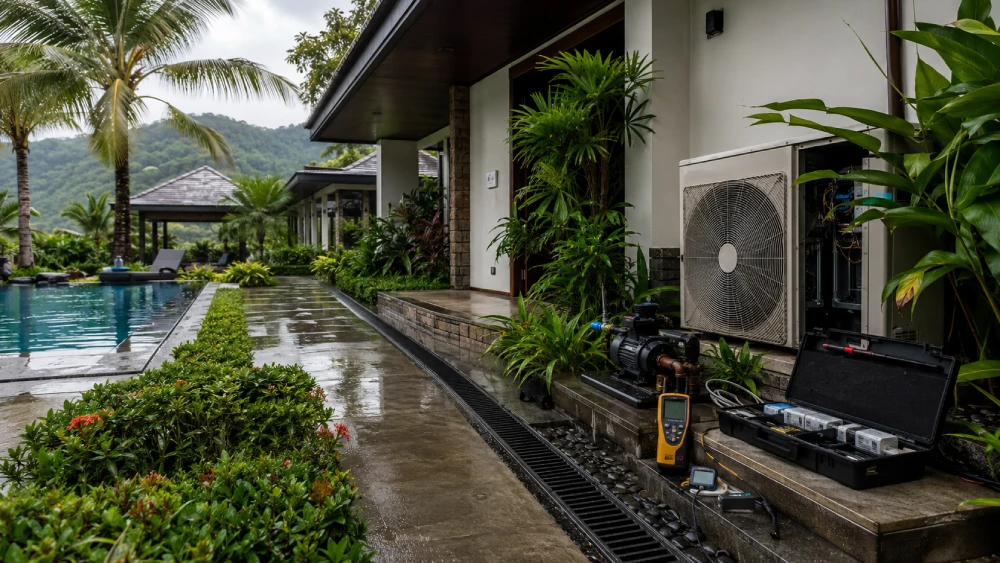
Local knowledge matters only when somebody is responsible for acting on it.
The agreement should identify who monitors conditions such as moisture, leaks, air-conditioning faults, pool issues where applicable, drainage problems, and visible deterioration.
For villas, Phuket villa humidity and mould prevention and Phuket rainy-season villa maintenance show why preventive property checks can matter in Phuket.
Avoid contracts that make broad promises such as “all maintenance handled” without specifying:
- What is inspected
- Who reports faults
- Who can approve work
- What is excluded
- How owners receive evidence
The goal is not to invent a universal maintenance schedule. The goal is to know who is responsible when a real problem appears.
Tenant Handover Should Be Documented
For managed condominium rentals, the condo move-in move-out inspection management process should define who records condition, keys, access devices, meter readings, inventory, and existing defects.
That information becomes important at move-out.
If damage is alleged, damage-deposit verification at check-in should connect the opening condition with later evidence.
The management contract should make clear:
- Who holds deposit records
- Who checks condition
- Who documents damage
- Who communicates with the tenant
- Who proposes deductions
- Who makes the final decision where required
Building Rules Need an Owner-to-Tenant Route
A condo manager may need to coordinate with building management even when the private-unit manager does not control common areas.
Condo house-rule compliance management is relevant when tenants or guests need current information about access, visitors, parking, pets, moving procedures, noise, or shared facilities.
The management agreement should identify who receives building notices and who communicates relevant changes to the occupant.
This is especially important for an overseas owner who may never see locally posted notices.
Local Coverage Must Match the Contract
A manager’s service area should reflect their ability to inspect, respond, coordinate contractors, and communicate locally.
Coverage may include Bang Tao, Rawai, Nai Harn, Kamala, Surin, Patong, Chalong, Kata, Karon, Mai Khao, Laguna, Kathu, Thalang, Cherng Talay, Choeng Thale, and surrounding areas in Phuket.
Coverage alone is not proof of quality.
A more useful question is whether the provider already understands the property type, development, access arrangements, contractor requirements, and management workload in the relevant area.
trusted property management company in phuket: Extra Costs
A management charge rarely represents every cost of owning or renting a property. Good management separates owner-paid expenses from the management fee, obtains approval where required, and records why each additional charge occurred.
Separate Management From Property Expenses
Owners should distinguish between the cost of management and the cost of operating or maintaining the property.
Separate categories may include:
- Repairs
- Replacement items
- Utilities
- Cleaning
- Common-area charges
- Contractor work
- Guest consumables where relevant
- Linen replacement
- Specialist maintenance
- Other owner-approved expenses
The condo utility reconciliation management process is relevant because utility responsibility can differ by tenancy and agreement.
A good manager should not assume the owner always pays or the tenant always pays. The contract should say which arrangement applies.
Repair Costs Need Evidence
An extra cost should have a reason attached to it.
For maintenance, the owner record can follow:
Problem → assessment → quotation → approval → work → invoice → completion evidence
If a repair must be completed quickly to protect the property, the contract should already define the manager’s emergency authority.
For non-urgent work, the owner should understand why the repair is recommended before money is spent.
This makes financial reporting useful instead of merely administrative.
Housekeeping Can Sit Outside Management
Housekeeping is another cost that owners should clarify before signing.
Housekeeping quality-control management shows that cleaning and cleaning verification are two different tasks.
A short-term property may need:
- Departure cleaning
- Linen handling
- Restocking
- Final readiness checks
A long-term tenancy may need cleaning only at specific handover points.
Owners should ask whether cleaning is included in the management charge, paid directly, deducted separately, or arranged only when requested.
Extra Charges Should Never Be a Surprise
A useful contract can classify costs as:
Included
Work covered by the recurring management charge.
Excluded
Work the manager does not provide.
Extra-charge
Work that can be arranged but creates an additional cost.
That simple distinction prevents “full service” from becoming an undefined promise.
Owners should also ask whether extra fees apply to:
- Tenant placement
- Lease renewal
- Major contractor coordination
- Emergency attendance
- Deep cleaning
- Replacement inventory
- Specialist work
- Contract termination
The answer can differ between providers. The important point is that the owner knows before the charge appears.
Manager Performance Should Still Be Measurable
Fees and contracts matter, but performance after appointment needs evidence too.
A good manager can be assessed through practical records:
- Are owner messages answered?
- Are open issues tracked?
- Are repairs completed?
- Are inspections recorded?
- Are invoices supplied?
- Are rental enquiries followed up?
- Are tenant or guest issues closed?
- Are reports delivered when agreed?
- Are owner approvals recorded?
A provider with a famous name or a large portfolio can still perform poorly on these basics.
A smaller provider can also perform poorly.
The test is what the management process actually produces.
Check the Management Scope Before You Sign
Good management should make the owner’s responsibilities, fees, repair approvals, reporting, and extra costs easier to understand before the property changes hands. PEARL Phuket Property provides a trusted property management company in phuket option for owners who want local oversight with clearly defined responsibilities. Compare the written scope against what your villa, condo, house, or rental model actually needs. We manage. You relax.
FAQs
Should a Good Phuket Property Manager Show a Sample Report?
A good Phuket property manager should be able to explain what owners normally receive after management begins. A sample or anonymised reporting format can help an owner see how income, repairs, expenses, open issues, and property condition will be recorded. The important point is not the visual design of the report. It is whether the owner can trace what happened and what action remains outstanding.
Can a Good Phuket Property Manager Change Fees Later?
A good Phuket property manager should rely on the management agreement when fees change. The contract should explain the fee structure, notice requirements, renewal terms, and any circumstances that allow pricing to be revised. Owners should avoid assuming that the first quoted fee can never change, but any change should be communicated clearly rather than appearing unexpectedly as a deduction.
Should a Good Phuket Property Manager Guarantee Occupancy?
A good Phuket property manager should not need an unsupported occupancy guarantee to demonstrate competence. Rental results can depend on property type, location, condition, availability, rental model, pricing, demand, building restrictions, and other factors outside one manager’s control. A stronger test is whether the manager can show how listings, enquiries, follow-ups, guest or tenant issues, and pricing discussions are actually being managed.
Does a Large Portfolio Prove a Good Phuket Property Manager?
No. A good Phuket property manager may manage many properties, but portfolio size alone does not prove communication quality, repair control, financial transparency, or local response. Owners should ask whether the provider manages properties similar to theirs and whether the operating process remains clear as the portfolio grows. Relevant experience is more useful than a large number presented without context.
What If a Good Phuket Property Manager Cannot Supply an Invoice?
A good Phuket property manager should be able to explain why an owner-paid expense occurred and provide appropriate supporting records where available. If an external contractor completed paid work, owners should normally expect enough documentation to identify the work and cost. Repeated unexplained deductions are a stronger warning sign than one administrative delay, especially when the contract promises transparent financial reporting.
Should Referrals Be Enough to Choose a Good Phuket Property Manager?
Referrals can help identify a good Phuket property manager, particularly when they come from owners with a similar property and management model. They should still be combined with contract review, fee comparison, reporting examples, business verification, and clear repair authority. One positive recommendation proves that one owner had a positive experience. It does not automatically establish the right fit for every property.
When Should an Owner Replace a Good Phuket Property Manager?
A good Phuket property manager should be measured against the responsibilities written into the agreement. Repeated missed reports, unexplained costs, unresolved repairs, poor communication, weak rental follow-up, or failure to provide agreed records can justify reviewing the relationship. Before changing providers, the owner should document the failures, check termination requirements, and ensure property records, keys, financial information, and active issues can be handed over properly.