A saltwater pool can be easier to manage once the system is balanced, but saltwater pool maintenance in Phuket still needs consistent attention. New owners often struggle with pH changes, salt readings, cell cleaning, filtration, and deciding what to do after heavy tropical rain.
Phuket adds another layer. Strong sun, monsoon downpours, falling garden debris, evaporation, and heavy villa use can change pool conditions faster than expected. The safest approach is a repeatable testing and cleaning routine, with extra checks whenever weather or usage changes sharply.
The key is knowing what to check, when to check it, and what warning signs mean something is wrong.
Quick Check: Before choosing saltwater pool maintenance in Phuket, check that the provider monitors water chemistry, salt-cell condition, filtration, circulation, and post-storm changes rather than only cleaning the visible pool surface.
Saltwater Pool Maintenance in Phuket: Core Routine
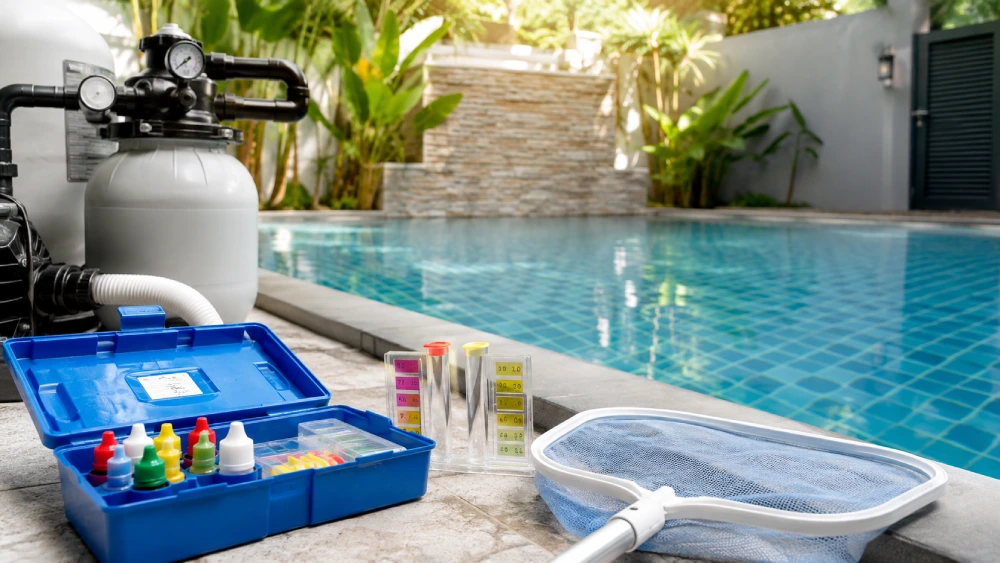
A stable saltwater pool follows a clear rhythm: remove debris, test the water, confirm chlorine production, maintain salinity within the chlorinator’s specified range, keep water moving, and inspect the equipment. Phuket weather determines when that normal routine needs extra attention.
Saltwater Pool Maintenance Schedule
| Maintenance Check | Practical Frequency | Extra Trigger |
| Remove leaves and floating debris | Daily or as needed | Wind, storms, nearby vegetation |
| Brush walls and vacuum floor | Weekly | Visible deposits or algae |
| Check pH | Weekly | Heavy rain, high use, chemistry changes |
| Check free chlorine | Weekly | Parties, heavy swimming, strong sun |
| Empty skimmer and pump baskets | Weekly | Heavy leaf or insect debris |
| Check salinity | Periodically/monthly | Heavy rainfall, overflow, drainage |
| Check wider chemistry | Periodically | Heavy rain or repeated imbalance |
| Inspect salt cell | Periodically | Low output, scaling, incorrect reading |
| Backwash or clean filter | As pressure or condition requires | Weak flow or increased pressure |
| Check water level | Routinely | Monsoon rain or dry-season evaporation |
Owners sometimes assume the salt chlorinator handles most maintenance automatically. It does not. The chlorinator generates chlorine from dissolved salt, but testing, filtration, water-level control, salt monitoring, debris removal, and equipment checks still remain essential.
For a private pool that forms part of wider villa care, understanding pool villa management needs in Phuket is useful because salt chemistry, filtration, chlorinator operation, and cleaning schedules all need someone clearly responsible for checking them.
For owners who are not on the island full-time, this can also sit within broader property management services in Phuket. Someone needs to notice weak circulation, a chlorinator warning, a falling water level, or storm-related damage before the problem becomes expensive.
Saltwater Pool Maintenance in Phuket: Chemistry
Water chemistry is where many new saltwater-pool owners feel least confident. The routine becomes easier once you know your pool’s normal readings, but pH drift, sanitizer demand, and salinity still need regular monitoring.
Watch pH Before It Drifts
The supplied research uses a practical pH target around 7.2 to 7.6 and free chlorine around 1 to 3 ppm as working references.
These are useful ranges, but testing should guide treatment rather than assumptions.
Saltwater chlorination can contribute to rising pH, which means a pool that was balanced last week can still require correction this week.
Do not wait until the water turns cloudy or green.
Regular property inspection checks can help identify water-quality changes, weak circulation, leaks, corrosion, or salt-cell problems before they become obvious in photographs.
Do Not Trust One Salt Reading Blindly
The research gives 2,700 to 3,400 ppm as a general salinity reference, but that is not a universal operating range for every salt chlorinator.
Different systems specify different salt levels.
If the chlorinator display gives an unusual reading or chlorine production suddenly changes, compare that reading with an independent salt test before adding more salt.
The chlorinator manufacturer’s range should come first.
Adding bags of salt because one display reads low can make the situation worse if the reading itself is inaccurate.
If diagnosis shows that the problem is mechanical rather than chemical, a salt chlorinator repair service in Phuket may be more appropriate than repeatedly adjusting salinity.
Learn the Pool Before Testing Less
New owners often test more frequently while learning how their pool behaves.
That is sensible.
One Phuket villa can behave very differently from another because of:
- shade
- pool size
- guest use
- sun exposure
- surrounding plants
- pump runtime
- chlorinator size
- rainfall
- evaporation
During the learning period, record:
- pH
- free chlorine
- salinity
- water level
- chlorinator output
- filter pressure or water flow
- visible debris
- unusual weather
- heavy swimming days
A simple record makes patterns much easier to see.
It is particularly valuable when considering remote villa ownership risks in Phuket, because an overseas owner cannot personally check whether the salt level changed, circulation weakened, or the chlorinator developed a fault.
Green Water Means Find the Cause
A saltwater pool can still turn green.
When it does, the question is not simply how much chemical should be added.
The real question is why available sanitizer became insufficient.
Possible causes include:
- reduced chlorine production
- incorrect chemistry
- filtration problems
- weak circulation
- heavy swimmer load
- large amounts of organic debris
- storm-related dilution
- chlorinator faults
Correct the cause before treating the colour as an isolated problem.
For holiday villas, vacation rental property oversight becomes relevant because guest turnover can change swimmer load dramatically. A pool may need checking after heavy occupancy even when the normal technician visited only a day earlier.
Where the property is operated as a short-stay rental, airbnb property management and cleaning in Phuket can also help connect guest turnover with pool-readiness reporting.
Saltwater Pool Maintenance in Phuket: Salt & Seasons
Phuket’s wet and dry seasons affect saltwater pools differently. Heavy rain can dilute salinity and sanitizer and raise the water level, while dry-season evaporation can concentrate dissolved material and lower water levels.
Phuket Seasonal Pool Changes
| Condition | Main Pool Problem | Maintenance Response |
| Heavy monsoon rain | Diluted salt and sanitizer | Recheck chemistry and salinity |
| Pool overflow | Water and chemical loss | Correct water level, then retest |
| Storm debris | Organic load and blocked baskets | Skim, vacuum and clean baskets |
| Strong sun | Higher sanitizer demand | Monitor chlorine more closely |
| Heavy guest use | Increased contamination load | Retest after unusually high use |
| Dry-season evaporation | Falling water level | Top up before skimmer level becomes too low |
| Dense garden growth | Leaves and organic debris | Coordinate garden and pool maintenance |
Test Again After Major Rain
Heavy rain deserves more attention than an ordinary passing shower.
A major downpour can:
- dilute salinity
- reduce sanitizer concentration
- raise the pool level
- trigger overflow
- wash debris into the water
- block skimmer baskets
- alter circulation conditions
After meaningful monsoon rainfall:
- Check whether the pool overflowed.
- Correct the water level if necessary.
- Test pH.
- Test free chlorine.
- Test salinity.
- Inspect skimmer and pump baskets.
- Check filtration and circulation.
- Adjust only what the readings show is necessary.
Do not automatically add salt after every rainfall.
The wider property should also be inspected after severe weather. Coordinating villa maintenance during Phuket rainy season helps connect pool maintenance with drainage, vegetation, runoff, power interruptions, and outdoor equipment exposure.
Coastal Pools Need Corrosion Checks
Saltwater pools near the coast have two separate salt considerations.
There is the controlled salt concentration inside the pool, and there is the external coastal environment affecting exposed equipment.
A beachfront property can require closer visual checks of:
- pumps
- electrical housings
- chlorinator components
- exposed fittings
- fasteners
- valves
- outdoor equipment cabinets
This is where beachfront villa management in Phuket becomes relevant. Seaside exposure can justify closer equipment-condition monitoring even when the pool chemistry itself remains stable.
Keep Garden Debris Away
Tropical landscaping creates an extra pool-maintenance load.
Leaves, flowers, insects, seeds, and small organic particles eventually reach the baskets and filter.
Wind and heavy rain can dramatically increase that load.
Regular garden maintenance service in Phuket can reduce overhanging branches and uncontrolled vegetation around the pool.
Pool technicians should not have to compensate every week for landscaping that constantly drops material into the water.
Rental Use Changes the Routine
A fixed calendar works best when pool usage is predictable.
Rental villas rarely behave that way.
A villa can remain vacant for several days and then host a full group of guests. High swimmer load increases sanitizer demand and adds sunscreen, sweat, dirt, and other contaminants to the water.
That means the maintenance routine should respond to actual occupancy.
Where late guest arrivals are common, a 24 hour check-in service villa in Phuket can help report visible pool-readiness problems before they become complaints.
Likewise, professional housekeeping services in Phuket can flag cloudy water, visible debris, a low water level, or other obvious issues while technical pool work remains with the appropriate person.
Saltwater Pool Maintenance in Phuket: Filtration
Good chemistry cannot compensate for poor water movement.
Pumps, baskets, filters, and valves keep water moving through the chlorination system. Weak circulation can therefore undermine an otherwise correct saltwater-pool routine.
Keep Water Moving
The supplied research uses roughly 8 to 12 hours of pump operation in hotter conditions as a reference.
That should not be copied blindly.
Actual pump runtime depends on:
- pool volume
- pump flow rate
- filtration design
- chlorinator output
- swimmer load
- debris
- weather
- water clarity
The real objective is adequate circulation and sufficient chlorine generation.
If circulation becomes noticeably weaker, do not simply extend the timer.
Inspect:
- baskets
- filter condition
- valves
- water level
- pump operation
- salt cell
- plumbing
- flow through return jets
Use Filter Condition as a Signal
A dirty filter restricts circulation.
The supplied research recommends cleaning or backwashing according to filter condition and pressure, rather than waiting for an arbitrary calendar date.
Sand filters and cartridge filters also require different maintenance procedures.
This is why preventive saltwater maintenance contributes to wider Phuket villa asset protection. Pumps, filters, chlorinators, fittings, and pool finishes all benefit when problems are corrected before repeated strain causes additional deterioration.
Clean Baskets Before Flow Drops
Skimmer and pump baskets are simple, but neglecting them can create large circulation problems.
Check them more closely:
- after storms
- during windy weather
- when nearby plants shed heavily
- after long vacancy
- when water flow changes
- when the pump sounds different
A basket packed with leaves reduces water movement before the filter or chlorinator even gets a chance to work properly.
Inspect the Salt Cell Before Cleaning
Salt-cell cleaning deserves caution.
The supplied research includes an owner who described damaging the process through overly aggressive acid treatment.
That is a useful warning.
Inspect first.
Look for:
- visible calcium scale
- reduced chlorine output
- incorrect system readings
- flow problems
- cell warnings
If cleaning is necessary, follow the chlorinator manufacturer’s specified procedure.
Do not acid-clean the cell automatically because a date arrived on the calendar.
Frequent aggressive cleaning can shorten component life.
If the salt cell, pump, filter, valve, electrical equipment, or plumbing actually fails, clearly defined property repair handling responsibilities help an overseas owner know who arranges inspection and authorizes repairs.
Where a major leak, circulation failure, electrical problem, or rapidly deteriorating pool requires immediate action, clear Phuket property emergency handling avoids wasting time deciding who has authority to respond.
Saltwater Pool Maintenance in Phuket: Villa Care
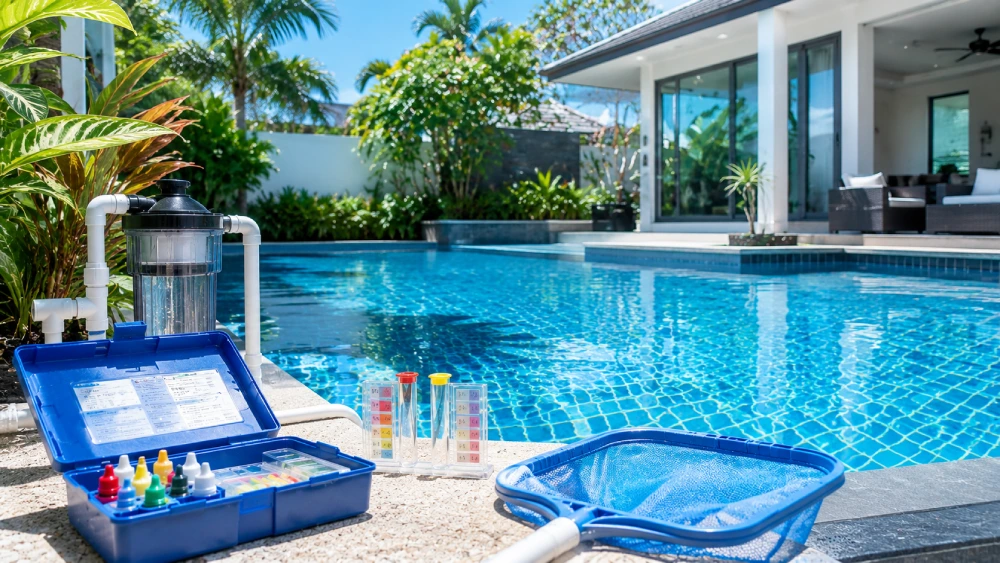
Saltwater pool care rarely exists in isolation. A villa also has landscaping, housekeeping, electrical systems, guest preparation, plumbing, drainage, and general maintenance, so responsibilities need to be clear.
Saltwater Care Within Wider Villa Maintenance
In a larger property-maintenance plan, luxury villa management inclusions in Phuket can naturally include scheduled pool observations, equipment checks, cleaning coordination, and reporting alongside wider property upkeep.
The important point is to distinguish observation from technical work.
Housekeeping can report cloudy water.
A property inspection can report a pump leak.
A pool technician should still be responsible for chemistry adjustments, chlorinator diagnosis, filter servicing, and technical repair.
DIY Saltwater Maintenance Can Work
For owners living at the property full-time, DIY saltwater maintenance can be practical.
The difficult stage is usually learning:
- how to test accurately
- your normal pH pattern
- the correct chlorinator salt range
- how the filter operates
- how to inspect the salt cell
- normal pump behaviour
- what changes after storms
- what poor circulation looks like
Once those patterns are understood, maintenance becomes much more predictable.
A robotic cleaner can reduce vacuuming work, but it cannot test chemistry, inspect the salt cell, diagnose poor circulation, or investigate a chlorinator error.
Overseas Owners Need Clear Responsibility
For owners who spend only part of the year in Phuket, consistency becomes more important than DIY ability.
A planned villa management & maintenance in Phuket arrangement can connect the pool with wider maintenance requirements around the property.
For standalone homes, house management services in Phuket can include reporting visible pool and equipment changes during wider property inspections.
Condominium owners face a different question.
The pool may be private, attached to one unit, or maintained as a shared facility.
Condo property management services in Phuket should therefore be considered separately from privately owned saltwater-pool maintenance.
Saltwater Pool Maintenance in Phuket: Areas
Saltwater pool care can be coordinated across Phuket’s main residential, resort, and villa areas.
Coverage includes Bang Tao, Rawai, Nai Harn, Kamala, Surin, Patong, Chalong, Kata, Karon, Mai Khao, Laguna, Kathu, Thalang, Cherng Talay or Choeng Thale, plus Ya Nui, Friendship Beach, Saiyuan, and surrounding areas.
The same basic principles apply across the island, but each pool behaves differently.
A heavily occupied Patong rental pool may have greater sanitizer demand than a lightly used private villa in Mai Khao.
A Rawai pool surrounded by mature tropical landscaping may collect more organic debris than an exposed pool elsewhere.
A beachfront villa may need closer corrosion inspection.
The maintenance routine should therefore reflect the actual pool, equipment, occupancy, landscaping, weather, and exposure, not simply its postcode or neighbourhood.
Get the Saltwater Routine Under Control
Saltwater pools become easier to manage once their normal chemistry and equipment pattern is understood.
Problems usually begin when testing becomes irregular, heavy rainfall is ignored, circulation weakens, salt readings are trusted without verification, or a chlorinator warning is treated by changing chemistry without finding the cause.
If you want the system checked consistently, arrange professional saltwater pool maintenance in Phuket around the pool’s equipment, occupancy, surroundings, and seasonal conditions.
A predictable routine is far easier to manage than recovering a neglected or suddenly green pool.
Saltwater Pool Maintenance FAQs
Can too much acid damage saltwater pool maintenance equipment?
Yes. Saltwater pool maintenance can damage equipment when a salt cell is cleaned too aggressively or with an unsuitable chemical concentration. The supplied owner research includes an expensive mistake caused by overly strong acid treatment. Inspect the cell first and follow the chlorinator manufacturer’s cleaning instructions rather than acid-cleaning it automatically on a fixed timetable.
Should saltwater pool maintenance trust the chlorinator display?
Not automatically. If a chlorinator display gives a salt reading that seems inconsistent with chlorine production or recent water changes, saltwater pool maintenance should include an independent salinity test. Compare that result with the manufacturer’s specified operating range before adding salt. This prevents an incorrect sensor or display reading from leading to unnecessary chemical adjustment.
Does rental use change saltwater pool maintenance?
Yes. Saltwater pool maintenance for a busy rental pool can require closer monitoring than care for a lightly used private villa. More swimmers increase sanitizer demand and introduce sunscreen, dirt, sweat, and other contaminants. Guest turnover can also produce short periods of very heavy use, so maintenance should respond to actual occupancy rather than only one fixed weekly appointment.
How should overseas owners manage saltwater pool maintenance?
Overseas owners need saltwater pool maintenance with clearly assigned responsibility for chemistry testing, salinity checks, water level, baskets, filtration, salt-cell condition, storm response, and equipment faults. A written inspection routine makes it easier to compare conditions over time and establishes who can arrange technical work when the owner is not available locally.
Is saltwater pool maintenance needed when water looks clear?
Yes. Clear water does not mean saltwater pool maintenance can be skipped. pH, sanitizer, salinity, circulation, and chlorinator performance can change before visible cloudiness or algae appears. Regular testing detects those changes earlier. Waiting for water to look bad usually means the problem has already progressed beyond a simple routine adjustment.
Can housekeeping replace saltwater pool maintenance?
No. Housekeeping can support saltwater pool maintenance by reporting visible debris, cloudy water, low water levels, or obvious equipment problems, but technical pool care is different. Water testing, chemical correction, filter servicing, salt-cell inspection, and equipment diagnosis require a defined pool-maintenance process and clear technical responsibility.
When does saltwater pool maintenance need professional help?
Professional saltwater pool maintenance becomes useful when chemistry repeatedly moves out of range, circulation is weak, the pool turns green, a chlorinator reports faults, pumps or filters stop operating normally, or the owner cannot maintain a consistent routine. Professional diagnosis is also important when repeated chemical adjustments fail to solve the underlying problem.