A pool pump rarely fails without warning. Changes in noise, weaker water flow, leaks, air in the system, or repeated overheating usually appear first. Pool pump servicing in Phuket should therefore combine routine observation with scheduled technical inspections rather than waiting for the motor to stop.
Phuket pools also deal with heavy rain, tropical debris, long operating periods, and busy rental use. These conditions can increase the load on baskets, filters, seals, and circulation equipment. A clear servicing routine helps identify smaller faults before they become pump replacements.
The important question is not only how often the pump should be serviced, but what should actually be checked each time.
Quick Check: Before choosing a pool pump repair service in Phuket, check that the provider inspects pump pressure, water flow, seals, bearings, electrical connections, and signs of leaks or unusual noise.
Pool Pump Servicing in Phuket: Service Timeline
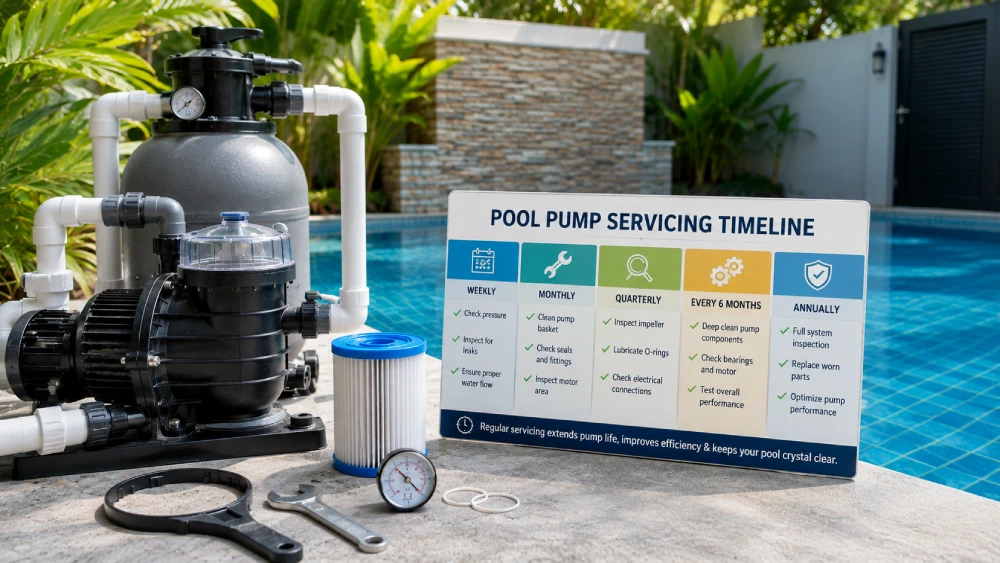
There is no useful one-line rule such as “service the pump once a year and forget about it.” A Phuket pool pump needs several levels of attention. Routine observation catches obvious changes, while periodic technical inspection looks deeper at wear, flow, electrical condition, and mechanical performance.
Pool Pump Service Schedule
| Service Level | Recommended Timing | Main Checks |
| Routine observation | Weekly | Basket, water flow, noise, leaks, priming |
| Post-storm inspection | After significant storms | Debris, circulation, basket restriction, filter condition |
| Technical inspection | Every 3–6 months where needed | Flow, pressure, small leaks, electrical condition |
| Deeper professional service | About every 6–12 months | Motor, bearings, seals, electrical components |
| Fault-triggered service | As soon as symptoms appear | Grinding, humming, leaking, overheating, loss of prime |
The weekly check is the part owners often underestimate.
Remove leaves, insects, hair, and other debris from the pump strainer basket. Look through the clear lid where possible and confirm the basket is not packed and the pump appears properly primed.
Listen as well.
A pump that has sounded the same for months and suddenly begins rattling, grinding, screeching, or humming differently is giving you useful information. Waiting until the motor stops completely removes the chance to deal with a smaller problem first.
Every 3–6 Months: Check Performance
A periodic technical inspection should go beyond emptying the basket.
The technician can check water flow, pressure, fittings, small leaks, seals, electrical connections, and signs that the pump is working harder than expected.
This is also where clear Phuket property maintenance responsibilities matter for remotely managed homes. Someone needs to know who records an abnormal pump noise, schedules technical inspection, provides access, and follows up after servicing.
A minor leak around a union or seal may appear harmless.
Left unresolved, it can contribute to loss of prime, water loss, corrosion around nearby components, or a more disruptive failure.
Every 6–12 Months: Inspect Deeper
A deeper professional inspection roughly every 6 to 12 months is a useful reference point, but the actual interval should depend on condition and workload.
A lightly used private villa does not place the same demand on its pump as a rental property with repeated guest turnover.
A deeper inspection can include:
- motor condition
- bearings
- mechanical seal
- pump-lid seal
- electrical connections
- capacitor where applicable
- timer or control operation
- impeller condition
- vibration
- leakage
- cooling and ventilation
Owners using broader property management services in Phuket should make sure pool-equipment observations are specifically included rather than assuming every general property visit includes technical pump inspection.
Service Intervals by Pool Use
| Pool Situation | Routine Observation | Deeper Service Approach |
| Light-use private villa | Weekly | Longer end of 6–12 months if pump remains healthy |
| Busy rental villa | Weekly or more often during heavy use | Shorter interval where workload justifies it |
| Pool near dense vegetation | More frequent basket checks | Inspect sooner if restrictions recur |
| Pool after major storms | Additional post-storm check | Service if abnormal flow, leaks, or noise appear |
| Vacant villa | Scheduled local observation | Do not assume non-use removes maintenance needs |
| Older/problematic pump | Frequent monitoring | Follow symptoms rather than calendar alone |
The calendar is a baseline.
A pump that starts grinding tomorrow should not continue operating for six months simply because its annual service is not yet due.
Pool Pump Servicing in Phuket: Local Conditions
Phuket conditions can change how closely the pump needs monitoring. Storm debris can fill baskets quickly, tropical vegetation increases organic material, and heavily occupied rentals can place more demand on circulation than lightly used private pools.
Monsoon Debris Can Restrict Flow
Heavy rain does not automatically mean the pump itself needs mechanical servicing.
The immediate concern is often what the storm puts into the pool and circulation system.
Leaves, flowers, insects, dirt, and other debris can collect in the skimmer and pump basket. As restriction increases, water flow can fall and the pump may operate under less favourable conditions.
After severe weather, check:
- pool water level
- skimmer basket
- pump basket
- return-jet flow
- filter condition
- visible leaks
- pump sound
- priming
If the pump sounds normal and circulation returns after debris removal, deeper repair may not be required.
If flow remains weak, the inspection should go further.
Dense Gardens Increase Basket Loading
A villa surrounded by mature tropical landscaping may need basket checks more frequently than a pool in an open area.
Plants do not follow the pump service calendar.
Falling leaves and flowers can create continuous loading, especially during wind or heavy rain.
Regular garden maintenance service in Phuket can reduce overhanging growth and the amount of organic debris repeatedly entering the pool.
This is a simple form of preventive maintenance.
Reducing the debris source can be more effective than repeatedly clearing an overloaded basket without addressing what is causing it.
Rental Villas Put More Demand on Circulation
Pool use changes pump workload.
A private villa occupied occasionally by two people does not behave like a holiday rental with repeated changeovers and periods of heavy swimming.
Where airbnb property management and cleaning in Phuket is coordinated, visible pool readiness should be included in the changeover process.
Housekeepers should not diagnose pump motors or open electrical equipment. However, professional housekeeping services in Phuket can report obvious changes such as cloudy water, unusual pool level, low return flow, visible leakage, or a pump that does not appear to be running.
Late arrivals create another reporting point.
A 24 hour check-in service villa in Phuket can flag a circulation problem reported by a guest outside normal daytime hours and escalate it to the appropriate technical contact.
This also connects with broader Phuket rental home protection measures. Preventive pump checks help protect filtration, plumbing, sanitation equipment, and water quality from secondary problems created by circulation failure.
Overseas Owners Need Local Observation
A remote owner cannot hear a bearing getting louder from another country.
They also cannot see a slow seal leak, feel weaker return flow, or notice that a pump is repeatedly losing prime.
That makes villa oversight for overseas Phuket owners particularly relevant when pump condition needs to be monitored between owner visits.
Useful reporting should be specific.
Instead of simply saying “pool checked,” record whether:
- pump was operating
- basket was clear
- flow appeared normal
- leakage was visible
- abnormal noise was heard
- priming was stable
- repair was required
That creates a maintenance history rather than a collection of occasional photographs.
Pool Pump Servicing in Phuket: Technical Diagnosis
Professional servicing becomes important when the issue goes beyond routine basket cleaning. Leaks, grinding noises, lost prime, overheating, weak circulation, or a motor that hums without starting need diagnosis rather than repeated guesswork.
Diagnose Weak Flow Before Replacement
Weak return flow does not automatically mean the pump motor is finished.
Several simpler problems can create the same symptom.
Check the system logically:
- Is the pool water level high enough?
- Is the skimmer restricted?
- Is the pump basket full?
- Is the pump properly primed?
- Is the lid O-ring sealing?
- Is the filter dirty?
- Are valves positioned correctly?
- Could a suction line be obstructed?
- Could debris be affecting the impeller?
- Has actual pump performance deteriorated?
This sequence reduces the risk of replacing the pump before the real problem is found.
Pump Symptoms and Likely Checks
| Pump Symptom | Possible Area to Check | Practical Response |
| Grinding or screeching | Bearings, motor, impeller | Arrange diagnosis rather than ignoring noise |
| Humming but not starting | Capacitor, impeller, electrical supply | Technical inspection |
| Air bubbles in returns | Lid seal or suction-side leak | Check O-ring, unions, valves, suction line |
| Pump losing prime | Low water, air leak, obstruction | Check water level and suction side |
| Weak return flow | Basket, filter, valve, line, impeller | Diagnose restriction before replacing pump |
| Water under pump | Seal, gasket, fitting, housing | Find exact leak source |
| Repeated shutdown | Heat or electrical problem | Check cooling, obstruction, supply, protection |
| Cracked housing | Structural damage | Compare replacement with repair viability |
O-Rings and Gaskets Matter
A lid O-ring is a small component, but it can create large symptoms.
If it becomes dry, flattened, poorly seated, cracked, or damaged, air may enter the suction side and interfere with priming.
Water can also escape through failed seals elsewhere in the pump.
A bad O-ring is a very different problem from a failed motor.
Good servicing separates the two before replacement decisions are made.
Strange Noise Is a Service Trigger
A new mechanical sound should bring inspection forward.
Grinding or screeching can indicate bearing or motor issues. Rattling may point toward debris, looseness, or an impeller-related problem.
A motor that hums without starting needs a different diagnosis again.
Possible areas to investigate include:
- capacitor
- impeller restriction
- electrical supply
- motor condition
Electrical work should be left to someone qualified to work safely around powered pool equipment.
The broader property maintenance duty framework should also distinguish between observing the fault and carrying out technical work. A manager may report, schedule, coordinate, and document the service without personally opening the motor.
When a Leak Means Repair
Not every pump leak means the whole unit should be replaced.
Possible serviceable leak points include:
- pump-lid seal
- O-ring
- gasket
- mechanical seal
- union
- plumbing fitting
The exact location matters.
Water around the lid is different from leakage between pump sections or water escaping through a cracked housing.
A technician should identify the actual failure point before recommending replacement.
Follow the Repair Through Properly
Finding the problem is only one part of servicing.
The repair process should move clearly from:
fault noticed → inspection → diagnosis → approval → repair → operating test → record
That property maintenance operating workflow is especially useful when the owner is not physically present.
After a repair, confirm that the original symptom is actually gone.
For example, replacing a seal should be followed by checking for leaks and stable priming. Work on a starting fault should be followed by confirming that the pump starts and runs correctly.
“Part replaced” is not the same thing as “problem solved.”
Pool Pump Servicing in Phuket: Repair or Replace
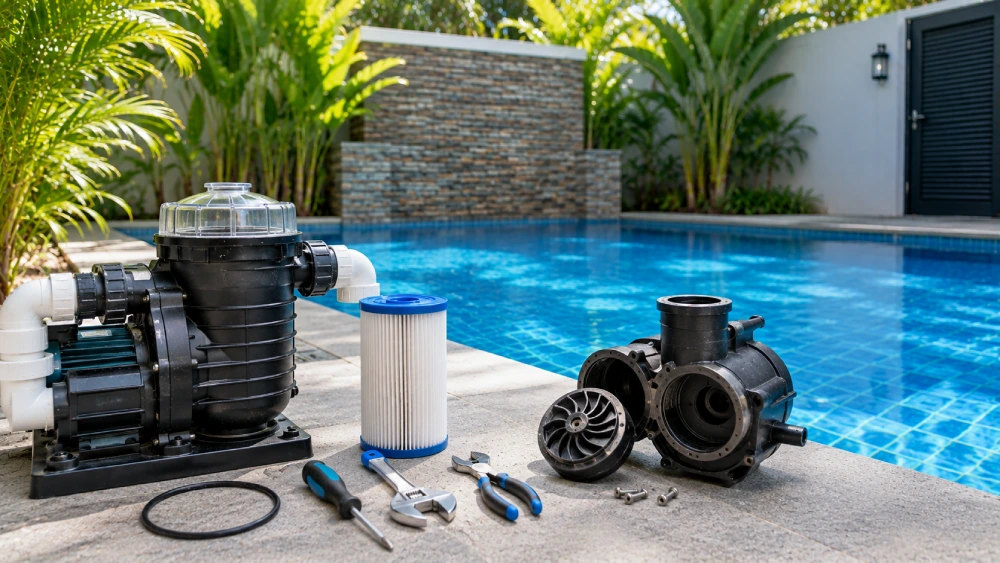
Owners often want to know when continued servicing stops making sense.
The answer depends on what failed, the pump’s overall condition, and whether repair is likely to restore dependable operation.
When Repair Still Makes Sense
A pump can often remain serviceable when the problem involves a replaceable or correctable component.
Examples include:
- O-ring
- gasket
- mechanical seal
- minor fitting leak
- obstruction
- capacitor where appropriate
- correctable electrical connection
- impeller debris
The fault should still be diagnosed properly.
Replacing random parts until the pump works is not an efficient maintenance strategy.
When Replacement Becomes More Logical
Replacement becomes more reasonable when the pump has:
- cracked structural housing
- serious motor damage
- repeated major failures
- extensive deterioration
- repair costs that no longer make sense relative to replacement
Age alone should not be the sole decision.
Two pumps of the same age can have very different histories depending on operating hours, installation quality, ventilation, exposure, water ingress, servicing, and workload.
Do Not Use One Fixed Repair Price
An O-ring replacement is not comparable with a bearing repair, electrical diagnosis, motor work, or complete pump replacement.
The useful question is therefore not:
“How much does pool pump servicing cost?”
It is:
“What failed, what work is needed, and what will restore normal operation?”
Before approving work, clarify:
- exact fault
- inspection performed
- part required
- labour involved
- whether fault is mechanical or electrical
- whether repair should restore normal performance
- why replacement is being recommended if applicable
Owners using villa management & maintenance in Phuket can use that information to approve repair work remotely without relying on vague descriptions.
Pool Pump Servicing in Phuket: Clear Responsibility
Pool servicing becomes harder when nobody knows who is actually responsible for noticing, reporting, approving, and following up on equipment faults.
A clear maintenance structure prevents small problems from being passed between staff.
Define What the Management Scope Includes
Do not assume pool-pump monitoring is automatically included in every property-management arrangement.
The Phuket management contract responsibilities should make clear whether the agreed scope includes:
- routine equipment observation
- pump-operation checks
- technician scheduling
- repair authorization
- emergency access
- service records
- follow-up after repairs
This is particularly important for overseas owners.
If technical pool servicing is excluded, the owner should know who is responsible for arranging it separately.
Separate Technical and Management Roles
A pool technician and a property manager do not necessarily perform the same function.
Understanding villa specialist and management roles helps separate:
technical role: diagnose pump, test electrical components, replace parts, service seals, inspect motor.
management role: notice problem, document symptom, arrange access, coordinate technician, approve work, verify completion.
Confusing these roles can lead to either unqualified repairs or nobody taking ownership of the problem.
Watch for Repeated Maintenance Failures
A pump problem can also expose weaknesses in the wider maintenance process.
Examples include:
- service visits repeatedly missed
- abnormal pump noise ignored
- the same leak reported several times
- no maintenance records
- recurring loss of prime with no investigation
- repairs approved without diagnosis
- no follow-up after work
- equipment problems discovered only when guests complain
Those are useful property management maintenance warning signs because they point to a process problem rather than one isolated pump fault.
A well-managed system should make recurring defects easier to identify, not easier to forget.
Different Property Types Need Different Responsibility
A private house with its own pool normally gives the owner direct responsibility for the pump.
Using house management services in Phuket can connect pool-equipment observations with wider maintenance checks when the owner is absent.
Condominium arrangements can be different.
A private plunge pool belonging to one unit may not be managed in the same way as a large shared pool maintained through common facilities.
Owners using condo property management services in Phuket should confirm exactly who controls and maintains the pump before authorizing technical work.
Pool Pump Servicing in Phuket: Areas Covered
Pool pump checks and wider pool support can be coordinated throughout Phuket.
Coverage includes Bang Tao, Rawai, Nai Harn, Kamala, Surin, Patong, Chalong, Kata, Karon, Mai Khao, Laguna, Kathu, Thalang, Cherng Talay or Choeng Thale, plus Ya Nui, Friendship Beach, Saiyuan, and surrounding Phuket areas.
The basic servicing principle remains consistent.
What changes is the pump’s workload and environment.
A high-turnover rental property may need more frequent observation than a quiet private pool.
A pool surrounded by mature tropical planting may need basket cleaning more often.
A system with a history of seal leaks or priming problems deserves closer monitoring than a newer pump running normally.
The correct schedule should therefore follow pump condition, pool use, debris load, storm exposure, operating hours, and maintenance history rather than the area name alone.
Service the Pump Before Failure Decides
The practical baseline is straightforward: inspect the pump routinely, bring technical checks forward when performance changes, and use a deeper professional service cycle of roughly 6–12 months as a working reference.
Do not wait for grinding, serious leaking, repeated shutdowns, or complete circulation loss before responding.
If the pump already shows warning signs, a pool pump repair service in Phuket can determine whether the cause is a restriction, seal, impeller, electrical component, motor fault, or structural problem before unnecessary replacement is approved.
Early diagnosis usually leaves more repair options.
Pool Pump Servicing FAQs
Does pool pump servicing in Phuket include capacitor testing?
Pool pump servicing in Phuket may include capacitor testing when a motor hums, struggles to start, starts intermittently, or shows another symptom associated with its starting circuit. A capacitor does not need automatic replacement because a service date arrives. Testing should respond to the actual symptom and should be carried out by someone competent to work safely with electrical pool equipment.
Can pool pump servicing in Phuket stop air bubbles?
Yes, if the bubbles originate on the suction side. Pool pump servicing in Phuket can include checking the pump-lid O-ring, unions, pool water level, valves, suction plumbing, and other locations where air can enter before the pump. Finding the entry point is more useful than repeatedly re-priming the system without fixing the underlying leak.
Does rental use change pool pump servicing in Phuket?
Rental use can change how closely pool pump servicing in Phuket needs to be monitored because periods of high occupancy can increase filtration and circulation demand. It does not mean every rental pump automatically needs the same shortened mechanical-service interval. Increase routine observation during busy periods and bring technical servicing forward when flow, sound, leakage, temperature, or performance changes.
Does pool pump servicing in Phuket include O-rings?
Yes, relevant seals should be checked where they affect pump performance. During pool pump servicing in Phuket, the lid O-ring can be inspected for flattening, dryness, cracking, poor seating, or other deterioration that may allow air into the suction side. A small sealing problem can produce priming and circulation symptoms that may otherwise be mistaken for a failing pump motor.
Can pool pump servicing in Phuket fix a humming pump?
Sometimes. A motor that hums but does not start may have an impeller obstruction, capacitor problem, electrical issue, or another fault requiring diagnosis. Pool pump servicing in Phuket should identify the cause before parts are changed. Repeatedly attempting to start a struggling motor without understanding the problem can increase the risk of further equipment damage.
When should pool pump servicing lead to replacement?
Pool pump servicing in Phuket should lead to replacement only after the actual fault and the overall equipment condition are assessed. An O-ring, gasket, seal, obstruction, or replaceable electrical component does not automatically justify a new pump. A cracked housing, serious motor damage, or repeated major failures can make replacement more practical, but diagnosis should come first.
Do vacant villas still need pool pump servicing in Phuket?
Yes. Pool pump servicing in Phuket remains relevant when a villa is unoccupied because rain, debris, pump run time, filtration, electrical operation, water loss, and equipment wear continue without guests. In fact, faults can become harder to notice when nobody uses the pool. Scheduled local observations should confirm circulation, basket condition, leakage, pump noise, and basic operation between owner visits.