An empty villa can conceal a pool problem for weeks. A stopped pump, falling water level, blocked filter, or failed dosing system may remain unnoticed until the owner receives a large repair bill or finds green water before returning.
Effective vacant property pool management replaces casual visits with scheduled inspections, recorded water readings, equipment checks, and clear repair authority.
Automation can support this process, but it cannot inspect a leak, clear storm debris, or prove that a technician attended. The critical question is simple: what evidence should an owner receive after every vacant-pool visit?
Quick Check: Before leaving a villa unattended, get vacant property pool management in Phuket with recorded water readings, dated inspection photographs, equipment checks, and an emergency response procedure.
Vacant Property Pool Management: 15 Checks
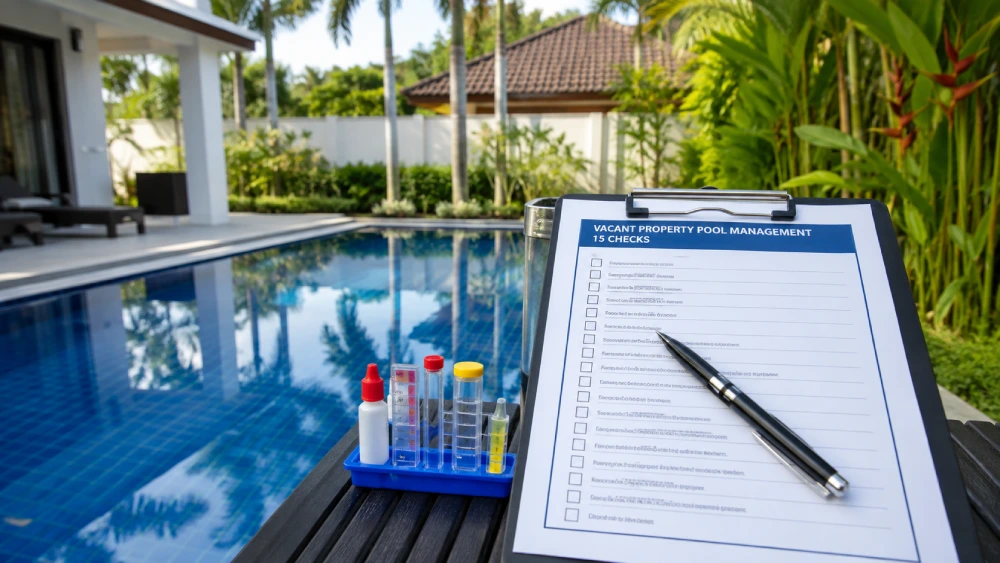
Vacant property pool management should control water quality, circulation, leakage, security, weather exposure, and reporting. Each inspection needs a repeatable checklist so the owner can compare conditions across visits.
Vacant-Pool Inspection Checklist
| Inspection point | What must be recorded | Fault requiring action |
| Water clarity | Clear, cloudy, green or discoloured | Cloudiness, algae or unexplained colour |
| Water level | Position against a fixed reference | Repeated or sudden water loss |
| Chlorine | Measured reading | Outside the operating target |
| pH | Measured reading | Outside the operating target |
| Other chemistry | CYA, alkalinity, salt or hardness when relevant | Abnormal or changing readings |
| Pump | Prime, noise, vibration and leakage | No flow, air leak or unusual sound |
| Filter | Pressure and visible condition | Restriction, bypass or damaged media |
| Baskets | Skimmer and pump-basket contents | Obstruction or excessive debris |
| Returns | Strength and direction of water flow | Weak or missing circulation |
| Dosing system | Timer, chlorinator, salt cell or controller | No output, warning or incorrect setting |
| Pool surfaces | Floor, walls, steps and fittings | Algae, cracking, staining or damage |
| Drainage | Overflow and surrounding runoff | Blockage, soil entry or standing water |
| Utilities | Water and electricity readings when included | Unexplained usage |
| Security | Gate, lock, cover, alarm and equipment-room access | Unauthorized or unsafe access |
| Visit record | Photographs, readings and completed actions | Missing or inconsistent evidence |
A vacant property inspection checklist should use the same photo positions, measuring points, and equipment checks during every visit. Consistency helps identify gradual water loss, falling circulation, or repeated chemical drift.
The wider Phuket property management responsibility scope must identify who inspects the pool, adds chemicals, arranges repairs, controls access, and updates the owner.
Define the Inspection Schedule
“Regular pool visits” is not a usable service standard. The agreement should state the planned schedule, the procedure for a missed visit, and the events requiring an additional inspection.
Extra visits may be needed after substantial rain, power failure, equipment alerts, visible water loss, storm debris, or a security incident. The schedule should reflect the pool system, surrounding vegetation, weather exposure, and length of vacancy.
The Phuket pool-villa management need becomes clear when the owner cannot verify the water or equipment condition between stays.
Vacant Property Pool Management: Water Control
Unused water still requires testing. Vacant property pool management cannot rely on visual appearance or a standard chemical dose because sunlight, rain, organic debris, and equipment faults affect each pool differently.
Record Chemistry Instead of Guessing
At minimum, each visit should record chlorine and pH. Alkalinity, cyanuric acid, salt, calcium hardness, and other readings should be checked when required by the pool system or previous results.
A reading should be recorded before chemicals are added. The visit report should then show the product used, quantity, reason for adjustment, and result of any follow-up test.
Vacant pool chemical-balance controls prevent staff from adding the same dose during every visit regardless of rainfall, water loss, or existing chemistry.
Chemical products must remain labelled and stored separately in a dry, secure area. Chlorine and acid must never be mixed or stored where water contamination, unauthorized access, or damaged containers could create a hazard.
Detect Water Loss Early
A changing water level should be compared with a fixed reference. Repeated topping-up without recording the quantity can conceal a leak.
The inspector should check the pool shell, fittings, pump, filter, valves, pipe connections, overflow, and surrounding ground for signs of water loss.
Utility readings can help identify unexplained consumption when automatic filling or manual topping-up is used. A sudden increase should trigger investigation rather than being accepted as normal vacancy use.
These checks form part of Phuket villa asset-protection controls, particularly when a small equipment leak could continue for weeks without an occupant reporting it.
Prevent Green Water
A green vacant pool usually indicates insufficient sanitizer, poor circulation, heavy contamination, or equipment failure. The response should start with testing and inspection rather than an arbitrary shock dose.
Leaves and soil must be removed, baskets cleared, circulation confirmed, and the filter checked. If algae has developed, treatment should follow the measured chemistry and actual pool volume.
Owners who receive only a photograph after treatment cannot verify why the pool turned green. The report should identify the cause, readings, treatment, equipment condition, and prevention step.
Vacant Property Pool Management: Equipment Checks
A timer showing an active schedule does not prove that water is moving. Vacant property pool management requires physical confirmation of pump prime, return flow, filter condition, and dosing output.
Equipment Warning Signs
| Warning sign | Possible cause | Required response |
| No return flow | Pump stopped, lost prime or closed valve | Inspect before chemical treatment |
| Weak return flow | Blocked basket or restricted filter | Clear restriction and retest flow |
| High filter pressure | Dirty filter or circulation blockage | Clean according to filter type |
| Low filter pressure | Air leak, pump fault or bypass | Diagnose suction and filtration |
| Repeated air bubbles | Low water or suction-side leak | Check level and connections |
| Unusual pump sound | Dry running, bearing fault or obstruction | Stop and inspect when unsafe |
| Chlorine falling rapidly | Dosing fault or heavy contamination | Test water and dosing output |
| Timer not operating | Power cut, failed timer or changed settings | Reset and verify operation |
| Water around equipment | Seal, pipe or valve leak | Isolate and arrange repair |
| Debris returning to pool | Filter-media or valve failure | Inspect filtration system |
Vacant pool equipment maintenance should cover pumps, filters, gauges, valves, timers, chlorinators, salt cells, dosing systems, and automatic water-level controls.
The inspector should record normal filter pressure when the system is clean. Future readings can then be compared with that baseline instead of relying on a generic pressure number.
Manage Power Interruptions
A power interruption can stop circulation and dosing. Some timers and controllers may not retain the correct schedule or restart automatically.
After a reported outage, the inspection should confirm breaker status, timer settings, pump prime, return flow, chlorinator operation, and any system warnings.
The Phuket property-management emergency response should define what happens when a power problem creates stagnant water, an electrical risk, or an urgent equipment fault.
Establish Repair Authority
Minor repairs can become major problems when nobody has authority to act. The agreement should set an emergency spending limit and distinguish work requiring prior owner approval.
Clear property management repair responsibilities should cover diagnosis, quotations, approval, contractor access, invoices, photographs, and post-repair testing.
No repair should be treated as complete until circulation, filtration, leakage, and normal operation have been checked.
Vacant Property Pool Management: Rain Response
Phuket rain can introduce soil, leaves, insects, and other organic material. It may contribute to overflow and change measured water chemistry through dilution.
A fixed post-rain chemical dose is unreliable. The pool should be inspected and tested before adjustments are made.
Post-Rain Inspection Sequence
| Stage | Required check |
| Property access | Confirm gates and equipment areas remain secure |
| Power | Check breakers, timers and controllers |
| Water level | Record overflow or abnormal loss |
| Drainage | Clear blocked overflow and surrounding drains |
| Debris | Remove leaves, soil and plant material |
| Baskets | Empty skimmer and pump baskets |
| Circulation | Confirm pump prime and return flow |
| Chemistry | Test before adding products |
| Filter | Record pressure and clean if required |
| Garden interface | Identify runoff or overhanging vegetation |
| Report | Document conditions and corrective work |
Phuket rainy-season villa maintenance should connect pool testing with roof drainage, external power, garden runoff, access, and property inspection.
A garden maintenance cost in Phuket should be assessed separately when trimming, pruning, debris clearing, or drainage correction falls outside routine pool care.
At exposed coastal properties, Phuket beachfront villa management operations may include additional checks for windblown waste, outdoor equipment condition, and access following severe weather.
Vacant Property Pool Management: Owner Reporting
A vacant-pool report must prove what was inspected and what changed. Generic messages such as “pool checked” or “all good” provide little protection for an overseas owner.
Each report should contain the inspection date and time, photographs, water readings, filter pressure, water level, equipment status, chemicals added, defects found, repairs requested, and next action.
Owner Report Requirements
| Report field | Purpose |
| Visit date and time | Confirms attendance |
| Consistent photographs | Shows changes across visits |
| Chemistry readings | Proves testing occurred |
| Water-level record | Supports leak detection |
| Filter pressure | Tracks restriction or flow problems |
| Equipment status | Confirms circulation and dosing |
| Chemical record | Explains products and quantities |
| Utility readings | Identifies unexplained consumption |
| Fault classification | Separates routine and urgent problems |
| Repair evidence | Confirms completed work |
| Next inspection | Establishes accountability |
Vacant pool performance tracking should monitor missed visits, abnormal readings, repeat algae, repair response time, utility changes, and return-readiness failures.
For owners outside Thailand, Phuket villa support for overseas owners should include accessible reports, invoices, approval requests, and clear escalation contacts.
The main Phuket remote villa-owner risks arise when no local person verifies contractor attendance, equipment condition, leakage, or emergency work.
Vacant Property Pool Management: Property Care
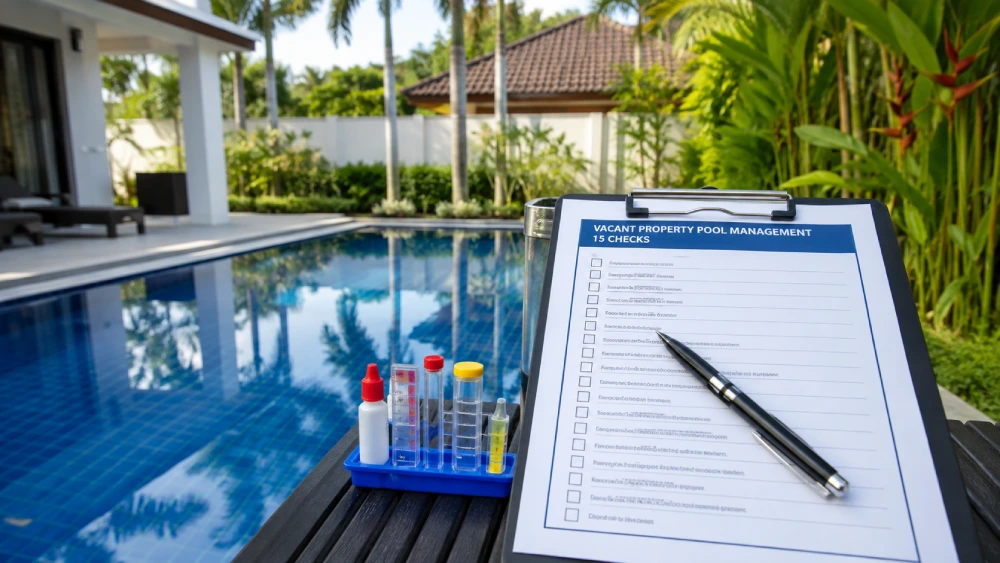
Pool condition connects with security, housekeeping, garden maintenance, utilities, and return preparation. A technically stable pool can still be unsafe if gates fail, surrounding surfaces deteriorate, or chemicals remain unsecured.
A vacant property management service in Phuket can coordinate pool records with security inspections, utility readings, maintenance approvals, and owner updates.
For unoccupied houses, holiday house management in Phuket should define whether pool checks, ventilation, key holding, emergency access, and external inspections are included.
Before occupancy, vacation rental housekeeping in Phuket should be scheduled after disruptive pool and equipment work has finished.
For Airbnb listings, a best airbnb property management company in Phuket should connect pool readiness with reservation dates, guest updates, and maintenance access.
At condominiums, condominium property management in Phuket must establish whether the affected pool is private, communal, or controlled by the development.
Resort villa management in Phuket may include wider coordination between pool care, housekeeping, garden teams, guest preparation, and owner reporting.
These responsibilities should be written into the agreement. Phuket rental-home protection controls should define access, inspections, utilities, equipment care, and emergency escalation.
For higher-service properties, luxury villa management inclusions can clarify whether pool testing, chemicals, equipment work, storm visits, and return preparation are included or separately charged.
Vacant Property Pool Management: Return Readiness
Routine vacancy care does not automatically prepare the pool for immediate use. A separate readiness inspection should be completed before the owner or guests arrive.
The team should confirm clear water, suitable chemistry, normal circulation, clean surfaces, working lights, secure drains, safe surrounding areas, and no unresolved equipment fault.
An early check-in villa in Phuket requires the operations team to confirm whether the pool and property can genuinely be released earlier than planned.
If the pool is green, cloudy, leaking, or chemically unstable, access should remain restricted. A green pool recovery service in Phuket may be needed before the amenity can be returned to use.
Vacant Pool Oversight Across Phuket
Inspection planning should follow access time, property occupancy, vegetation, weather exposure, and equipment condition rather than using one identical schedule for every district.
Remote Northern Properties
Vacant homes in Mai Khao and Thalang may require carefully planned technician access, spare-key control, utility checks, and prompt reporting when owners are abroad.
High-Turnover West-Coast Properties
Bang Tao, Surin, Kamala, Patong, Kata, and Karon properties may need vacancy inspections coordinated between bookings, housekeeping, and guest arrival deadlines.
Garden-Exposed Southern Properties
Rawai, Nai Harn, Saiyuan, Ya Nui, Friendship Beach, and Chalong pools may need the inspection plan to account for each property’s surrounding vegetation, drainage, and time left unoccupied.
Estate and Central Properties
Laguna Phuket, Cherng Talay, Choeng Thale, Kathu, and surrounding areas can include private villas, rental houses, condominium developments, and shared facilities.
The responsible party must be identified before servicing begins. Private and communal pools can follow different access, approval, and maintenance procedures.
Require Evidence From Every Pool Visit
A timer and monthly invoice do not prove that a vacant pool is protected. Owners need measured readings, dated photographs, equipment checks, fault reporting, and clear repair authority.
If an unattended pool lacks this control, arrange green pool recovery service in Phuket support before algae, leakage, or equipment failure turns routine maintenance into urgent recovery.
Frequently Asked Questions
How often should a vacant property pool be inspected?
Inspection frequency depends on the pool system, weather exposure, surrounding vegetation, equipment condition, and vacancy length. A written vacant property pool management schedule should also define additional visits after heavy rain, power failure, equipment warnings, visible water loss, or security incidents. One fixed schedule will not suit every Phuket property.
Should the pool pump run while a property is vacant?
The circulation system should normally follow the operating schedule required by the pool’s design and current water conditions. Turning the pump off for an extended absence may cause stagnation and chemical instability. Under vacant property pool management, technicians must verify pump prime and return flow because an active timer does not prove that water is circulating.
How can owners verify that each pool visit occurred?
Require a dated report containing consistent photographs, chlorine and pH readings, water level, filter pressure, equipment status, chemicals added, and faults found. Utility readings may also be included. A proper vacant property pool management record should show what changed and what action was completed, rather than stating only that the pool was checked.
Can regular inspections prevent a vacant pool turning green?
Scheduled testing, debris removal, filtration checks, and early fault detection can substantially reduce algae risk. However, storms, power interruptions, contamination, and equipment failure may change conditions quickly. Effective vacant property pool management cannot guarantee that algae will never occur, but it should identify warning signs before the water reaches a severe recovery stage.
Should an unused pool be drained during a long vacancy?
Draining should not be the default response simply because nobody will use the pool. Removing a large volume of water may create structural or groundwater concerns depending on the pool and site. Any drainage within vacant property pool management should follow measured water conditions and qualified pool-specific advice, not vacancy length alone.
What repair authority should the manager receive?
The agreement should establish an emergency spending limit and a separate approval process for larger work. Routine adjustments must be distinguished from major leaks, pump failure, electrical risks, and overflow. Clear vacant property pool management should document the diagnosis, estimated cost, owner approval, completed repair, invoice, and final operating check.
What should be checked before the owner or guests return?
A separate readiness inspection should confirm water clarity, operating chemistry, circulation, equipment condition, clean surfaces, working lights, secure drains, gates, and safe chemical storage. The final vacant property pool management report should confirm that every check passed. Routine vacancy visits alone do not prove that the pool is ready for immediate use.