A clear condo handover process protects owners and tenants from disputes over existing defects, missing items, utility usage, cleaning, keys, repairs, and deposit deductions. Condo tenant move-in/move-out inspection management in Phuket creates one reliable condition record using dated photographs, meter readings, inventory checks, access logs, and signed reports.
At move-out, the same evidence helps separate normal ageing from new damage without relying on memory or vague descriptions. When each finding is recorded clearly from the start, both parties can complete the final handover with fewer delays, stronger evidence, and a fairer assessment of responsibility.
Quick Check: Before appointing a local manager, get condo tenant move-in move-out inspection management in Phuket with joint condition reports, dated inspection evidence, key control, meter records, and itemised move-out findings.
Condo Tenant Move-In Move-Out Inspection Management In Phuket

A complete inspection system covers three connected phases: written lease and building controls, the move-in condition baseline, and the final move-out comparison. Each phase must produce records that both parties can review and retain.
Condo Inspection Control Map
| Inspection stage | Main risk | Required action | Evidence retained |
| Before signing | Wrong owner, unclear authority, verbal promises | Verify authority and written terms | Identification, lease and written approvals |
| Before move-in | Existing defects become disputed | Complete a joint walkthrough | Signed condition report |
| Key handover | Missing cards, remotes or keys | Count and test every access item | Handover register |
| Utility handover | Previous usage is charged to the tenant | Record meter number and reading | Dated meter photographs |
| During tenancy | Leaks or deterioration go unreported | Record faults and repairs promptly | Messages and maintenance history |
| Pre-move-out | Tenant has no time to correct minor issues | Complete a preliminary walkthrough | Pre-move-out checklist |
| Final inspection | Furniture or belongings hide damage | Inspect the empty, cleaned unit | Final photographs and report |
| Deposit review | Wear is confused with damage | Compare item by item | Original and final evidence |
| Handover closure | Condition changes after inspection | Control keys and later access | Final access record |
The wider Phuket condo management inclusions should connect tenant records, keys, building procedures, inspections, maintenance, move-out coordination, and owner reporting.
One Report Must Control the Tenancy
The move-in condition report should remain the main reference from the first walkthrough to the final handover. Creating separate documents with different wording, photographs, or inventory descriptions weakens the evidence.
The report should identify:
- Condo development and unit number
- Inspection date and time
- Owner or authorised representative
- Tenant
- Attending manager or agent
- Lease start and end dates
- Room-by-room condition
- Included furniture and appliances
- Existing defects
- Utility readings
- Keys, cards and remotes
- Building or parking items
- Photographic file reference
- Comments from either party
- Signatures and copy delivery
The property management company operating workflow should keep tenancy documents, inspections, contractor tasks, owner approvals, and final reports within one controlled record.
Condo Tenant Inspections: Legal Checks
Inspection procedures should match the signed lease, current Thai requirements, owner authority, and the condominium’s own rules. Generic online statements about fixed deposit limits or refund deadlines should not replace current legal review.
Verify the Owner and Authority
Before taking a deposit or handing over the unit, confirm who owns the condo and who has authority to sign, receive funds, approve repairs, and return the deposit.
The tenant or manager should compare:
- The name in the lease
- Owner identification
- Relevant ownership evidence
- Agent authority, where used
- Payment-account details
- Unit and development information
- Contact details for notices
- The party responsible for returning funds
PEARL’s property management services for tenant inspections in phuket should keep the authority check connected to the lease, inspection record, payment trail, maintenance approvals, and owner reporting.
An electricity bill, identification copy, or ownership document should not be treated as complete proof on its own. The records should support one another and any mismatch should be clarified before payment.
Put Every Promise in Writing
A verbal promise about cleaning, repairs, deposits, air-conditioning service, replacement furniture, utility charges, or access can become difficult to enforce later.
The Phuket property management contract terms should define inspection authority, access notice, tenant obligations, repair approval, condition reporting, deposit handling, and final handover.
Written terms should clarify:
- Who pays each utility
- How readings are taken
- Who handles routine maintenance
- How urgent repairs are approved
- Whether the tenant may arrange repairs
- Cleaning expectations
- Air-conditioning servicing
- Pet and smoking rules
- Occupancy limits
- Inspection notice
- Key and card replacement
- Deposit assessment
- Final handover procedure
The property management duty framework should assign responsibility for preparing the unit, documenting condition, coordinating access, reporting faults, and retaining owner records.
Avoid Unsupported Deposit Claims
The supplied research contains conflicting information about common deposits and refund periods. Neither a seven-day period, a fourteen-day period, nor one specific deposit formula should be published as a universal Phuket rule without current authoritative confirmation.
A safer inspection process is to:
- State the agreed deposit terms in writing
- Record the property condition accurately
- Separate normal wear from new damage
- Obtain a clear cost basis for deductions
- Identify disputed and undisputed amounts
- Check current Thai requirements before setting deadlines
- Give both parties the final calculation
The inspection manager should document facts, not provide unverified legal conclusions.
Coordinate With the Juristic Office
Condo move-ins and move-outs may involve access cards, parking permits, lift protection, furniture-moving periods, contractor registration, loading areas, and building rules.
The Phuket condo tenant handling process should connect tenant onboarding with building access, rule communication, maintenance, inspections, and final handover.
Before move-in, confirm:
- Approved tenant details
- Access-card activation
- Parking arrangements
- Furniture-moving rules
- Lift-booking procedures
- Contractor access
- Common-area restrictions
- Contact details for building management
Before move-out, confirm the return of building property and any recorded access or common-area issue. Do not automatically deduct a building charge without supporting documentation.
Condo Tenant Inspections: Move-In Proof
The move-in inspection creates the condition baseline for the whole tenancy. It should test how the condo functions, not merely record that furniture and appliances appear to be present.
Complete a Joint Walkthrough
The owner, authorised manager, or agent should walk through the condo with the tenant before the final key handover where practical.
Use the same room order throughout the report:
- Entrance and access
- Living room
- Kitchen
- Bedrooms
- Bathrooms
- Balcony
- Storage areas
- Furniture and appliances
- Utilities
- Keys and building items
The rental property inspection checklist should cover walls, floors, windows, doors, furniture, appliances, plumbing, air conditioning, safety, cleanliness, and visible maintenance needs.
Descriptions should be precise. Replace “wall damaged” with wording such as “two paint chips beside the bedroom wardrobe, approximately level with the middle shelf.”
Build a Useful Photograph File
General room photographs help with orientation, but they do not prove the condition of a disputed item. Each existing defect needs a close image and a wider image showing its location.
The photograph file should include:
- Unit entrance
- Every wall and ceiling
- Flooring and skirting
- Doors and locks
- Windows and screens
- Cabinets and drawers
- Areas under sinks
- Bathrooms and grout
- Furniture surfaces
- Mattresses and linen
- Appliances
- Air-conditioning units
- Balcony and railings
- Meter readings
- Keys and access cards
- Existing damage
The Phuket rental-home protection controls should combine dated photographs with inventory records, signed reports, maintenance history, tenant obligations, and final inspection evidence.
Both parties should receive or be given reliable access to the same final media set.
Test Water and Plumbing
A visual check will not reveal poor water pressure, slow drainage, leaking joints, drain smells, or water-heater problems.
During the walkthrough:
- Run every tap
- Test hot water
- Flush each toilet
- Check shower drainage
- Look under sinks
- Inspect cabinet bases
- Check ceilings for stains
- Test visible stop valves where appropriate
- Record smells or moisture
- Note old sealant or swelling
A small leak can damage cabinets gradually. If the original report shows swelling, stains, or previous moisture, that evidence becomes important during the move-out comparison.
Test Air Conditioning and Appliances
An appliance should not be marked “good” merely because it switches on.
Check:
- Air-conditioning cooling
- Unusual AC noise
- Water leakage
- Remote-control operation
- Refrigerator cooling
- Freezer condition
- Washing-machine cycles
- Water-heater function
- Hob and extractor
- Microwave
- Television
- Lights and sockets
- Included small appliances
The Phuket apartment rental operating workflow should link tenant preparation, condition evidence, maintenance, communication, rent periods, and final handover.
Where useful, record appliance brands, models, serial numbers, existing marks, missing accessories, and prior repair information.
Record Utilities Together
Water and electricity disputes often begin with an unclear opening reading or the wrong meter.
Both parties should record:
- Meter type
- Meter number
- Unit connected to the meter
- Reading
- Date and time
- Clear photograph
- Billing arrangement
- Outstanding previous account where relevant
Do not estimate the opening figure. The move-out reading should be taken through the same process so both records can be compared.
Count Keys, Cards and Remotes
Every physical access item should appear on the handover register.
PEARL’s tenant key handover and check-in inspection service in phuket should record unit keys, mailbox keys, access cards, parking passes, gate remotes, appliance remotes, and emergency access instructions.
Each item should be tested where practical. A card that is listed but inactive has not been properly handed over.
Check Noise, Pests and Shared Areas
Some conditions are outside the condo but still affect the tenancy. The move-in record should separate them from defects within the unit.
Check:
- Proximity to rubbish rooms
- Lift or plant-room noise
- Road noise
- School or construction noise
- Common-area smells
- Damp corridors
- Pest activity around drains
- Condition of shared access
- Parking access
- Building maintenance work
The Phuket apartment property management structure should distinguish unit condition from wider building operations while keeping both visible to the owner.
Adapt Checks to the Property
A condo checklist should not be copied unchanged from a villa, house, or holiday rental because the assets and responsibilities differ.
A process for villa tenant move-in move-out inspection management in phuket may include private pumps, gates, larger outdoor areas, standalone utility systems, and full-site security.
Similarly, house tenant move-in move-out inspection management in phuket may require checks for roofs, driveways, external walls, private water systems, gardens, storage buildings, and perimeter access.
For furnished holiday use, short-term rental move-in move-out inspection management in phuket may involve a new condition check after every short stay rather than one baseline for a long tenancy.
The inspection template must match the actual condo, included assets, lease length, and building responsibilities.
Condo Tenant Inspections: During Tenancy
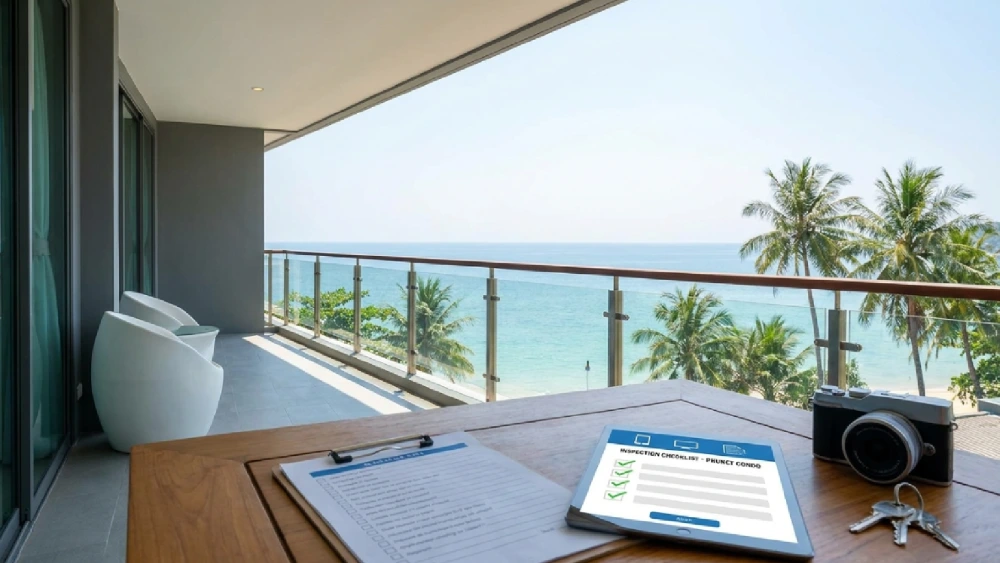
The condition record must remain active after move-in. Leaks, mould, appliance faults, replacement items, lost cards, and maintenance work should be added to the tenancy history as they occur.
Record Problems When They Begin
Tenants should report developing damage promptly rather than waiting until move-out.
Examples include:
- Water under a sink
- Swelling cabinets
- Mould
- Bubbling paint
- AC leakage
- Pest activity
- Broken appliance parts
- Loose furniture
- Window or lock faults
- Balcony drainage problems
The Phuket property management responsibility scope should assign tenant communication, maintenance coordination, key control, inspection records, damage reporting, and owner updates.
The manager should record when the problem was reported, what evidence was received, who inspected it, what action was approved, and whether the repair was completed.
Update the Inventory After Repairs
If an appliance, mattress, table, remote, lock, or access card is replaced, the original inventory becomes outdated.
Add:
- Item removed
- Reason
- Replacement item
- Date
- Condition
- Model or serial number
- Cost where relevant
- Owner approval
- Contractor details
- Updated photograph
This prevents the final inspector from comparing the wrong item against the original report.
Do Not Allow Unauthorised Repairs
A tenant may attempt a quick repair to avoid a deduction, but an unsuitable repair can worsen the condition or make the cause harder to determine.
The tenant should report the issue and obtain written approval before altering a fixture, appliance, cabinet, wall, floor, lock, plumbing connection, or electrical item.
The rental property repair responsibility should clarify who inspects the fault, approves work, appoints the contractor, and records completion.
Condo Tenant Inspections: Move-Out Proof
The move-out process should give the tenant a chance to prepare, then compare the empty unit against the original condition record. It should not begin with a deduction amount.
Schedule a Preliminary Walkthrough
A preliminary walkthrough before the final handover can identify:
- Missing items
- Required cleaning
- Personal alterations
- Obvious new damage
- Unreturned building property
- Outstanding repairs
- Utility arrangements
- Access-card issues
It gives the tenant time to address agreed minor matters. It should not be treated as the final condition assessment because belongings may still hide walls, floors, cabinets, and appliances.
The good Phuket property management standards should include consistent checklists, clear communication, detailed photographs, named responsibility, accurate reports, and repair follow-up.
Inspect an Empty, Cleaned Unit
The final inspection should happen after personal belongings are removed and agreed cleaning is completed.
PEARL’s move-in move-out housekeeping inspection services in phuket should verify kitchens, bathrooms, cupboards, refrigerator interiors, floors, grout, curtains, balconies, linen where included, and cleaning-related deductions.
Inspecting before cleaning makes it difficult to separate removable dirt from permanent damage. Inspecting while boxes remain can hide walls, flooring, furniture, and missing inventory.
Compare in the Same Room Order
Use the original report, photographs, inventory, and maintenance history. Compare each room in the same sequence used at move-in.
Move-Out Comparison Table
| Finding | Evidence required | Normal handling |
| Existing scratch | Move-in photograph and report | No new damage deduction |
| Faded paint | Age, exposure and original condition | Assess as possible normal ageing |
| Broken appliance | Original test, maintenance history and final test | Identify cause and repair responsibility |
| Swollen cabinet | Move-in condition, leak records, material and location | Assess moisture, age and tenant conduct |
| Missing key or card | Signed handover register | Confirm replacement basis |
| Cleaning issue | Final photographs and cleaning standard | Separate from physical damage |
| Missing item | Signed inventory and move-out evidence | Establish item and condition |
| New wall hole | Original wall photograph and final close-up | Assess repair requirement |
| Utility balance | Opening and final meter records | Calculate from agreed terms |
| Building charge | Juristic office evidence | Verify before passing on |
Descriptions should explain the item, location, visible condition, and difference from move-in. Avoid labels such as “bad condition” without supporting detail.
Separate Wear From Damage
Normal wear and tenant damage cannot be decided by one photograph alone.
Consider:
- Age
- Original condition
- Material quality
- Normal use
- Location
- Humidity exposure
- Maintenance history
- Previous repairs
- Reported leaks
- Tenant actions
- Length of tenancy
- Whether deterioration was reported
An older particleboard cabinet beside a wet area may fail from age, material choice, moisture, poor sealing, a leak, tenant neglect, or a combination of factors. The decision must follow the evidence.
Inspect Specialist Areas
Some condos include private terraces, plunge pools, roof areas, or garden spaces that need specialist condition checks.
A move-in move-out pool condition inspection service in phuket may document water condition, pump operation, visible surfaces, lighting, covers, controls, and maintenance history for a private pool.
A move-in move-out garden condition inspection service in phuket may record private terrace planting, irrigation, pots, trees, drainage, lighting, furniture, and storm-related damage.
Common facilities controlled by the condominium should be recorded separately from owner-controlled private areas.
Record Disagreement on the Report
Neither party should sign a blank, incomplete, or vaguely worded report.
Where the parties disagree:
- Record both positions
- Identify the disputed item
- Reference the photographs
- Avoid inserting a final cost without evidence
- Do not leave empty spaces
- Date each change
- Give both parties the completed copy
- Photograph or digitally preserve the signed version
A signed report should not be changed later without a visible record and acknowledgement.
Calculate Deductions Item by Item
Deposit deductions should not begin with a round amount.
For each proposed deduction, show:
- Item or area
- Move-in condition
- Move-out condition
- Reason responsibility is attributed
- Whether wear or age was considered
- Repair or replacement basis
- Quote, invoice, or assessment
- Amount proposed
- Disputed or agreed status
Do not combine cleaning, missing inventory, utility bills, access-card charges, and repairs into one unexplained figure.
A full new replacement cost should not be applied automatically to an old item without considering its age, previous condition, and the appropriate repair or valuation basis.
Close Access After Handover
Once the final inspection is complete, control who enters the unit.
Record:
- All returned keys
- All cards and remotes
- Date and time possession returned
- Final meter readings
- Final photographs
- Contractors authorised after inspection
- Work completed before the next tenant
- Owner approval
- Updated inventory
This prevents later work or access from being confused with the tenant’s final condition.
Condo Inspection Coverage Across Phuket
Local inspections require staff who can attend the unit, coordinate with the juristic office, test equipment, document condition, and return for the final handover.
PEARL supports condo inspections across Bang Tao, Laguna Phuket, Cherng Talay, Surin, Kamala, Patong, Kata, Karon, Rawai, Nai Harn, Ya Nui, Friendship Beach, Chalong, Saiyuan, Kathu, Thalang, Mai Khao, and surrounding Phuket areas.
Available across Bang Tao, Rawai, Nai Harn, Kamala, Surin, Patong, Chalong, Kata, Karon, Mai Khao, Laguna, Kathu, Thalang, Cherng Talay, and surrounding areas in Phuket.
Protect the Condo at Every Handover
Reliable condo tenant move-in move-out inspection management in Phuket gives owners and tenants one clear condition baseline, consistent evidence, controlled key records, and a fair final comparison. Owners can get condo tenant move-in move-out inspection management in phuket without personally arranging every inspection, juristic office visit, meter reading, contractor check, or handover report. PEARL Phuket Property keeps the process documented from the first walkthrough to the final key return. We manage. You relax.
FAQs
Should Move-In Move-Out Inspection Management Verify the Condo Owner?
Yes. Before signing the lease or transferring funds, the inspector should confirm that the person acting for the condo has valid authority. Move-in move-out inspection management should compare identification, ownership evidence, lease details, agent authority, and payment instructions. Any mismatch between names, documents, or bank-account information should be clarified before the tenant accepts the keys or pays the deposit.
How Should Humidity Damage Be Recorded During Inspections?
Humidity-related damage should be documented with clear close-up and wider photographs showing its exact location. The move-in move-out inspection management record should describe swelling, mould, bubbling paint, damaged sealant, stains, soft materials, and moisture near sinks, windows, bathrooms, or air-conditioning lines. Item age, material, previous condition, and maintenance history should also be included to support a fair comparison later.
Should Every Appliance Be Tested During the Inspection?
Every appliance included in the lease should be tested where practical. Effective move-in/move-out inspection management goes beyond checking whether an appliance switches on. The inspector should test its main function, controls, cooling or heating performance, unusual noise, leakage, visible damage, and included accessories. These results create a baseline that can be compared with the appliance’s condition at move-out.
What Happens When Move-In Photographs Are Missing?
The inspector should not assume that the condo began the tenancy in perfect condition. When photographs are unavailable, move-in move-out inspection management should rely on the signed report, inventory, maintenance records, tenancy messages, other dated images, item age, and available supporting evidence. Missing photographs weaken the condition baseline, so any later damage finding or deduction should reflect that uncertainty.
Can Mould Automatically Be Treated as Tenant Damage?
No. Mould may result from poor ventilation, leaks, air-conditioning drainage, building defects, humidity, material quality, delayed maintenance, or tenant behaviour. A fair move-in move-out inspection management process should record the affected location, previous condition, maintenance history, reporting timeline, and likely cause. Responsibility should be assigned only after those factors are reviewed together, rather than from appearance alone.
How Should Inspection Disagreements Be Documented?
Any disagreement should be written directly into the final condition report before it is signed. The move-in move-out inspection management record should identify the item, each party’s position, the photographs being referenced, and whether repair responsibility or cost remains unresolved. Both parties should receive the completed copy immediately, with no blank spaces, vague descriptions, or later undocumented changes.
Should the Inspection Manager Set a Deposit Deadline?
The manager should not repeat an unverified standard deadline. Move-in/move-out inspection management should follow the signed lease and current, properly verified Thai requirements. Before confirming a return date, the manager should complete the condition comparison, calculate supported repair costs, separate disputed and undisputed amounts, confirm outstanding utility or building charges, and check the applicable legal position.