Housekeeping services in Phuket can run out of towels, toiletries, cleaning products, or approved linen even when the storeroom looks full. The problem usually comes from weak records, mixed property stock, unchecked deliveries, laundry discrepancies, or supplies removed without a booking reference.
During back-to-back stays, one missing item can delay room setup and trigger an expensive emergency purchase. Housekeeping inventory management in Phuket solves this by linking every item to a property, storage location, turnover, staff handover, supplier movement, and owner report. The useful question is simple: can every important item be counted and explained?
Quick Check: Before appointing a provider, take control of housekeeping inventory in Phuket by checking property-level stock records, booking reservations, laundry reconciliation, access logs, and purchase approvals.
Housekeeping Services in Phuket: Stock Framework
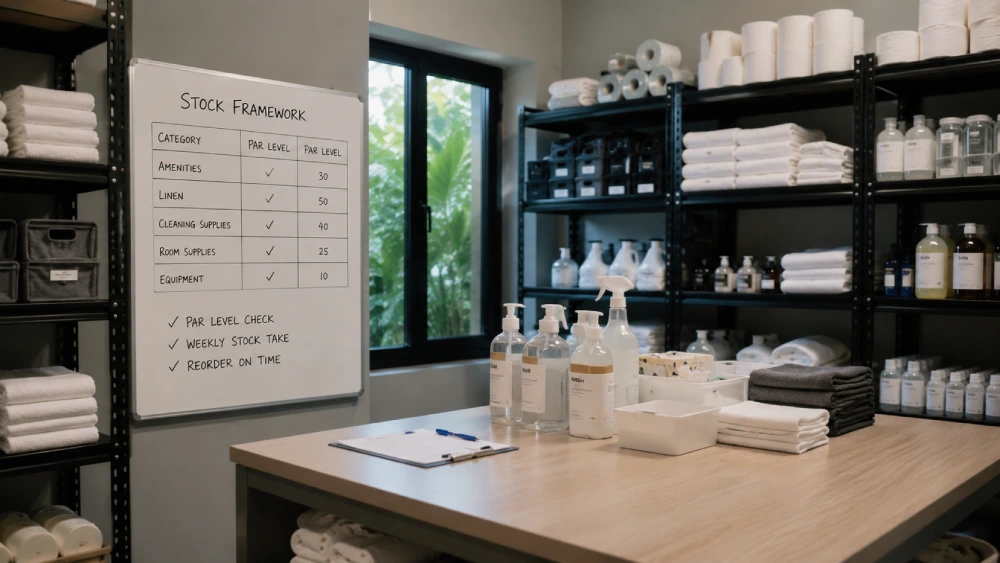
Reliable stock control starts with a property-specific register and realistic minimum levels. The framework below separates what the property owns from what is clean, reserved, at the laundry, damaged, missing, or available for the next turnover.
Housekeeping Inventory Control Framework
| Inventory stage | Main risk | Required control | Evidence retained |
| Master register | The property does not know what it owns | Record each item, type, size and owner | Inventory master |
| Stock planning | A generic quantity is used | Calculate requirements from real demand | Stock-level plan |
| Booking allocation | Stock appears available but is already needed | Reserve supplies for each turnover | Booking allocation |
| Staff issue | Products leave storage without records | Record issues, returns and consumption | Stock issue sheet |
| Property transfer | One villa uses another owner’s supplies | Authorise and record every transfer | Transfer record |
| Laundry dispatch | Linen leaves without a count | Count by property, item and size | Laundry dispatch |
| Supplier delivery | Incorrect quantities are accepted | Match the order, delivery and invoice | Delivery inspection |
| Clean storage | Moisture or poor separation damages stock | Inspect storage conditions | Storage record |
| Physical audit | Records do not match the shelves | Compare expected and actual balances | Variance report |
| Purchasing | Staff place duplicate or unapproved orders | Set purchase limits and approvals | Purchase authorisation |
| Loss review | Missing items are blamed on staff too quickly | Investigate the full movement chain | Loss report |
| Owner reporting | Purchases rise without explanation | Report every movement by property | Owner stock summary |
Build One Property Inventory Master
A housekeeping inventory register should identify each item precisely. Broad labels such as “linen,” “toiletries,” or “cleaning products” are not enough to investigate shortages or plan a turnover.
The register should show:
- Item name
- Category
- Sheet or towel size
- Product specification
- Property owner
- Property allocation
- Storage location
- Current quantity
- Condition
- Stock status
- Minimum level
- Last physical count
- Replacement responsibility
The Phuket property management responsibility scope should identify who maintains this register, checks supplier deliveries, approves purchases, investigates losses, and reports the closing balance.
Owners comparing property management services in phuket should check whether inventory is recorded by individual property. A shared list covering several villas cannot show which owner paid for a missing sheet, replacement appliance, or emergency amenity order.
The Phuket villa asset-protection controls should include linen, housekeeping equipment, keys, guest supplies, cleaning products, and other property-owned stock. These items may have a lower individual value than furniture, but repeated unexplained replacement creates a significant operating cost.
Separate Inventory by Current Status
A property may own enough linen on paper but still lack a complete guest-ready set.
Each item should be assigned to a clear status:
- Approved and available
- Reserved for an upcoming booking
- Currently in guest use
- Dirty and waiting for collection
- At the laundry
- In transit
- Waiting for rewash
- Waiting for repair
- Damaged
- Expired
- Missing
- Retired
Only approved, clean, correctly sized items should count as available for room setup. Damp sheets, stained towels, broken tools, and products with damaged packaging should not remain inside the usable total.
Set Stock From Real Property Demand
A universal three-par, four-par, or five-par rule should not be imposed on every property. A compact condominium with weekly stays has different needs from a six-bedroom pool villa with frequent back-to-back bookings.
Stock planning should consider:
- Maximum occupancy
- Number and size of beds
- Bath and pool-towel requirements
- Average stay length
- Turnover frequency
- Same-day bookings
- Laundry return time
- Supplier delivery time
- Historic damage and rejection
- Seasonal booking demand
- Storage capacity
- Emergency requirements
Owners using villa management services in phuket should receive a stock plan based on the villa’s rooms, occupancy, laundry cycle, and booking pattern.
The Phuket short-term rental management operations should connect booking schedules with linen and amenity requirements. Stock that appears available today may already be required for two arrivals tomorrow.
Protect Premium Villa Inventory
Luxury properties may use premium linen, larger towel sets, branded toiletries, specialist cleaning products, decorative fabrics, and room-specific guest items.
The luxury villa management inclusions should define:
- Which items belong to the owner
- Which items belong to a supplier
- Approved brands and specifications
- Room-level quantities
- Replacement standards
- Storage requirements
- Purchase authority
- Owner reporting
Premium items should not move into another managed property without a recorded transfer and clear cost allocation.
Reserve Stock for Each Booking
The housekeeping team should not arrive at the property and then discover what the booking requires.
Before the turnover begins, confirm:
- Number of guests
- Length of stay
- Bed configuration
- Extra-bed requirements
- Children’s bedding
- Bath-towel quantities
- Pool towels
- Toiletries
- Drinking water
- Kitchen supplies
- Welcome products
- Special detergent requests
The required stock should then be reserved for that booking. Staff should not use reserved stock for another property without authorisation.
An airbnb property management housekeeping in phuket process should connect each confirmed booking with the linen, towels, amenities, and cleaning supplies needed for setup.
The Phuket Airbnb villa-owner support becomes especially important when extensions, cancellations, extra guests, or early arrivals change stock requirements after the original plan was issued.
Record Every Staff Issue and Return
Housekeeping products often disappear from records because staff remove items informally.
The issue sheet should show:
- Date and time
- Property
- Booking or task
- Item
- Quantity issued
- Person receiving it
- Quantity returned
- Quantity consumed
- Damage or spillage
- Approving person
Unused stock should return to the correct property balance. It should not remain in a vehicle, cleaner’s bag, shared cupboard, or another villa’s storeroom.
A controlled property management company operating workflow should connect supply requests, approval, delivery, storage, staff issues, physical counts, invoices, and owner reports.
Set Approved Guest Amenity Levels
Guest amenities should not depend on which housekeeper prepares the room.
Approved quantities should reflect:
- Number of guests
- Booking length
- Property promise
- Product size
- Mid-stay replenishment policy
- Owner budget
- Emergency reserve
The list may include toilet paper, soap, shampoo, drinking water, coffee, tea, sugar, rubbish bags, dishwashing products, kitchen basics, and welcome items.
A provider offering housekeeping services in phuket should record the quantities placed in the property and any extra stock issued during the stay.
Consistent quantities help managers compare amenity use between bookings. They also show whether repeated emergency purchases come from genuine demand, staff over-issuing, weak records, or an unrealistic minimum level.
Track Cleaning Products Separately
Cleaning products should have their own register because they create different storage, safety, and consumption issues from linen or guest amenities.
Record:
- Product name
- Container size
- Intended surface or task
- Quantity received
- Quantity issued
- Remaining quantity
- Opening date where relevant
- Storage location
- Reorder level
- Leakage or damage
Products transferred into smaller containers should remain clearly identified. Unlabelled bottles make consumption harder to trace and increase the risk of the wrong product being used on a surface.
Reduce Waste Without Creating Shortages
Good inventory control reduces duplicate buying, expired products, excessive emergency orders, and unnecessary linen replacement.
The property management cost-cutting methods should focus on measured consumption rather than simply purchasing cheaper products.
Useful controls include:
- Reviewing consumption by turnover
- Returning unused stock
- Rotating older suitable supplies
- Separating damaged items
- Investigating frequent shortages
- Matching invoices to accepted deliveries
- Recording supplier credits
- Setting approval limits
Buying a large quantity because the unit price is lower may increase waste when the property lacks suitable storage or uses the product slowly.
Housekeeping Services in Phuket: Laundry Logistics
Linen inventory moves through rooms, dirty storage, transport, commercial laundry, return inspection, clean storage, and the next booking. Every handover needs a count because a laundry receipt alone cannot confirm which items returned.
Separate Every Property and Linen Batch
Multi-property management creates a risk that identical white sheets and towels will move between villas without any record.
Each batch should identify:
- Property
- Collection date
- Batch number
- Bag number
- Item type
- Item size
- Quantity
- Known stains
- Known damage
- Supplier destination
Property codes, washable labels, separate bags, or another reliable identification method can help preserve ownership.
Beachfront and pool properties need separate categories because pool towels, bath towels, and bed linen face different use conditions.
The Phuket beachfront villa management operations should account for sand, salt residue, damp outdoor textiles, sunscreen marks, and increased towel movement.
The Phuket pool-villa management need includes separate control of pool towels, poolside amenities, and stock issued for outdoor guest use.
A pool cleaning service in phuket may coordinate poolside readiness, but housekeeping should still record how many towels and guest items are issued, returned, damaged, or missing.
Reconcile the Full Linen Chain
Linen should be counted at every stage. Waiting until the next turnover makes it difficult to establish where a shortage occurred.
Linen Movement Reconciliation
| Linen stage | Record required | Main check |
| Removed from room | Room removal count | Does the count match the setup? |
| Dirty storage | Property and bag record | Is linen separated correctly? |
| Supplier dispatch | Item and size count | What physically left the property? |
| Supplier intake | Acknowledged quantity | Does the laundry agree with the dispatch? |
| Supplier return | Returned quantity | Are items missing or substituted? |
| Quality inspection | Accepted and rejected count | Is the linen clean, dry, and usable? |
| Clean storage | Available balance | Was approved stock placed correctly? |
| Booking issue | Room setup count | What was used for the next arrival? |
Returned linen should be checked for:
- Correct property
- Correct item type
- Correct size
- Complete quantity
- Stains
- Dampness
- Musty odours
- Tears
- Chemical marks
- Foreign items
A bag or weight total may support supplier billing, but it cannot confirm that the correct sheets, pillowcases, towels, and protectors returned.
Check Supplier Deliveries Before Signing
Housekeeping inventory includes purchased supplies as well as laundry returns.
Before accepting a delivery:
- Match it with the approved purchase request.
- Check the supplier order.
- Count the physical delivery.
- Check product names and sizes.
- Inspect packaging.
- Record substitutions.
- Separate damaged items.
- Record shortages.
- Request credits where required.
- Update stock only after acceptance.
The final invoice should reflect the quantity and condition actually accepted.
Supplier staff should not be allowed to place products directly into general storage without a receiving check. Otherwise, incorrect items can be counted as available before anyone notices the discrepancy.
Plan Laundry Around Turnovers
The incoming guest should use already approved clean linen. The outgoing guest’s batch should support a later booking.
This protects the turnover when:
- Collection is delayed
- Laundry processing takes longer
- Stains need additional treatment
- Items return damp
- The supplier returns the wrong size
- Part of the batch is missing
- Several items fail inspection
A late laundry delivery should trigger a controlled reserve release rather than an unrecorded transfer from another property.
The Phuket property-management emergency response should define who can approve urgent replacement linen, emergency transport, or backup supplier use.
A 24 hour check-in service villa in phuket should receive final confirmation that the required linen, towels, access items, and guest supplies are present before a late-night arrival.
Control Condominium Inventory
Condominiums may have limited cupboards, restricted contractor access, shared lifts, parking rules, and designated delivery times.
The Phuket condo management inclusions should connect unit cleaning with linen storage, keys, access cards, deliveries, and guest readiness.
Owners using condominium property management services in phuket should confirm:
- Where clean linen is stored
- Where dirty linen waits
- Who can access the cupboard
- How deliveries enter the building
- How keys and cards are counted
- How emergency stock is protected
Limited storage makes accurate minimum levels more important. Overstock can block access and hide older supplies, while understock can delay the next setup.
Control Apartment Rental Stock
The Phuket apartment rental operating workflow should connect checkout, inventory inspection, cleaning, restocking, linen setup, and approval before the next occupancy.
Apartment stock should be recorded by unit even when supplies are purchased in bulk.
Shared products need an allocation method based on actual issues or another documented basis. One owner should not absorb costs simply because the main storeroom is located inside their building.
Control House and Vacant-Property Stock
Long-term houses may use fewer guest amenities, but their linen, cleaning equipment, keys, and stored supplies still require inspections.
Owners using house management services in phuket should check:
- Musty linen
- Pest activity
- Leaking products
- Damp walls
- Damaged packaging
- Missing keys
- Expired supplies
- Unrecorded staff use
- Stock needed before the owner returns
A vacant property should not be treated as fully stocked simply because no recent guest turnover has occurred.
Coordinate Garden and Outdoor Supplies
Housekeeping inventory may include entrance mats, outdoor towels, bin liners, terrace-cleaning products, protective covers, and other supplies affected by garden or pool work.
A garden maintenance service in phuket should coordinate irrigation, leaves, soil, storm debris, and wet paths before final housekeeping approval.
Outdoor teams should not take housekeeping tools, chemicals, or guest supplies without a recorded issue. Shared use makes it harder to understand which service consumed the stock.
Housekeeping Services in Phuket: Storage Audits
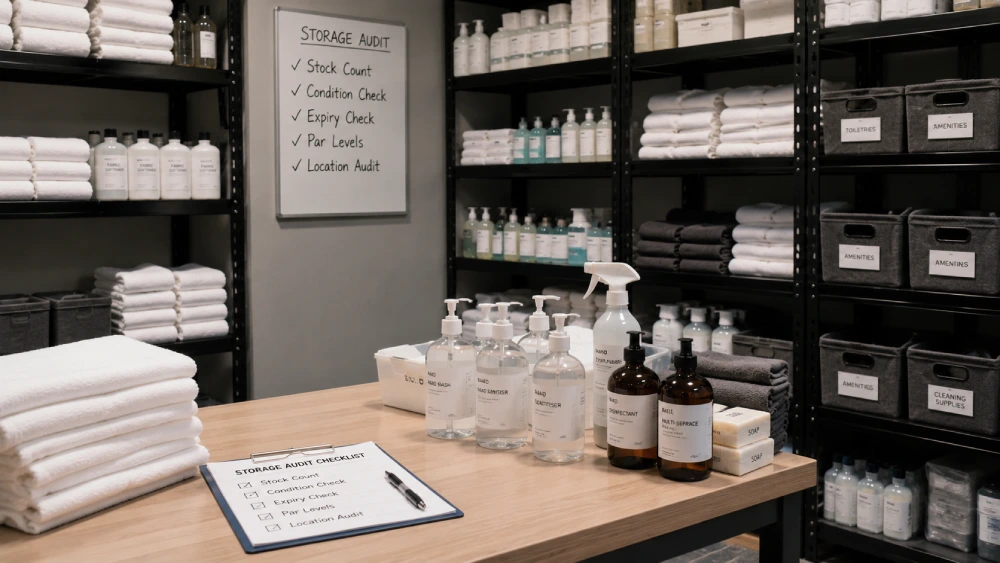
Storage and audit controls show whether recorded stock physically exists and remains usable. Phuket’s humidity increases the need for dryness checks, while controlled access and clear variance reviews help prevent assumptions about loss or misuse.
Protect Inventory From Moisture
Clean linen, paper products, guest amenities, and cleaning chemicals need different storage conditions, but all should be protected from obvious moisture, leaks, pests, and contamination.
Good storage practice includes:
- Keeping stock off the floor
- Preventing contact with damp walls
- Separating chemicals from linen
- Separating guest amenities from cleaning products
- Using labelled shelves
- Keeping property stock distinct
- Isolating leaking containers
- Removing damaged packaging
- Restricting unnecessary access
- Recording storage inspections
The Phuket rental-home protection controls should include storerooms because a small leak or moisture problem can affect several categories before it is visible elsewhere.
A specific storage device should be chosen from actual conditions. One property may need improved ventilation, while another may need stronger moisture control or repairs to stop water entering the room.
Rotate Stock Without Hiding Damage
Older suitable stock should normally be used before newer stock, but age alone should not decide whether an item remains usable.
Check:
- Packaging condition
- Product expiry
- Linen odour
- Linen staining
- Container leakage
- Tool condition
- Pest evidence
- Moisture damage
A damaged older product should be removed from normal use rather than issued simply to preserve rotation.
Conduct Risk-Based Physical Audits
High-use, high-value, or frequently missing items should be counted more often than stable products with restricted access.
The audit frequency should reflect:
- Consumption
- Item value
- Number of users
- Property transfers
- Supplier lead time
- Laundry movement
- Previous discrepancies
- Booking frequency
The rental property inspection checklist should include linen quantities, towels, toiletries, keys, cleaning equipment, damaged stock, and storage conditions where relevant.
Inventory Balance Formula
Use a simple reconciliation:
Opening balance + accepted deliveries + authorised transfers in − issued stock − authorised transfers out − approved losses = expected closing balance
The expected balance should then be compared with the physical count.
A difference does not automatically prove misuse. It shows that the movement records and physical stock require review.
Stock Variance Decision Matrix
| Audit finding | Likely control issue | Required response |
| Physical stock is below the record | Unrecorded use, transfer, loss, or delivery error | Review the full movement chain |
| Physical stock exceeds the record | Delivery or return was not entered | Verify ownership before adjusting |
| Wrong property owns the item | Unrecorded transfer | Correct allocation and costs |
| Damaged stock remains available | Status was not updated | Isolate and adjust usable quantity |
| Reserved stock appears available | Booking allocation was ignored | Protect the reservation |
| Laundry stock is counted twice | Status categories overlap | Correct the inventory stage |
| Open containers are counted as full | Measurement method is weak | Apply a consistent estimation method |
| Repeated emergency purchasing occurs | Minimum level or supplier timing is wrong | Review reorder planning |
| Supplier credits are missing | Invoice reconciliation is incomplete | Follow up and report the credit |
| Variance repeats in one category | Process failure is recurring | Review access, issue, and count controls |
Investigate Missing Stock Before Assigning Blame
A missing item may have been:
- Issued without a record
- Transferred to another property
- Held by the laundry
- Rejected after cleaning
- Delivered short
- Damaged and discarded
- Used during a longer stay
- Taken by a guest
- Stored in the wrong location
- Counted incorrectly
The investigation should review:
- Previous physical count
- Staff issue records
- Property transfers
- Laundry dispatch and return
- Supplier deliveries
- Damage and disposal records
- Booking allocation
- Access logs
- Current storage search
- Supporting photographs or documents
Access evidence should support the review without being treated as automatic proof of responsibility.
Restrict Storeroom Access
The access record should identify:
- Person entering
- Role
- Entry time
- Exit time
- Reason
- Key or code used
- Stock removed
- Stock returned
- Incident reported
Keys and access codes should be reviewed when staff leave or change responsibilities.
Temporary workers should receive only the access required for their assigned task. Unrestricted access makes stock investigations harder and increases uncertainty.
Define Purchasing Authority
Routine restocking and emergency purchasing need different approval levels.
The Phuket property management contract structure should define:
- Stock ownership
- Routine purchase limits
- Emergency purchase limits
- Approved brands
- Substitution rules
- Bulk-order approval
- Replacement responsibility
- Supplier credits
- Storage responsibility
- Owner reporting
Staff should not replace a standard product with a more expensive alternative without recording the reason and approval.
Use Digital Records With Clear Ownership
Digital tools can connect bookings, stock issues, laundry movement, supplier deliveries, and owner reports. They can also create inaccurate balances when users fail to update records.
A useful system should show:
- Property
- Item
- Quantity
- Status
- Storage location
- Booking reservation
- Staff issue
- Laundry movement
- Supplier delivery
- Adjustment approval
- Current balance
- Audit history
Technology should support the operating process. It should not replace physical counts, delivery checks, or management review.
Report Clearly to Overseas Owners
The Phuket remote villa-owner risks include unexplained purchases, repeated shortages, poor storage, and inventory transfers that the owner cannot see.
The Phuket villa support for overseas owners should provide a property-level inventory report showing:
- Opening balance
- Accepted purchases
- Stock issued
- Property transfers
- Turnover consumption
- Laundry movement
- Damaged stock
- Missing stock
- Supplier credits
- Emergency purchases
- Closing balance
- Upcoming requirements
The report should explain significant differences rather than presenting purchase receipts without context.
Track Inventory Performance
The property management performance tracking should include:
- Physical count accuracy
- Low-stock events
- Emergency purchases
- Missing items
- Damaged deliveries
- Expired products
- Linen rejection
- Laundry shortages
- Supplier credits
- Consumption per turnover
- Repeated property shortages
- Time needed to correct discrepancies
A recurring shortage should lead to a process review. Continually buying more stock may hide weak handovers, incorrect minimum levels, poor supplier performance, or unrecorded transfers.
Cover Phuket Properties by Area
Housekeeping inventory support can be coordinated across:
- West Phuket: Bang Tao, Surin, Kamala, Patong, Kata and Karon
- South Phuket: Rawai, Nai Harn, Ya Nui, Friendship Beach, Chalong and Saiyuan
- North and central Phuket: Mai Khao, Laguna, Kathu, Thalang and Cherng Talay or Choeng Thale
- Surrounding areas: Other villas, condos, houses and short-term rentals across Phuket
Available across Bang Tao, Rawai, Nai Harn, Kamala, Surin, Patong, Chalong, Kata, Karon, Mai Khao, Laguna, Kathu, Thalang, Cherng Talay, and surrounding areas in Phuket.
Island-wide inventory control should still remain property-specific. The location of the central store should not determine which owner pays for stock used elsewhere.
Stop Inventory Shortages Before Turnover
Housekeeping inventory management in Phuket should give every property a traceable record from supplier delivery to guest-room use. PEARL Phuket Property can help owners take control of housekeeping inventory in phuket through property-level registers, booking reservations, laundry checks, storage audits, purchase controls, and owner reporting. This prevents emergency buying from becoming the normal operating system. We manage. You relax.
FAQs
How Should Housekeeping Inventory Record Supplier-Owned Stock?
Housekeeping inventory should keep supplier-owned linen, rented equipment, dispensers, and other temporary items separate from owner-owned assets. The record should show the supplier, quantity, delivery date, current property, return condition, damage responsibility, and expected return. This prevents rented items from being treated as permanent owner stock or accidentally transferred to another managed property.
How Should Housekeeping Inventory Measure Open Containers?
Housekeeping inventory should use one consistent method for partially used cleaning products and guest supplies. Depending on the product, the manager may record an estimated percentage, measured volume, container weight, or simple status such as full, partly used, or nearly empty. The chosen method should be practical enough for staff to apply consistently rather than creating false precision.
Who Should Approve Housekeeping Inventory Substitutions?
A housekeeping inventory substitution should be approved by the person responsible for the property’s operating standard and purchasing limit. The record should show the original item, substitute, reason, price difference, quantity, and approver. This matters when a supplier replaces a standard product with a different fragrance, quality, size, brand, or chemical specification.
How Should Housekeeping Inventory Split Shared Costs?
When stock is purchased centrally, housekeeping inventory costs should be allocated through recorded issues, property transfers, turnover consumption, or another clearly documented method. Dividing every bulk purchase equally may be unfair when properties have different occupancy, sizes, or service levels. The owner report should show how shared linen, amenities, and cleaning products were assigned.
Can Guest Belongings Enter Housekeeping Inventory?
Guest belongings should not enter normal housekeeping inventory merely because they were left behind. Food, toiletries, clothing, chargers, documents, and valuables should follow a separate lost-property process. The record should identify the item, property, room, date found, finder, photograph, storage location, guest contact, and final collection, delivery, or disposal outcome.
What Should Support Housekeeping Inventory Replacements?
A housekeeping inventory replacement should be supported by the latest count, condition record, damage evidence, laundry report, supplier acknowledgement, or loss investigation. A staff message saying an item is missing is not enough for repeated purchases. The approval should identify the property, item, quantity, reason, price, responsible party where known, and any supplier credit.
How Long Should Housekeeping Inventory Records Be Kept?
The retention period for housekeeping inventory records should follow the management agreement, owner-reporting needs, accounting requirements, incident procedures, and applicable privacy rules. Useful records may include purchases, deliveries, issues, transfers, audits, loss reports, supplier credits, and approvals. Sensitive photographs or access records should be protected and retained only for a justified period.