Pool cleaning service in Phuket should do more than add chlorine and remove leaves. Heavy rain, direct sun, changing guest numbers, weak circulation, blocked filters, and inaccurate testing can alter a pool faster than a fixed weekly routine can detect.
Adding more chemicals without identifying the cause may waste products, damage surfaces, or leave the water unsuitable for guests. Pool chemical balance management in Phuket connects testing, filtration, measured dosing, equipment checks, post-rain inspections, and final reopening approval.
The key question is not whether chemicals were added. It is whether the readings, equipment, and pool condition prove the treatment worked.
Quick Check: Before appointing a provider, fix your pool chemical balance in Phuket by checking its testing method, dosing records, filtration inspections, post-rain response, and guest-ready approval process.
Pool Cleaning Service in Phuket: Tropical Shifts

Phuket pools face rapid changes from rain, sun, debris, swimmer use, and equipment performance. Reliable chemical control starts by measuring what has changed instead of applying the same treatment during every visit.
Tropical Pool Balance Factors
| Pool condition | What can change | Weak response | Required control |
| Heavy rain | Water level, chemical concentration, debris and clarity | Adding chemicals automatically | Inspect, test, correct and retest |
| Strong sun | Free-chlorine retention | Adding more tablets without checking stabiliser | Compare chlorine loss with CYA |
| High guest use | Sanitiser demand and organic load | Keeping the vacant-property schedule | Add booking-linked testing |
| Blocked circulation | Chemical distribution and filtration | Treating every problem with chemicals | Restore flow before redosing |
| Salt-system fault | Chlorine production | Assuming salt means the pool is balanced | Test output and inspect the cell |
| Algae growth | Chlorine demand, clarity and surfaces | Applying one large treatment | Sustain treatment, brushing and filtration |
| Cloudy water | Visibility and guest readiness | Repeatedly adding chlorine | Check chemistry and equipment |
| Surface stains | Appearance and finish condition | Treating every mark as algae | Diagnose the stain first |
| Water replacement | Chemical concentration | Copying the previous dose | Retest and recalculate |
| Product substitution | Required treatment quantity | Using the old amount | Recalculate from the exact strength |
The Phuket rainy-season villa maintenance process should include pool overflow, debris, blocked baskets, circulation, chemical readings, and post-storm reopening checks.
Use Chemical Ranges as References
The supplied research identifies the following commonly used reference ranges:
| Measurement | General reference from research | What changes the interpretation |
| Free chlorine | 1–3 ppm | Stabiliser, pool use, sunlight, contamination and system type |
| pH | 7.2–7.6 | Pool finish, sanitiser system, treatment product and alkalinity |
| Total alkalinity | 80–120 ppm | Pool system, source water, pH movement and product guidance |
| Stabiliser or CYA | No universal figure supplied | Chlorine product, sun exposure and operating method |
| Salt | No universal figure supplied | Chlorinator manufacturer and system requirements |
These figures should not become automatic dosing instructions. A technician still needs the pool volume, exact product, product strength, current readings, pool system, recent weather, and treatment history.
One chlorine figure cannot be applied safely to every pool. Free chlorine should be interpreted with stabiliser, recent swimmer use, sunlight, algae conditions, and the type of sanitising system.
Retest After Meaningful Rain
Rain does not affect every pool equally. The result depends on rainfall volume, drainage, overflow, existing water balance, pool size, circulation, and how much debris entered the water.
After a significant downpour, the pool team should:
- Check the water level and overflow.
- Remove leaves and organic debris.
- Clear skimmer and pump baskets.
- Confirm that water is circulating.
- Inspect clarity and visible contamination.
- Test the required chemical factors.
- Correct the measured problem.
- Circulate the treatment.
- Retest before approving guest use.
Chemical dosing should follow the test result. Adding the normal amount after every shower can overshoot the required correction.
A Phuket property-management emergency response becomes relevant when a storm causes flooding, contamination, equipment failure, chemical spillage, green water, or another condition that cannot wait for the next routine visit.
Track Sunlight and Stabiliser Together
Direct sun can reduce available chlorine during the day. Stabiliser can protect chlorine from rapid sunlight loss, but excessive stabiliser may make a low chlorine reading less effective than it appears.
Warning signs include:
- Acceptable chlorine in the morning but very little later
- Continually increasing tablet use
- Rising chemical costs
- Repeated algae despite chlorine being present
- No stabiliser results in the maintenance record
- Manual dosing despite a working chlorinator
The correct response is to create a trend. Test at consistent times, record sunlight exposure, note recent rain and guest use, and compare free chlorine with stabiliser.
Chlorine tablets should also be identified by product type. Some tablets add stabiliser, so continually increasing them without testing may create a second problem.
Link Testing to Guest Use
A villa pool used by eight guests has a different operating demand from the same pool sitting vacant. Sunscreen, cosmetics, organic material, children’s use, parties, and long swimming periods can increase the work required from the sanitiser and filtration system.
The Phuket short-term rental management operations should connect the booking calendar with pool testing, cleaning visits, chemical stock, equipment inspections, and final arrival readiness.
An airbnb property management responsibilities in phuket process should alert the pool team when:
- Occupancy increases
- A stay is extended
- A party or event is reported
- Guests leave the pool unusually dirty
- A same-day arrival follows heavy use
- The pool is temporarily closed
- A repair may affect the next booking
The Phuket Airbnb villa-owner support should include clear updates when pool treatment affects check-in information, promised facilities, or guest communication.
Confirm the Real Pool Volume
Chemical calculations depend on the actual volume of water. An advertised length and width are not enough when the pool contains different depths, large steps, benches, an overflow channel, or a balance tank.
The pool profile should record:
- Length and width
- Shallow and deep sections
- Average working depth
- Steps and benches
- Overflow or infinity system
- Balance-tank volume
- Normal water level
- Pool finish
- Sanitising system
- Pump and filter details
The same scoop or dose should not be copied between two villas merely because their pools look similar.
Owners using villa management & maintenance in phuket should expect the working volume and equipment details to remain in the property maintenance record.
Improve the Testing Method
Inaccurate testing creates inaccurate treatment. Broad test-strip colours, expired reagents, poor sample locations, and inconsistent timing can produce conflicting readings between technicians.
A controlled test procedure should state:
- Which test method is used
- Where the sample is collected
- How deep the sample is taken
- How long the pool circulates before testing
- How soon testing occurs after treatment
- How reagents are stored
- How questionable results are confirmed
- Where the result is recorded
Sampling directly beside a return jet or immediately after a chemical addition may not represent the wider pool.
The good Phuket property management standards should include dated test results, named technicians, treatment quantities, retest evidence, equipment findings, and transparent owner reporting.
Check Circulation Before Adding More
Chemical balance depends on water movement. Poor circulation can leave one part of the pool adequately treated while another area receives little sanitiser.
Inspect:
- Pump operation
- Water flow from returns
- Suction
- Skimmer baskets
- Pump basket
- Filter pressure
- Valve positions
- Return-jet direction
- Air entering the system
- Dead zones around steps or corners
A dirty filter, weak pump, incorrect valve position, blocked basket, or failing salt cell cannot be corrected by continually purchasing more chemicals.
The property management repair responsibilities should explain who arranges technical work when repeated chemical failures come from pumps, filters, leaks, circulation systems, salt cells, or automatic dosing equipment.
Diagnose Cloudy Water Properly
Cloudy water may involve chemistry, filtration, circulation, suspended debris, incomplete algae treatment, or a combination of these problems.
Before adding another product, check:
- Current chemical results
- Stabiliser and free chlorine together
- Filter condition
- Filter pressure
- Pump operation
- Return flow
- Recent algae treatment
- Recent rain
- Debris load
- Whether a chemical treatment temporarily affected clarity
The pool should not be approved for guests merely because several numbers appear inside general reference ranges. Visibility, circulation, equipment condition, and treatment status also matter.
Separate Stains From Algae
Not every coloured mark is living algae. Metal staining, scale, ageing plaster, surface damage, and organic growth can appear similar without close inspection.
Record:
- Stain colour
- Exact location
- Texture
- Whether brushing changes it
- Pool-surface material
- Water-source history
- Recent chemical treatment
- Signs of corrosion
- Relevant test results
Repeated strong treatment may waste chemicals or affect the surface when the mark is not biological.
The Phuket villa asset-protection controls should include pool finishes, grout, metal fittings, pumps, filters, seals, and other components affected by poor diagnosis or long-term imbalance.
Pool Cleaning Service in Phuket: Local Pool Care
Local pool care connects the technician’s testing work with bookings, weather, repairs, purchasing, and owner reporting. The service agreement should state who tests, treats, inspects, approves costs, and confirms that the pool can reopen.
Separate Technical and Management Duties
A pool technician may handle:
- Water testing
- Chemical calculation
- Chemical addition
- Brushing and vacuuming
- Filter checks
- Salt-cell inspection
- Algae treatment
- Equipment fault reporting
A property manager may handle:
- Service scheduling
- Booking information
- Access
- Purchase approval
- Repair authorisation
- Guest communication
- Invoice checks
- Owner reporting
- Pool-closure decisions
- Final readiness coordination
The distinction between villa specialists and property managers matters when technical findings require approval, guest communication, emergency expenditure, or coordination with another contractor.
The Phuket property management responsibility scope should identify the person responsible for ensuring that a technician’s test result becomes a completed action rather than an unread message.
Define the Pool-Care Agreement
Owners should not accept a vague promise of “weekly pool care.” The agreement should state what happens during a routine visit and what counts as additional work.
The Phuket property management contract structure should cover:
- Normal testing scope
- Cleaning tasks
- Chemical responsibility
- Included products
- Chemical purchasing
- Post-rain inspections
- Algae recovery
- Emergency call-outs
- Filter and pump checks
- Salt-cell care
- Equipment repairs
- Pool closures
- Guest communication
- Owner approval limits
- Reporting requirements
Owners assessing property management services in phuket should confirm whether pool work is completed directly, coordinated through a specialist, or charged separately.
Match Service to Property Type
A private villa, condominium pool, Airbnb rental, long-term house, and luxury estate may require different access, testing, reporting, and guest-readiness controls.
The Phuket pool-villa management need is strongest where the property has frequent bookings, outdoor use, changing occupancy, remote ownership, and limited time between stays.
The luxury villa management inclusions may require detailed water records, stronger presentation checks, rapid technical response, equipment monitoring, and supervisor approval.
For condominium properties, condominium property management services in phuket may need to coordinate private-unit responsibilities with shared facilities, building rules, contractor access, and juristic management.
For houses used intermittently, house management services in phuket should confirm how the pool is monitored during vacancy and prepared before the owner, tenant, or guest returns.
Coordinate Related Property Services
Pool chemistry may be affected by work occurring around the water.
Garden teams can introduce:
- Leaves
- Soil
- Fertiliser residue
- Grass clippings
- Irrigation water
- Storm debris
- Organic matter
A garden maintenance service in phuket should coordinate trimming, blowing, irrigation, and debris removal with pool service times.
A pool cleaning service in phuket should reinspect the pool when garden work, storms, repairs, or guest activity changes the water after the scheduled visit.
Housekeeping teams may also observe cloudy water, strong odours, missing pool towels, staining, damaged gates, or visible debris. Professional housekeeping services in phuket should report these observations without attempting technical dosing outside the team’s role.
Prepare for Late Guest Arrivals
A pool treatment completed late in the day may affect a guest arriving after reception or maintenance staff have left.
A 24 hour check-in service villa in phuket should receive a clear status:
- Pool open
- Pool open with monitoring
- Treatment underway
- Closed pending retest
- Closed for equipment repair
- Approved reopening time
Check-in staff should not guess whether the pool can be used. They need the final test result, any temporary restriction, and the contact responsible for urgent questions.
Control Chemical Purchasing
A chemical invoice should connect to a measured requirement.
The purchase record should show:
- Property
- Pool
- Product
- Product concentration
- Quantity
- Reason
- Current stock
- Test result supporting the purchase
- Approving person
- Supplier
- Delivery confirmation
The property management cost-cutting methods should focus on accurate dosing, controlled stock, early repairs, and fewer repeated emergency treatments.
Buying cheaper products does not reduce costs when the product strength changes, dosing is not recalculated, or equipment faults continue wasting chemicals.
Store Pool Chemicals Safely
Pool products should remain in their original, identified containers unless the product instructions and operating procedure support another method.
Storage controls should include:
- Dry conditions
- Restricted access
- Clear labels
- Separation of incompatible products
- Protection from leaks
- Product-specific handling
- No guest access
- No storage beside clean linen or food
- Damaged-container reporting
- Stock records
- Expiry or condition checks where relevant
Products should not be treated as interchangeable. Liquid chlorine, tablets, granules, acid products, salt, stabiliser, and other treatments have different strengths and handling requirements.
Report to Overseas Owners
Remote owners need more than photographs of clear blue water. A useful pool report should show:
- Visit date and time
- Technician
- Pre-treatment readings
- Products added
- Product strength
- Quantities
- Circulation or filtration findings
- Equipment faults
- Corrective work
- Retest results
- Pool status
- Additional costs
- Next required action
The Phuket remote villa-owner risks include repeated dosing, hidden equipment faults, unreported pool closures, and invoices unsupported by test results.
The Phuket villa support for overseas owners should provide enough information for the owner to understand what changed, why treatment was required, and whether the underlying problem was resolved.
Pool Cleaning Service in Phuket: Balance Sequence
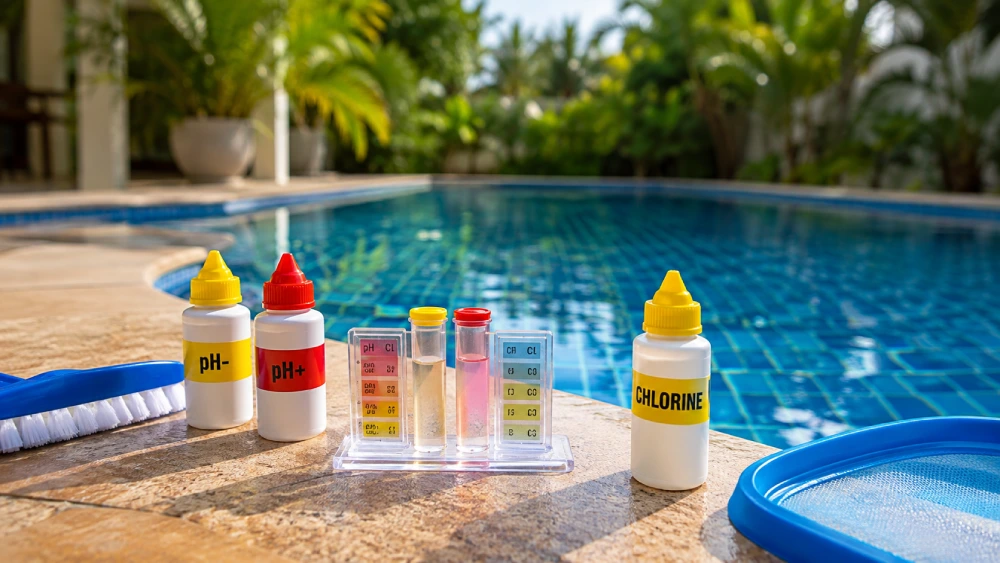
The chemical-balance sequence should begin with identification and testing, not automatic dosing. Circulation problems must be corrected, product quantities calculated, and the pool retested before it returns to guest use.
Pool Chemical Balance Sequence
| Stage | Required action | Decision before continuing |
| Identify | Confirm pool type, volume, finish and equipment | Is the property record accurate? |
| Inspect | Check clarity, debris, water level, algae and stains | Is the problem visible or equipment-related? |
| Circulate | Check pump, filter, baskets, valves and returns | Is water moving effectively? |
| Test | Measure the factors required for the pool | Are the results reliable? |
| Interpret | Review chlorine with stabiliser and pH with alkalinity | Which factor genuinely needs correction? |
| Calculate | Use exact volume, product and concentration | Is the dose property-specific? |
| Treat | Add the measured product using its instructions | Must the pool remain closed? |
| Circulate again | Allow the treatment to distribute | Has sufficient circulation occurred? |
| Retest | Record the result after treatment | Did the correction work? |
| Approve | Check clarity, equipment, access and final status | Is the pool ready for guests? |
Identify the Pool System First
Before testing, record whether the pool uses:
- Manual chlorination
- Salt chlorination
- Automatic dosing
- Another sanitising system
A saltwater pool still needs free-chlorine testing. It also requires checks of salt level, cell condition, flow, operating time, controller output, pH, alkalinity, and other system-specific factors.
Repeated manual chlorine additions to a salt pool may indicate:
- A dirty cell
- A worn cell
- Insufficient pump time
- Poor flow
- Incorrect output
- A controller fault
- Excessive demand
- Another balance problem
Inspect Before Taking the Sample
The technician should first inspect:
- Water clarity
- Water level
- Debris
- Visible algae
- Surface marks
- Skimmer baskets
- Pump basket
- Return flow
- Filter pressure
- Equipment noise
- Air in the system
- Signs of leakage
A chemical test cannot identify every mechanical problem. The inspection explains whether an unusual reading may be linked to circulation, water replacement, contamination, or equipment failure.
The rental property inspection checklist can also include pool clarity, surfaces, water level, equipment, leaks, chemical storage, gates, lighting, and access conditions.
Correct Circulation Problems First
When water movement is weak, test results may not represent the complete pool. Chemicals may remain concentrated near the dosing point while steps, corners, or distant areas receive less treatment.
Restore the operating system before repeatedly changing chemical levels. This may require:
- Emptying baskets
- Cleaning or backwashing the filter
- Correcting a valve position
- Adjusting return jets
- Repairing a pump
- Checking a salt cell
- Fixing a leak
- Correcting automatic dosing equipment
Chemical purchasing should not become a substitute for equipment maintenance.
Interpret Connected Readings
Pool readings influence one another. The strongest examples are:
- Free chlorine and stabiliser
- pH and total alkalinity
- Sanitiser demand and swimmer load
- Chemical performance and circulation
- Water replacement and concentration
- Product strength and required quantity
Avoid making several large corrections at once. A staged approach allows the team to identify which adjustment worked and reduces the risk of overshooting the intended result.
Calculate From the Exact Product
Before adding a product, confirm:
- Pool volume
- Current result
- Intended result
- Product name
- Active concentration
- Product instructions
- Surface or system restrictions
- Previous additions
- Required circulation
- Reopening conditions
Changing from one product concentration to another requires a new calculation. Old scoops, memorised amounts, and copied treatment notes should not override the actual product information.
Record Every Addition
The chemical log should show:
- Date and time
- Pool
- Technician
- Test results
- Product
- Concentration
- Quantity
- Reason
- Circulation time
- Retest result
- Equipment problem
- Pool status
- Approver for extra cost
The property management company operating workflow should connect the technician’s findings with purchase approval, repairs, invoices, guest information, and owner reporting.
Treat Algae as a Full Recovery
One large chemical dose does not complete algae treatment.
A controlled recovery should include:
- Confirming that the problem is algae
- Removing leaves and debris
- Restoring circulation
- Testing accurately
- Applying appropriate treatment
- Brushing walls, steps, corners, fittings and affected areas
- Vacuuming where required
- Cleaning or monitoring the filter
- Retesting during treatment
- Continuing until the water and readings stabilise
- Investigating the original cause
- Approving the pool before reopening
The treatment method and sanitiser level must fit the pool, product, stabiliser, contamination, and surface. A community term or generic online number should not replace a pool-specific procedure.
Use a Reopening Decision
| Finding | Pool status | Required action |
| Clear water and approved readings | Potentially open | Complete equipment and access check |
| Treatment recently added | Treatment in progress | Keep closed until required circulation and retest |
| Cloudy water | Not guest-ready | Diagnose chemistry and filtration |
| Visible algae | Closed for recovery | Continue treatment and brushing |
| Pump or filter failure | Usually closed | Repair and retest |
| Chemical spill | Closed | Secure the area and follow the product response |
| Unconfirmed test result | Pending | Repeat the test |
| Surface stain with stable water | Case-dependent | Diagnose separately without unnecessary shock treatment |
| Heavy rain with no retest | Pending | Inspect, test and approve |
| Final result recorded and equipment working | Approved | Notify the guest team |
The Phuket villa guest-management importance becomes clear when closures, cloudiness, strong odours, or late corrective work affect a promised villa facility.
Track Pool-Care Performance
Useful performance measures include:
- Scheduled visits completed
- Condition-triggered tests completed
- Failed readings
- Retests completed
- Algae recoveries
- Cloudy-water incidents
- Chemical consumption
- Emergency purchases
- Equipment faults
- Pool closures
- Reopening time
- Guest complaints
- Repeat problems
- Owner-report delivery
The property management performance tracking should identify patterns rather than judging performance from one photograph or one test result.
Repeated emergency dosing may point to weak testing, poor circulation, a failing system, unrealistic service frequency, inaccurate pool volume, or uncontrolled guest use.
Phuket Pool-Care Coverage
Pool chemical checks can be coordinated across the island’s main rental and residential areas.
West-coast properties: Bang Tao, Surin, Kamala, Patong, Kata and Karon.
Southern properties: Rawai, Nai Harn, Ya Nui, Friendship Beach, Chalong and Saiyuan.
Northern and central properties: Mai Khao, Laguna Phuket, Kathu, Thalang, Cherng Talay and Choeng Thale.
Coverage also extends to surrounding Phuket areas where villas, houses, condominiums, and holiday rentals require scheduled pool care.
Travel time, weather, technician access, booking schedules, and emergency response should be considered when setting the service plan. Island-wide coverage does not mean that every property should receive the same testing frequency or chemical quantity.
Correct the Cause Before Adding More Chemicals
Repeated chemical additions should not replace accurate testing, working circulation, and equipment repairs. PEARL Phuket Property can help owners fix your pool chemical balance in phuket through scheduled checks, post-rain testing, treatment records, technical coordination, and clear owner updates. The pool should return to guest use only after the correction has been checked. We manage. You relax.
FAQs
Can Pool Chemical Balance Records Reveal a Leak?
Pool chemical balance records can help identify an unusual pattern, but they cannot prove a leak by themselves. Repeated dilution, changing salt levels, rising chemical use, frequent water additions, and unstable readings may justify a physical leak investigation. The manager should compare water-level records, weather, guest use, backwashing, overflow, equipment condition, and refill activity before concluding that water loss comes from a leak.
How Should Pool Water Treatment Be Handed Over?
A proper handover should include the pool volume, sanitising system, products currently used, recent chlorine and pH readings, stabiliser history, treatment records, chemical stock, equipment faults, pending repairs, and current swimming status. The incoming technician should inspect the equipment and complete fresh water testing before applying any treatment. Copying the previous dosing routine without verification may continue an existing water-quality or circulation problem.
Can Pool Service Records Verify Chemical Charges?
Yes. A detailed service record can show whether an additional visit or chemical purchase was justified. It should connect the original water-test results with the pool condition, product name, concentration, quantity used, technician, treatment time, follow-up reading, and approval. A general invoice marked “pool chemicals” does not confirm which pool received the product or whether the amount matched a measured requirement.
How Is a Villa Pool Maintained During Vacancy?
A vacant villa pool still needs scheduled testing and equipment checks. Rain, direct sun, evaporation, leaves, low circulation, leaks, and salt-chlorinator faults can affect water quality even when nobody is swimming. The maintenance frequency may differ from an occupied rental, but long inspection gaps can allow a minor issue to develop into cloudy water, algae growth, damaged equipment, or expensive recovery work.
Should Water Treatment Change When Children Use the Pool?
Treatment should respond to actual swimmer load and test results, not age alone. Frequent swimming, sunscreen, toys, food near the pool, and a high number of users may increase sanitiser demand and justify additional testing. The technician should not apply a stronger dose automatically because children are staying. Any adjustment should follow measured readings, pool volume, circulation performance, product instructions, and safe reopening requirements.
Who Approves Pool Chemical Balance Product Changes?
A pool chemical balance product change should be approved by the person responsible for the property standard and purchasing limit. The record should show the original product, substitute, concentration, reason, price difference, and revised calculation. Technicians should not use the old quantity when a supplier changes the chemical strength, formulation, or treatment instructions.
How Long Should Pool Chemical Balance Logs Be Kept?
Pool chemical balance logs should be retained according to the management agreement, accounting needs, incident procedures, equipment warranty records, and owner-reporting requirements. Useful records include test results, chemical additions, repairs, pool closures, supplier invoices, and reopening approvals. Keeping a consistent history helps identify repeated chlorine loss, pH movement, filter problems, equipment failure, or unexplained chemical spending.