A villa pool may look acceptable one evening and turn cloudy green after rain, equipment failure, or a missed maintenance visit. Adding more shock without checking the water can waste chemicals and hide the actual fault.
Proper green pool recovery management begins by distinguishing algae from metals, excessive stabilizer, poor circulation, and filter failure. The water must then be treated, brushed, filtered, and tested through a controlled sequence.
Recovery is complete only when the pool is clear, chemically stable, and safe to reopen. So, what should be checked before another chemical enters the water?
Quick Check: Before applying another chemical dose, choose a green pool recovery service in Phuket that verifies water chemistry, circulation, filter condition, and the cause of the green colour.
Green Pool Recovery Management: Find the Cause
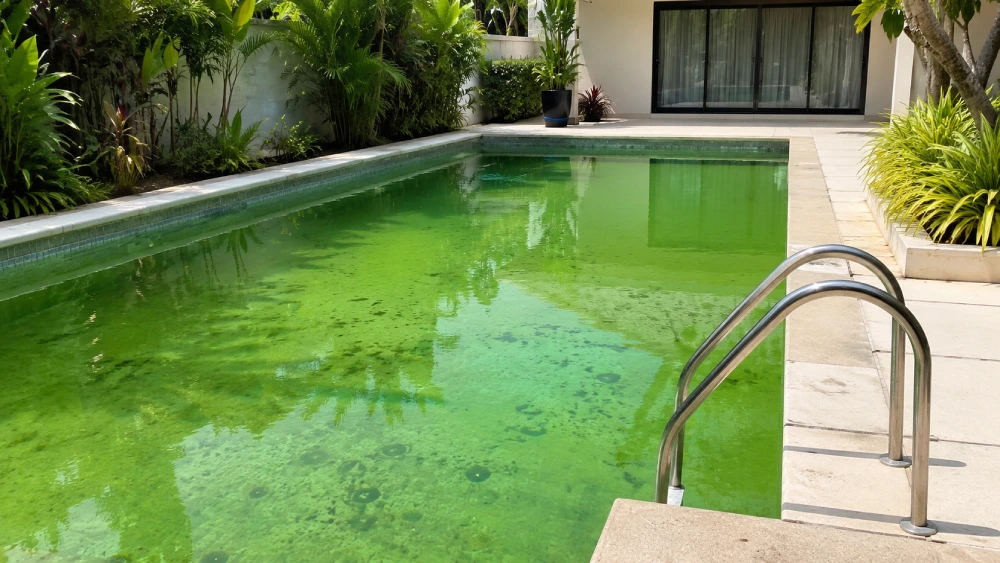
Green pool recovery management should begin with evidence. Water colour provides a warning, but it cannot confirm whether the cause is algae, dissolved metal, excessive cyanuric acid, poor circulation, or several connected problems.
Green Water Diagnosis Checklist
| Pool condition | Possible cause | Check before treatment |
| Green and cloudy | Active algae bloom | Chlorine, pH, CYA and surface growth |
| Clear with a green tint | Copper or iron | Metal test and chemical history |
| Green material on walls | Attached algae | Brush test and low-flow areas |
| Green after heavy rain | Debris, dilution or sanitizer loss | Water readings, baskets and drainage |
| Green after repeated shock | High CYA or circulation failure | Stabilizer, pump and filter |
| Cloudy blue after treatment | Suspended dead algae | Filter pressure and return fl |
| Green again within days | Original cause remains | Dosing, circulation and service records |
Determine Whether the Problem Is Algae
A cloudy green pool with slippery or discoloured surfaces commonly indicates algae. Inspect the floor, walls, steps, corners, grout, lights, ladders, and drains because growth can remain protected in areas with poor circulation.
Clear green water needs a different investigation. Copper or iron can tint the water without creating the cloudy appearance or attached growth expected from algae.
Chlorine can oxidize dissolved metals and make the green colour more visible. If the water becomes greener immediately after shocking, test for metals before increasing chlorine again.
The initial water test should cover free chlorine, combined chlorine, pH, total alkalinity, and cyanuric acid, commonly called CYA. Calcium hardness, salt, phosphate, and metal testing can be added when the system or symptoms justify them.
A rental property inspection checklist should include water colour, surface growth, filter pressure, return
Check CYA Before Increasing Chlorine
CYA protects outdoor-pool chlorine from sunlight. However, the free-chlorine level required to control algae increases as CYA rises.
Stabilized chlorine tablets add CYA during use. The chlorine is consumed, but the stabilizer may remain and gradually accumulate.
This explains why a standard shock dose can produce little improvement in an overstabilized pool. Treatment must be calculated from the measured CYA, pool volume, current chlorine, and product strength.
Partial water replacement may be appropriate when CYA is too high to manage practically. A full drain should not be the automatic response because groundwater, pool construction, finish condition, and replacement-water quality must be considered.
The wider Phuket property management responsibility scope should establish who tests the pool, approves water replacement, arranges repairs, and confirms safe reopening.
Green Pool Recovery Management: Treatment Order
Once algae has been confirmed, green pool recovery management must remove debris, restore circulation, correct measured chemistry, maintain effective sanitizer, and physically remove the dead growth.
Changing the order can slow recovery. Adding chlorine before correcting a circulation fault prevents treated water from moving throughout the pool.
Controlled Recovery Sequence
| Stage | Required action | Completion signal |
| Restrict access | Keep swimmers away | Pool access is controlled |
| Remove debris | Scoop leaves and clear baskets | Solid waste is removed |
| Test water | Record chemistry before dosing | Baseline readings exist |
| Check circulation | Inspect pump, filter, valves and returns | Normal flow is confirmed |
| Correct chemistry | Adjust measured water values | Treatment conditions are suitable |
| Treat algae | Add a calculated chlorine dose | Required level is reached |
| Brush surfaces | Loosen attached growth | Hidden areas are covered |
| Maintain treatment | Retest and restore chlorine | Demand begins stabilizing |
| Filter water | Capture suspended material | Water progresses toward clear |
| Remove sediment | Vacuum settled algae | Floor and corners are clean |
| Verify reopening | Check clarity, chemistry and equipment | Safe conditions return |
Remove Organic Waste First
Leaves, soil, insects, and plant waste consume sanitizer. Removing this material before intensive treatment reduces unnecessary chlorine demand.
Skimmer and pump baskets should be cleared. The water level, suction, valve positions, and return flow must also be checked.
The property management company operating workflow should connect pool inspection, test results, owner approval, chemical treatment, equipment repair, and guest communication.
At remotely managed homes, Phuket remote villa-owner risks include missed water changes, unreported pump fail
Correct Chemistry From Test Results
Recovery procedures commonly set pH near 7.2–7.4 before intensive chlorination. Adjustment must still follow accurate testing and the chosen treatment method.
Alkalinity affects pH stability, while CYA changes the required chlorine level. Ignoring either value can slow or prevent recovery.
Chemicals must be measured and introduced separately according to their labels. Chlorine and acid must never be mixed, placed together in a container, or added through incompatible equipment.
The chlorine quantity cannot be determined from the water colour. Pool volume, current free chlorine, CYA, treatment target, and product concentration are required.
Maintain Chlorine Through Recovery
A heavy algae load can consume chlorine quickly. One shock application may begin the process, but recovery can stall if the effective level falls too soon.
The water should be retested during treatment. Chlorine is then restored according to the selected recovery method rather than through random repeated doses.
Liquid chlorine can raise chlorine without adding more CYA. Its strength varies by product, so the quantity still requires accurate calculation.
Clear reporting forms part of good Phuket property management standards. Owners should receive the test readings, treatment record, equipment findings, and reopening confirmation.
Brush Every Algae-Holding Area
Brushing removes attached growth and exposes it to treated water. The main walls and floor are only the obvious locations.
Steps, grout lines, ladder fittings, lights, drains, overflow channels, corners, and areas behind removable equipment also require attention.
Recovery photographs should show the original condition, brushed surfaces, changing water clarity, filter work, and final result. These records help confirm that the process addressed more than the visible centre of the pool.
Green Pool Recovery Management: Filter Recovery
Chemicals can kill algae, but filtration and vacuuming remove the remains. Green pool recovery management stalls when the pump cannot circulate correctly or the filter becomes restricted by dead material.
A pool may change from green to cloudy blue before becoming clear. This stage usually requires effective filtration and physical removal rather than continuous chemical additions.
Filter Problems That Delay Recovery
| Warning sign | Possible fault | Required check |
| Weak return flow | Restricted basket, filter or pump | Inspect the circulation route |
| Rapid pressure increase | Filter collecting contamination | Clean or backwash correctly |
| No pressure movement | Damaged gauge or bypassing media | Inspect gauge and filter |
| Debris returns to pool | Torn media or incorrect valve setting | Stop and diagnose the filter |
| Persistent cloudy water | Active algae or weak filtration | Retest and inspect circulation |
| Pump loses prime | Low water, air leak or obstruction | Correct the suction problem |
| Green pockets remain | Poor flow distribution | Adjust returns and br |
The pump may need to operate continuously during active recovery when it is designed and safe for extended use. Run time alone does not prove the filter is working.
Filter pressure, return strength, pump temperature, water level, and basket condition should be monitored. A restricted system can remain switched on while circulating very little water.
Sand, cartridge, and diatomaceous-earth filters require different cleaning procedures. Backwashing should not be recommended for every filter.
The Phuket rental-home protection controls should include pump checks, filter servicing, leak reporting, w
Remove Dead Algae Correctly
Dead algae can remain suspended or settle on the floor. The filter should capture suspended material, while settled deposits may require vacuuming.
Vacuuming to waste can prevent heavy debris from returning through the filter when the plumbing supports that method. It removes water, so the water level and replacement-water quality must be managed.
Clarifiers and flocculants do not correct active algae, excessive CYA, weak circulation, or damaged equipment. They should not become the first response to an undiagnosed problem.
Some flocculants require material to settle before vacuuming to waste. Product directions and filter compatibility must be checked first.
Green Pool Recovery Management: Phuket Rain
Phuket rainfall can introduce leaves, soil, pollen, insects, and other organic contamination. It may also dilute pool chemistry and contribute to overflow.
Humidity should not be presented as the sole cause of green water. Low sanitizer, contamination, warm water, sunlight, circulation problems, and missed servicing are more useful operating factors.
Phuket beachfront villa management operations may also account for exposed outdoor areas, windblown debris, salt deposits around equipment, and access after severe weather.
Nearby vegetation can increase organic loading during storms. An overgrown garden recovery service in Phuket may be appropriate when branches, leaves, soil, or plant waste repeatedly enter the water.
Post-Rain Prevention Checklist
- Test the water after substantial rainfall.
- Remove floating and settled debris.
- Empty skimmer and pump baskets.
- Confirm normal pump and return flow.
- Check whether a power interruption stopped the timer.
- Inspect the chlorinator or salt system.
- Review CYA before using stabilized chlorine.
- Brush known low-circulation areas.
- Record unusual chlorine loss.
- Check drainage around the pool.
- Control garden runoff and falling leaves.
- Increase inspections at vacant homes.
The Phuket pool-villa management need becomes clear when owners cannot inspect the water after storms or between guest stays.
Consistent property management performance tracking should record test results, rainfall, treatment time, filter work, pool closure, equipment failures, and repeat algae events.
For foreign owners, Phuket villa support for overseas owners should provide photographic evidence, test readings, repair approval, invoices, and reopening confirmation.
Green Pool Recovery Management: Guest Safety
Improved colour does not confirm that a pool is ready for use. Swimmers should remain out while the water is chemically unstable, active algae remains, or the bottom cannot be seen clearly.
Reopening should require stable operating chemistry, clear water, visible floor and drains, clean surfaces, working circulation, and no unresolved equipment fault.
The wider Phuket short-term rental management operations should connect pool status with reservation dates, guest messages, housekeeping, maintenance access, and check-in readiness.
For Airbnb properties, the Phuket Airbnb rental management framework should define how pool closures are reported
An unsafe pool shortly before arrival may require Phuket property-management emergency response. A reopening time should not be promised until chemistry, clarity, and equipment performance justify it.
Pool inspection, recovery, and guest readiness also belong within luxury villa management inclusions. The operating recor
Green Pool Recovery Management: Property Readiness
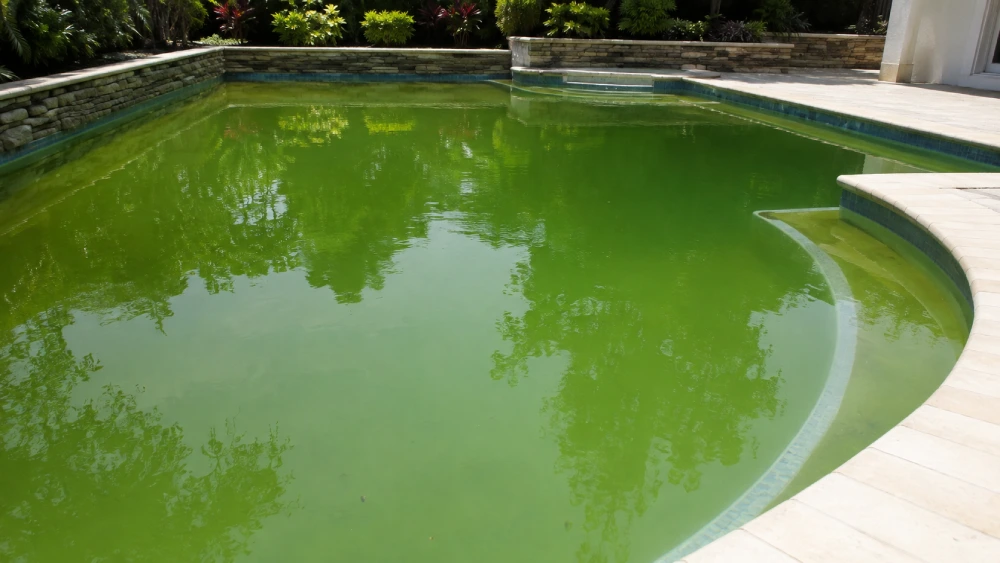
Pool recovery can affect housekeeping, maintenance access, guest communication, and arrival scheduling. The property team must receive the same recovery status as the pool technician.
Remote owners may require a remote property management service in Phuket to review readings, authorize repairs, monitor progress, and confirm when the pool is ready.
At managed houses, rental house property management in Phuket can coordinate equipment access, repair approval, water delivery, and the revised occupancy schedule.
Recovery may leave settled debris and wet surrounding surfaces requiring attention. Coordinating best housekeeping services in Phuket with the pool schedule prevents cleaning from being completed before disruptive recovery work ends.
If guests are already staying at the property, a best airbnb property manager in Phuket should restrict access, explain the problem, document progress, and avoid unsupported reopening promises.
At condominium properties, condo rental property management in Phuket must determine whether the affected pool is private or communal and who can authorize treatment, drainage, and repairs.
Owners comparing villas with 24 hour check-in near me in Phuket should confirm how late arrivals are handled when pool recovery is incomplete. Property entry does not confirm that every amenity is ready.
For villas with check-in available now in Phuket, the arrival team should receive the current pool status before meeting guests. Any restriction and the next inspection time should be explained during check-in.
Green Pool Recovery Management Across Phuket
The technical recovery sequence remains consistent across Phuket, but inspection frequency should reflect occupancy, property access, nearby vegetation, and guest schedules.
High-Turnover Rental Pools
Pools serving short stays in Patong, Kata, Karon, Kamala, Chalong, and Bang Tao may need recovery coordinated closely with departures, housekeeping, and incoming reservations.
Pool clearance should be confirmed separately from room readiness. A prepared interior does not make unstable water safe.
Vacant and Remotely Owned Pools
Homes in Mai Khao, Thalang, Rawai, Nai Harn, Saiyuan, Ya Nui, and Friendship Beach may remain unattended between owner visits or bookings.
The operating plan should identify who tests the water, clears debris, reports equipment faults, and authorizes urgent treatment.
Estate and Villa-Community Pools
Laguna Phuket, Cherng Talay, Choeng Thale, Surin, Kathu, and surrounding Phuket areas include private villas, condominium developments, rental houses, and shared facilities.
The responsible party must be established before work starts. Private and communal pools may follow different approval, access, and maintenance procedures.
The Phuket property management contract structure should state whether routine testing, chemicals, emergency recovery, equipment repairs, and guest communication are included.
Confirm the Cause Before Retreatment
Repeated shock treatments cannot lower excessive CYA, remove dissolved metal, or repair failed circulation. The next action should be based on reliable readings and an equipment inspection.
If the cause remains uncertain, arrange a green pool recovery service in Phuket to diagnose the problem, control treatment, and verify when the pool is safe to reopen.
Frequently Asked Questions
Can green pool recovery work without draining?
Green pool recovery can often be completed without draining when algae is the primary cause and circulation works correctly. Partial water replacement may be required when testing confirms excessive CYA, metals, calcium, or another condition that treatment cannot reduce. Pool construction, groundwater, finish condition, and replacement-water quality must be assessed before removing substantial water.
Why can green pool recovery fail after shocking?
Green pool recovery may fail after shocking when the dose was not calculated from pool volume and CYA, chlorine fell too quickly, or the filter could not remove dead algae. Green water may also result from copper or iron. Reliable testing and equipment inspection are required before selecting another treatment.
How long should green pool recovery take?
Green pool recovery does not have one dependable duration. A light bloom with working circulation may respond faster than a neglected pool with excessive CYA, damaged equipment, or heavy debris. Progress should be measured through chlorine demand, water clarity, surface condition, filter performance, and stable readings rather than a fixed promise.
When is green pool recovery safe for swimming?
Green pool recovery is ready for swimmer access only when the water is clear enough to see the floor and drains, surfaces are clean, circulation works normally, and chemistry has returned to the appro
Does green pool recovery require algaecide?
Green pool recovery does not always require algaecide. Confirmed algae can often be controlled through calculated chlorine treatment, brushing, circulation, filtration, and debris removal. Some algaecides add copper or create foam. Any product should address a diagnosed condition and remain compatible with the pool chemistry and equipment.
Can metals interfere with green pool recovery?
Copper and iron can change the correct green pool recovery process because oxidized metals may tint otherwise clear water green. Additional chlorine can intensify that colour. Metal testing, fill-water history, heater inspection, and recent product records help distinguish dissolved metals from active algae.
Why does green pool recovery stall at cloudy blue?
Green pool recovery commonly reaches cloudy blue after algae dies but remains suspended. Effective filtration and physical removal are then required. Filter pressure, return flow, me