Renovating a villa in Phuket can involve far more than choosing tiles, repainting walls, or replacing furniture. Owners often need contractor sourcing, scope control, access supervision, budget tracking, permit checks, material timing, rainy-season planning, pool and garden coordination, post-work cleaning, and final inspection before the villa is used again.
So, How Does Villa Renovation Management Work In Phuket? It works by turning a risky, contractor-led project into a controlled process with a local manager watching the schedule, site, quality, communication, and handover. For overseas owners, that oversight is often the difference between a clean upgrade and an expensive renovation drift.
Quick Check: Pearl Property Management Company can handle property renovation oversight and coordination in Phuket so contractor access, site checks, owner updates, cleaning, and handover are managed through one local point of contact.
How Does Villa Renovation Management Work In Phuket?
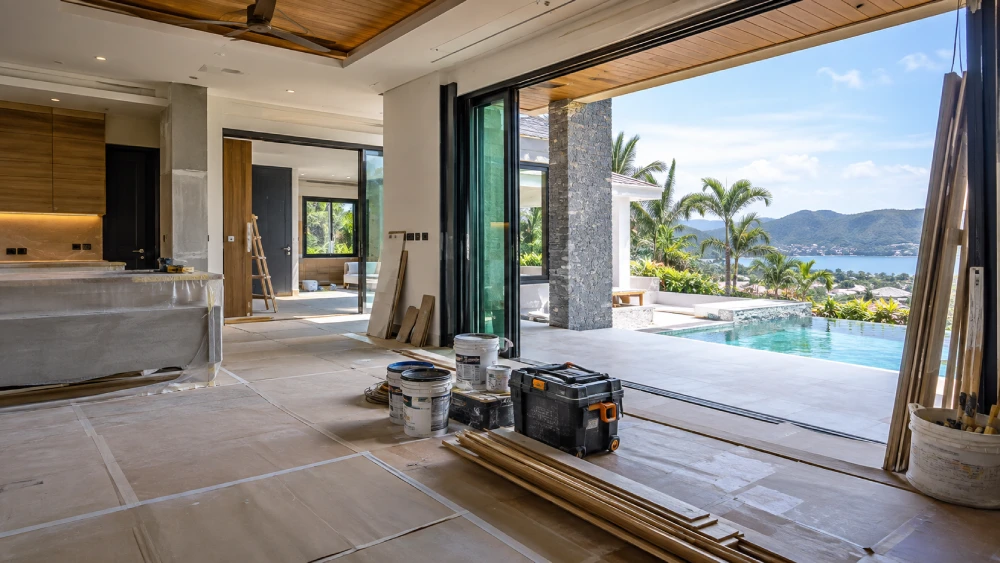
Villa renovation management in Phuket starts with a simple principle: the owner should not be relying only on the contractor to define the work, control the timeline, approve quality, and report progress. A renovation manager sits between the owner and the trades, translating the owner’s goals into a scope, checking whether the work is being done properly, and making sure the villa is protected during the project.
Villa renovation management workflow
| Stage | What happens | Why it matters in Phuket |
| Scope review | Define rooms, repairs, finishes, exclusions, and priorities | Prevents vague contractor quotes and missed tasks |
| Contractor coordination | Source, brief, compare, schedule, and control access | Reduces owner dependence on informal updates |
| Permit and rule check | Confirm whether approvals, estate rules, or juristic permissions apply | Structural or external changes may require local review |
| Site supervision | Check progress, materials, workmanship, safety, and cleanliness | Catches mistakes before they are built over |
| Budget tracking | Compare invoices, variations, deposits, and completed work | Helps prevent uncontrolled renovation spending |
| Weather planning | Sequence exterior work around rain and humidity | Phuket’s wet season can delay paint, roofing, drainage, and landscaping |
| Handover | Inspect defects, test systems, clean, restock, and prepare the villa | Makes the villa usable, rentable, or owner-ready again |
Thailand’s public service portal states that building alteration applications are handled under the Building Control Act framework, with local officials reviewing documents, land-use issues, site conditions, plans, and related laws before issuing alteration approval where required. Owners should verify permit needs with the relevant local authority before structural, external, roof, pool, drainage, or use-change work begins.
Pearl Property Management Company’s role is to make the renovation practical on the ground. That means the project is not just “being renovated”; it is being checked, documented, cleaned, coordinated, and handed back in usable condition.
Why Phuket villa renovations need local oversight
The answer to How Does Villa Renovation Management Work In Phuket? begins with local conditions. Phuket villas deal with heat, ultraviolet exposure, humidity, salt air in coastal areas, heavy rain, pests, and outdoor living spaces. A renovation that looks good on completion can still fail later if materials, drainage, ventilation, waterproofing, sealants, or exterior finishes are not suitable.
Phuket’s rainy season is commonly described as running from May to October, and local villa-care guidance warns that the wet season, humidity, salt air, and sun can age buildings faster than many owners expect. That matters for renovation timing. Exterior painting, roof work, terrace repairs, garden redesign, pool surround work, and waterproofing all need sequencing around weather.
Pearl Property Management Company can provide villa renovation project management in Phuket when owners need renovation oversight connected to the villa’s long-term care. A managed renovation should not create new maintenance problems; it should solve the right problems and leave the villa easier to look after.
Step 1: Define the renovation scope
A Phuket villa renovation should start with a written scope. This is where the owner decides what problem the renovation is solving: guest wear, outdated interiors, water damage, mould, rental preparation, poor layout, pool deterioration, garden overgrowth, air-conditioning issues, or general asset protection.
The scope should separate must-do work from optional upgrades. For example, fixing water ingress, drainage, electrical safety, pool leaks, and bathroom waterproofing is more urgent than changing loose furniture. Cosmetic work can wait; damage-causing defects should not. Pearl Property Management Company can use inspection findings, owner priorities, and contractor input to build a scope that reflects the villa’s real condition.
A strong scope also reduces disputes. If a contractor’s quote says “renovate bathroom,” that is too vague. It should state demolition, waterproofing, plumbing, tiles, fixtures, drainage, ventilation, lighting, silicone, waste removal, cleaning, and handover expectations. For owners who want to understand what should be checked before committing to work, the villa inspection checklist is a useful reference point.
Step 2: Check permits, estate rules, and approvals
Not every villa renovation in Phuket needs the same approvals, but owners should not assume that all renovation work is informal. Interior cosmetic work may be straightforward, while structural work, extensions, roof changes, pool alterations, retaining walls, drainage changes, or use-related changes can trigger local authority, estate, juristic, or lease requirements.
Thailand’s government information portal describes applications for building alteration under the Building Control Act and notes that local officials review land use, the site area, relevant laws, and plans before deciding on permits. Phuket City Municipality also operates an online building-control system that includes requests for construction, alteration, demolition, plan changes, and building-use changes.
Pearl Property Management Company does not replace architects, engineers, or legal advisers where specialist sign-off is required. Its practical value is making sure the permit question is not ignored, the right parties are asked early, and contractor work does not begin on assumptions that could delay or expose the owner later.
Step 3: Source and compare contractors
Villa renovation management in Phuket usually requires more than one contractor. A renovation may involve builders, electricians, plumbers, painters, pool technicians, gardeners, carpenters, glass suppliers, air-conditioning teams, furniture vendors, and cleaners. Each trade may give a quote in a different format, which makes comparison difficult.
A renovation manager helps by creating a consistent brief. Contractors should price the same scope, the same rooms, the same materials, the same exclusions, and the same timing expectations. Quotes should identify deposits, staged payments, warranties where offered, material brands where relevant, and what happens if hidden problems are found.
For overseas owners, this step is especially important because remote renovation guidance in Phuket commonly highlights the need for detailed photo documentation, video walkthroughs, and structured handover when owners are not present. Pearl Property Management Company can help owners avoid renovation decisions based only on informal messages, partial photos, or contractor optimism.
Step 4: Build a realistic renovation schedule
The renovation schedule should match the villa’s use. A private villa can often be taken offline more easily than a short-term rental villa with bookings. An Airbnb villa may need work scheduled between reservations, during low season, or in phases that avoid cancelling income unnecessarily.
Weather also affects scheduling. Local Phuket renovation guidance warns that rainy-season delays can stretch projects, especially exterior work such as roofing, rendering, external painting, pool construction, and landscaping. It also notes that humidity should be treated as a serious renovation factor.
Pearl Property Management Company can connect renovation planning with Airbnb renovation and rental preparation in Phuket when the goal is to bring the property back onto the rental calendar. The rental home protection checklist also helps owners think through how renovation affects future guest use, maintenance risk, and property condition.
Step 5: Control budget, variations, and payments
The renovation budget should be controlled from the start because villa projects can drift when the owner approves small changes without seeing their cumulative effect. A new bathroom tile choice, extra lighting, upgraded fittings, additional waterproofing, changed furniture, and added landscaping can all be sensible individually, but expensive together.
A managed renovation should track quoted work, approved variations, deposit payments, staged payments, receipts, and completion status. Owners should know what has been paid, what has been completed, what is pending, and what still needs inspection. No payment stage should be treated as a substitute for checking the site.
Pearl Property Management Company can help owners connect cost decisions to real property outcomes. The operating cost-control framework is useful when renovation spending needs to be weighed against future maintenance, rental readiness, and asset protection. Owners comparing renovation oversight against wider service costs may also find the property fee structure relevant.
Step 6: Supervise site access and villa protection
A renovation site needs access control. Contractors, delivery teams, cleaners, pool staff, gardeners, furniture suppliers, and technicians may all need to enter the villa. Without local coordination, keys get passed informally, gates are left open, deliveries arrive at the wrong time, and completed areas can be damaged by later trades.
Villa protection should include covering floors, isolating rooms, protecting furniture, storing owner belongings, controlling dust, securing tools, managing rubbish, and keeping wet areas safe. This is especially important if part of the villa remains furnished or if the renovation happens while other maintenance work continues.
Pearl Property Management Company can make access and site checks part of a documented process. For owners comparing general oversight with renovation-specific responsibility, the Phuket property oversight responsibilities explain how local coordination, contractor communication, inspections, maintenance, and owner reporting fit together.
Step 7: Manage pool and garden renovation work
Many Phuket villa renovations extend beyond interiors. Pool tiles, pumps, filtration, decking, terrace drainage, garden irrigation, lighting, outdoor furniture, boundary planting, and drainage can all affect how the villa feels and performs. These areas also interact: poor drainage can damage landscaping, garden debris can affect pool condition, and pool leaks can damage surrounding finishes.
Pearl Property Management Company can coordinate pool restoration and maintenance coordination in Phuket when the renovation includes pool systems, pool surfaces, water quality, or poolside readiness. The company can also coordinate garden restoration and landscaping coordination in Phuket when the work involves lawns, planting, irrigation, trimming, storm damage, or villa presentation.
Outdoor renovation work should be judged by more than appearance. In Phuket, shade, drainage, surface slip risk, water runoff, plant growth, pool debris, and maintenance access all matter. A beautiful outdoor renovation that is hard to maintain can quickly become expensive.
Step 8: Watch for humidity, mould, and water issues
Humidity and water control should be central to villa renovation management in Phuket. Cosmetic upgrades can hide deeper problems if the underlying causes are not checked. A freshly painted wall may look perfect for a few months, then show stains again if there is roof leakage, rising damp, poor ventilation, bathroom waterproofing failure, or air-conditioning condensation.
Local Phuket property-care sources consistently highlight humidity as a major risk for villas, particularly when homes are closed, poorly ventilated, or exposed to wet-season conditions. Before repainting, replacing wardrobes, installing cabinetry, or closing walls, the manager should check for moisture sources and make sure the chosen materials suit the villa’s conditions.
Pearl Property Management Company can use the humidity and mould prevention guide and the rainy-season villa maintenance checklist as part of the owner’s thinking around renovation timing, ventilation, inspections, and post-work monitoring.
Step 9: Coordinate condo and house renovation work
Not every renovation Pearl oversees will be a large villa project. Condominiums and houses in Phuket need similar discipline, but the approvals, access rules, noise limits, delivery paths, elevator protection, juristic office requirements, and neighbour impact can be different.
For condos, Pearl Property Management Company can provide condo renovation supervision and management in Phuket where the work must fit building rules, common-area access, contractor registration, lift use, and unit handover. Condo projects often fail not because the work is complex, but because access and rules were not planned properly.
For houses, Pearl can support house renovation coordination and upkeep in Phuket where repairs, cleaning, garden, pool, and ongoing maintenance need to be managed together. The renovation process should fit the property type instead of copying a villa schedule onto a smaller or more restricted home.
Step 10: Inspect defects before handover
Handover is where renovation management proves its value. The owner should not accept a renovated villa simply because the contractor says it is finished. A proper handover checks paint lines, tile finish, drainage, leaks, doors, locks, air-conditioning, lights, switches, plumbing, water pressure, grout, silicone, cabinetry, appliances, pool systems, garden work, rubbish removal, and cleaning.
A defect list should be written, photographed, and tracked until resolved. If the villa will be rented, the handover should also check guest-facing details: beds, bathrooms, kitchen equipment, outdoor seating, lighting, odours, towels, pool condition, Wi-Fi, safety items, and arrival presentation.
Pearl Property Management Company can connect the defect process with the repair handling process so small post-renovation issues are logged, assigned, followed up, and closed. The emergency response process is also relevant if hidden renovation defects create urgent issues after guests or owners return.
Step 11: Clean, restock, and prepare the villa
Renovation is not finished when the tools leave. Dust, packaging, adhesive residue, tile haze, sawdust, paint smell, dirty windows, marked floors, and disturbed storage areas can make a renovated villa feel unfinished. The villa needs post-work cleaning before owner use, tenant handover, or guest arrival.
Pearl Property Management Company can arrange post-renovation housekeeping and cleaning in Phuket so the property is cleaned to a usable standard after construction work. That includes practical coordination with linen, towels, amenities, inventories, and guest-readiness if the villa is returning to rental use.
The luxury villa care inclusions help show how housekeeping, maintenance, inspections, guest preparation, and owner reporting fit into broader villa care after renovation. Renovation should return the villa to operation, not leave the owner with a second project to make it livable.
Step 12: Protect the villa after renovation
A good renovation should lead into better maintenance. Once the work is complete, the villa needs a follow-up plan for warranty items, cleaning rhythm, pool checks, garden recovery, air-conditioning servicing, humidity monitoring, and inspection of areas that were repaired. This is especially true after waterproofing, roof repairs, pool works, drainage changes, and exterior painting.
Pearl Property Management Company can help owners connect renovation with future protection. The villa asset protection steps are relevant because the renovated villa still needs ongoing checks. The remote villa ownership risks are also important for owners who leave Phuket after the work is complete.
For owners who live abroad, the remote-owner coordination process explains why local eyes, clear reporting, and contractor follow-up matter after renovation. A renovation can solve today’s problem, but unmanaged maintenance can slowly recreate tomorrow’s.
Villa specialist or property manager for renovation?
A villa specialist, builder, architect, designer, contractor, and property manager can all be useful, but they do different jobs. The contractor completes the work. The architect or engineer may design and certify technical elements. The designer may guide finishes. The property manager protects the owner’s operating interests before, during, and after the renovation.
For many villa owners, the best answer is not choosing one role for everything. It is making sure each role is clear. Technical design should be handled by qualified specialists. Construction should be handled by competent contractors. Owner representation, access control, updates, inspection, cleaning, and handover can sit with Pearl Property Management Company.
The villa specialist differences are useful for understanding where each role begins and ends. Renovation management works best when the owner has both technical input where needed and local property oversight throughout the project.
Villa Renovation Management in Phuket: Areas Covered

Villa renovation management and wider property support can be coordinated throughout Phuket.
Coverage includes Bang Tao, Rawai, Nai Harn, Kamala, Surin, Patong, Chalong, Kata, Karon, Mai Khao, Laguna, Kathu, Thalang, Cherng Talay or Choeng Thale, plus Ya Nui, Friendship Beach, Saiyuan, and surrounding Phuket areas.
The basic renovation management principle remains consistent.
What changes is the villa’s condition, access, contractor requirements, weather exposure, and how the property is used.
A high-turnover rental villa may need renovation scheduling that protects guest bookings and allows time for post-work cleaning.
A coastal property may need closer attention to exterior finishes, salt exposure, drainage, pool areas, and garden recovery.
A villa with older waterproofing, recurring leaks, mould history, or previous contractor issues deserves tighter inspection before, during, and after the work.
The correct renovation plan should therefore follow scope, property condition, contractor availability, rainy-season exposure, owner location, rental calendar, pool condition, garden condition, and maintenance history rather than the area name alone.
Final answer on villa renovation management in Phuket
So, How Does Villa Renovation Management Work In Phuket? It works by turning renovation into a controlled sequence: scope, approvals, contractor comparison, schedule planning, budget tracking, site access, work supervision, weather planning, defect inspection, cleaning, and post-renovation care. That structure matters in Phuket because villas face humidity, rain, salt air, outdoor wear, guest turnover, and remote-owner challenges.
Pearl Property Management Company is the right fit when the owner needs practical oversight rather than scattered contractor updates. Through property renovation oversight and coordination in Phuket, Pearl can coordinate the people, site checks, cleaning, reporting, pool and garden support, and handover steps that make the renovation usable. The result is a more controlled project and a villa that returns to owner use or rental operation with fewer avoidable gaps.
FAQs
How Does Villa Renovation Management Work In Phuket for overseas owners?
Villa renovation management in Phuket works for overseas owners by giving them a local representative who can check the site, coordinate contractors, document progress, compare work against the agreed scope, and report problems before they become expensive. Remote renovation guidance for Phuket highlights photo documentation, video walkthroughs, and structured handover as important parts of managing work from abroad. Pearl Property Management Company helps because the owner does not have to rely only on contractor messages or occasional photos to understand what is happening at the villa.
Do villa renovations in Phuket need permits?
Some villa renovations in Phuket may need permits or approval, especially if the work affects the structure, roof, building form, drainage, pool, land use, external appearance, or building use. Thailand’s public service portal describes building alteration applications under the Building Control Act and says local officials review documents, land-use issues, site conditions, plans, and related laws before deciding on approval. Cosmetic interior work may be simpler, but owners should confirm the position with the relevant municipality, estate, juristic office, architect, engineer, or legal adviser before work starts.
Why is rainy season important in Phuket villa renovation management?
Rainy season is important because Phuket renovation work can be affected by heavy rain, humidity, delayed exterior work, slower drying times, leaks, mould risk, and material suitability. Local Phuket renovation guidance warns that rainy-season delays can stretch work and that exterior tasks such as roofing, rendering, external painting, pool construction, and landscaping need careful timing. A renovation manager helps by sequencing weather-sensitive work, checking exposed areas, protecting materials, and making sure the villa is not left vulnerable during wet periods.
What should a villa renovation scope include?
A villa renovation scope in Phuket should include the rooms involved, the exact work to be done, materials, finishes, exclusions, contractor responsibilities, access rules, payment stages, waste removal, defect correction, cleaning, and handover requirements. For bathrooms, the scope should cover waterproofing, drainage, fixtures, tiles, ventilation, lighting, silicone, and testing. For outdoor work, it should cover drainage, surface suitability, poolside safety, planting, irrigation, and maintenance access. A vague scope creates quote confusion, budget drift, and handover disputes.
Can Pearl Property Management Company supervise contractors?
Pearl Property Management Company can coordinate and supervise contractor activity from a property-management perspective. That can include contractor access, work scheduling, progress checks, owner updates, defect notes, cleaning coordination, and handover support. Where specialist design, engineering, legal, or permit certification is required, those tasks should be handled by qualified professionals. Pearl’s value is owner-side coordination: making sure the renovation is tracked, the villa is protected, and the finished work is checked before the property returns to use.
How does renovation management protect a Phuket rental villa?
Renovation management protects a Phuket rental villa by controlling downtime, sequencing work around bookings, checking guest-facing standards, managing defects, and preparing the property before it returns to the rental calendar. An unmanaged renovation can lead to missed bookings, rushed cleaning, unfinished details, poor photos, guest complaints, or maintenance failures soon after reopening. A managed process helps align contractor work, housekeeping, linen, pool care, garden presentation, and final inspection so the villa is ready for guests instead of merely “finished.”
What happens after a villa renovation is complete?
After a Phuket villa renovation is complete, the property should go through defect inspection, system testing, post-renovation cleaning, restocking, photo documentation, and follow-up planning. Bathrooms, kitchens, air-conditioning, lighting, locks, drainage, pool systems, outdoor areas, and garden work should be checked before handover. The villa should also have a maintenance plan for any newly installed finishes, waterproofing, pool equipment, landscaping, furniture, and appliances. This stage matters because a renovation that is not cleaned, tested, and monitored can still create owner or guest problems.