A pool heater can keep running while airflow drops, scale develops inside the heat exchanger, or an electrical fault starts forming. Pool heater maintenance in Phuket matters even in a warm climate because heat pumps and other heating systems still face humidity, monsoon rain, debris, water-chemistry changes, and coastal exposure.
From practical equipment checks, the safest approach is to combine routine observation with a deeper professional inspection roughly once a year. Performance changes, storms, leaks, corrosion, or repeated shutdowns should bring that inspection forward. The first clues often appear before the heater stops completely.
Quick Check: Before choosing a pool equipment repair company in Phuket, check that the provider inspects heater airflow, water flow, heat exchanger condition, electrical connections, drainage, corrosion, and signs of reduced heating performance.
Pool Heater Maintenance in Phuket: Key Parts
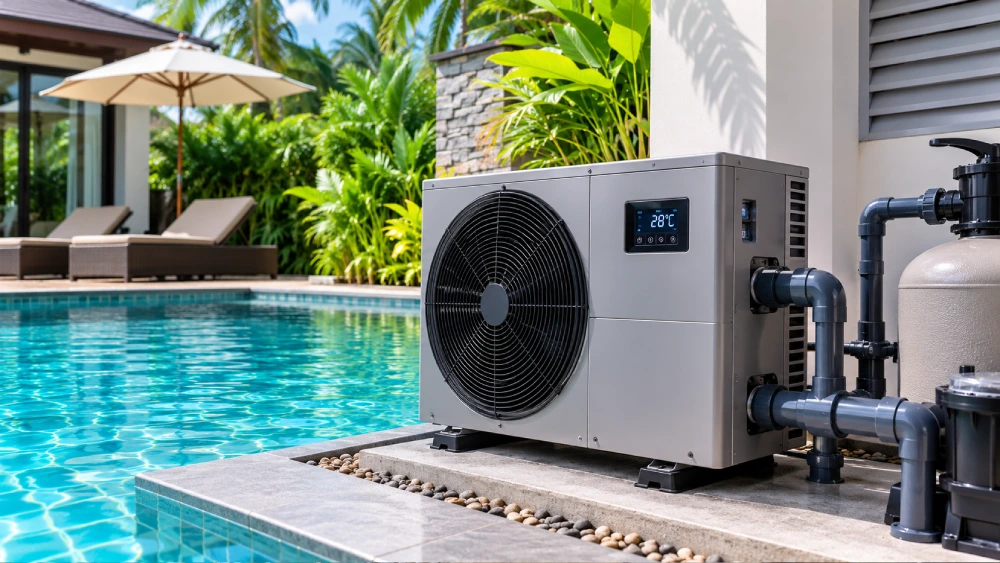
Effective pool heater maintenance in Phuket starts by understanding which components actually affect heating. The heat exchanger, evaporator coil, water-flow controls, electrical parts, and condensate drainage each create different symptoms when maintenance is missed.
Pool Heater Components to Inspect
| Heater Component | What It Does | Maintenance Concern | Warning Sign |
| Heat exchanger | Transfers heat into pool water | Scale, corrosion, restricted water flow | Slower heating or reduced efficiency |
| Evaporator coil | Collects heat from surrounding air on a heat pump | Leaves, dust, insects, salt and dirt buildup | Poor airflow or longer heating time |
| Flow or pressure switch | Confirms sufficient water circulation | Low flow, restriction or switch fault | Heater refuses to run or shuts down |
| Electrical connections | Power fans, controls and compressor components | Moisture, deterioration, loose or damaged connections | Intermittent operation or electrical trip |
| Fan and airflow area | Moves air through heat-pump coil | Vegetation and debris obstruction | Weak airflow or reduced performance |
| Condensate tray and drain | Removes condensation from heat pump | Dirt or organic blockage | Water collecting around unit |
| Controls and sensors | Manage operating conditions and safety | Sensor, thermostat or control faults | Error, inconsistent heating or shutdown |
These checks form part of broader pool equipment maintenance, but a heater needs its own attention because it combines water circulation, heat transfer, airflow and electrical operation.
Heat Exchanger and Water Chemistry
The heat exchanger is where energy from the heating system is transferred into the pool water. If deposits build up inside it or the metal begins deteriorating, heat transfer can become less effective.
Poor water balance can contribute to either corrosive conditions or scale formation. The correct chemistry should follow the heater manufacturer’s operating requirements rather than one universal number applied to every model.
This is why heater care needs to remain connected to normal pool-water testing.
When pool villa management for Phuket owners includes heated pools, chemistry records should be considered alongside heating performance instead of treating the heater as a completely separate appliance.
Evaporator Coil and Airflow
A pool heat pump relies on the outdoor evaporator coil to collect heat from the surrounding air.
That coil needs free airflow.
Leaves, dust, insects and other debris can accumulate around the fins. Coastal properties may also require closer inspection for deposits or corrosion on exposed components.
Do not pack equipment, tools or stored items around the heat pump.
Plants can create the same problem.
Where vegetation grows close to the equipment area, regular garden maintenance service in Phuket can help keep branches, leaves and dense growth from restricting the heater’s air intake and discharge area.
Water Flow and Safety Switches
A pool heater needs sufficient water moving through it.
Many systems include a flow or pressure switch designed to prevent heating when circulation is inadequate.
That means a heater that refuses to start is not automatically broken.
Before replacing components, check the wider circulation path:
- pool water level
- skimmer baskets
- pump basket
- filter condition
- valve positions
- pump operation
- water flow through the heater
- flow or pressure switch condition
A dirty filter or circulation restriction may therefore appear to be a heating fault.
A technician should determine why the heater is not receiving adequate flow before bypassing or replacing a safety component.
Electrical Connections and Controls
Pool heaters combine water and electricity, so electrical faults deserve proper diagnosis.
Humidity, outdoor exposure, water ingress, loose connections, deteriorated wiring, control faults, fan issues, and circuit problems can all affect operation.
If a heater starts intermittently, trips protection, displays repeated errors, or stops unexpectedly, avoid repeatedly resetting it without finding the cause.
These are useful issues to include in routine property manager inspection checks when a villa has heating equipment that an overseas owner cannot inspect personally.
Pool Heater Maintenance in Phuket: Service Plan
A sensible maintenance plan separates normal observation from professional servicing. The supplied research supports an annual preventive inspection as a baseline, with extra checks after severe weather or whenever heating performance, water flow, drainage, or electrical behaviour changes.
Pool Heater Maintenance Timing
| Maintenance Trigger | What to Check | Why It Matters |
| Routine pool visits | Airflow area, leaks, debris, obvious corrosion, heater operation | Finds visible problems early |
| Roughly annual professional service | Coil, electrical parts, controls, heat exchanger condition, flow, drainage | Provides deeper preventive inspection |
| After major monsoon weather | Debris, standing water, airflow, drainage, visible electrical exposure | Storms can change equipment conditions quickly |
| Heater takes longer to warm pool | Coil, water flow, scale, controls, operating conditions | Performance loss may precede failure |
| Heater repeatedly shuts down | Flow switch, circulation, controls, electrical protection | Safety devices may be reacting to another problem |
| Water appears around unit | Condensate drainage, plumbing and equipment leaks | Helps separate normal condensation from faults |
| Visible corrosion develops | Exposed metal, connections and affected components | Coastal exposure may require earlier action |
Annual Service Is a Baseline
The supplied research supports roughly one professional preventive-maintenance inspection per year.
That does not mean the heater should be ignored for the other eleven months.
Routine pool visits should still identify obvious changes such as:
- debris around the heat pump
- blocked airflow
- new corrosion
- water collecting where it did not before
- unusual heater noise
- reduced heating
- control errors
- repeated shutdowns
- damaged housings or wiring
A villa under villa management & maintenance in Phuket can include those observations within normal property checks while reserving technical heater diagnosis for the appropriate technician.
Monsoon Conditions Need Extra Checks
A scheduled annual service should not prevent an additional inspection after severe weather.
Phuket’s rainy season can leave organic debris around outdoor equipment, increase standing water, affect drainage, and expose already weak electrical housings or connections.
The heater surroundings should therefore be checked after significant storms.
Related villa maintenance during Phuket rainy season should also keep drainage paths open and prevent vegetation or loose materials from accumulating around outdoor pool equipment.
Pool heater maintenance in Phuket should respond to actual events, not only the date on the service calendar.
Coastal Corrosion Needs Closer Attention
Not every Phuket property has the same exposure.
A villa close to the sea can face a different environment from a more sheltered inland property.
For outdoor pool heaters at exposed coastal properties, check for visible corrosion around:
- metal housings
- fasteners
- electrical enclosures
- coil areas
- pipe connections
- mounting points
This is where beachfront villa management in Phuket becomes relevant. Equipment condition should reflect the property’s actual exposure rather than assuming one identical maintenance routine across the island.
Condensate Drainage Must Stay Clear
Heat pumps naturally produce condensation during operation.
The drain tray and outlet need a clear path for that water.
Leaves, insects, dirt or organic material can interfere with drainage. Standing water around a heater should therefore be investigated rather than automatically dismissed as normal condensation.
First establish where the water is coming from.
If the problem is a blocked drain, clear it correctly. If water comes from plumbing, the heat exchanger circuit, or another component, the heater may require repair.
Reduced Heating Needs Diagnosis
One of the most common mistakes is assuming that weak heating means the entire unit has failed.
A heater that takes longer than normal to reach the target temperature can have several possible causes:
- restricted airflow
- inadequate water flow
- dirty coil
- scale
- sensor fault
- control problem
- electrical problem
- changed operating conditions
That is why performance should be diagnosed before replacement is recommended.
If repairs are required, property management repair handling can help an absentee owner document the fault, arrange access, coordinate technicians, and record what was actually repaired.
Scaling Can Reduce Heat Transfer
Deposits inside a heater can make it harder to transfer energy efficiently.
Scale should be treated as a diagnostic issue, not an excuse to perform aggressive chemical flushing on every heater automatically.
The correct response depends on:
- heater design
- heat-exchanger material
- degree of scale
- water chemistry history
- manufacturer’s cleaning procedure
Avoid applying one cleaning chemical or descaling method to every system.
A technician should first establish whether scale is actually present and whether it explains the performance problem.
Vacant Villas Still Need Heater Checks
A heater can deteriorate even when no guests are swimming.
An empty villa can still experience:
- heavy rain
- humidity
- vegetation growth
- insects
- corrosion
- electrical problems
- leaks
- circulation faults
That makes vacant property pool management relevant when the heater remains installed during long periods without occupancy.
The equipment should not disappear from the maintenance schedule simply because nobody is currently requesting warm pool water.
For properties using house management services in Phuket, the same principle applies to private residential pools that are only used seasonally.
Rental Villas Add Operational Pressure
Rental properties create a different heater problem.
The equipment may appear normal until a guest expects a particular pool temperature and reports that the water is not heating quickly enough.
A technical fault during occupancy then becomes a guest-management problem.
With airbnb property management and cleaning in Phuket, the operating team should know how to report a heater fault without guessing at the cause.
Likewise, Airbnb guest issue management in Phuket can cover communication and access while the technical diagnosis remains with the appropriate pool-equipment technician.
Housekeeping Can Flag Visible Changes
Housekeepers are not heater technicians, but regular staff can notice visible problems.
For example:
- unusual water around the equipment
- damaged casing
- error display
- unusual noise
- debris covering the heat-pump area
- guest reports about water temperature
That makes professional housekeeping services in Phuket useful as an early reporting layer.
The role is to notice and report, not to open electrical equipment or perform technical repairs.
Arrival Teams Can Report Guest Problems
A guest may first mention the heater during arrival or shortly after checking in.
If a property uses a 24 hour check-in service villa in Phuket, the arrival team can record the complaint, confirm the requested pool temperature, and escalate the issue without attempting an unsafe repair.
This is particularly useful for late-night arrivals.
A guest saying “the pool is cold” does not prove the heater is faulty. The operating conditions and equipment still need checking.
Pool Heater Maintenance in Phuket: Local Support
Local support matters most when a heater requires access, diagnosis or repair while the owner is outside Thailand. The useful service is not simply calling someone. It is documenting the problem, controlling access and checking that the equipment operates afterward.
Remote Owners Need Maintenance Records
Owners abroad cannot personally inspect:
- coil cleanliness
- visible corrosion
- control errors
- drainage
- heater noise
- actual pool temperature
- water flow
- electrical condition
That makes documentation important.
A simple heater maintenance record can show:
| Record | Useful Detail |
| Service date | When inspection or repair happened |
| Heater type | Heat pump, electric or other system |
| Reported problem | Slow heating, shutdown, leak, error or routine service |
| Visual condition | Debris, corrosion, water accumulation or damage |
| Water flow | Whether circulation appeared normal |
| Heating test | Whether temperature increased after service |
| Repair completed | Component cleaned, tested, adjusted or replaced |
| Follow-up required | Further monitoring or specialist work |
These records reduce the remote villa ownership risks in Phuket that arise when an owner receives only a message saying “heater fixed” without knowing what failed.
Repair Before Replacement
A heater that shuts down should be diagnosed in sequence.
Start with operating conditions and the systems that the heater depends on:
- confirm pool circulation
- inspect filter condition
- confirm valve positions
- check airflow
- look for debris or corrosion
- inspect controls or error indications
- test relevant electrical components
- assess heat-exchanger condition
- determine whether the failed part is repairable
Replacement makes more sense when diagnosis identifies a major structural or economic reason, not simply because the pool has stopped warming.
For owners using broader property management services in Phuket, repair authorization should ideally state the fault, proposed work, and whether a replacement is actually necessary.
Know When a Fault Is Urgent
Some heater issues can wait for scheduled diagnosis.
Others should be escalated quickly.
Examples include:
- electrical burning smell
- repeated breaker or protection trips
- exposed damaged wiring
- major equipment leak
- water entering electrical areas
- severe corrosion around electrical components
- heater repeatedly shutting down immediately after reset
Clear Phuket property management emergency handling helps define who contacts the technician and who can authorize urgent access when the owner is unavailable.
Do not continue operating equipment when there are obvious electrical or serious leak concerns.
Condos Need Responsibility Checks
Pool heater responsibility can differ by property type.
A private villa owner usually controls their own equipment. In a condominium, the pool may be:
- a private plunge pool
- part of one unit
- shared by multiple residents
- maintained as a common-area facility
Before arranging work through condo property management services in Phuket, confirm who owns the heater and who is responsible for authorizing maintenance.
That avoids paying for work on equipment controlled by another party.
Pool Heater Maintenance in Phuket: Areas Covered
Pool-heater inspections and related pool equipment support can be coordinated across Bang Tao, Patong, Surin, Kamala, Rawai, Nai Harn, Mai Khao, Ya Nui, Friendship Beach, Chalong, Saiyuan, Laguna Phuket, Kata, Karon, Kathu, Thalang, Cherng Talay or Choeng Thale, and surrounding Phuket areas.
The maintenance requirement should still reflect the property itself.
A beachfront villa may need closer corrosion checks. A heavily landscaped home may need more attention around heat-pump airflow. A vacant villa may need scheduled observation because nobody is present to notice declining performance.
The useful maintenance plan follows heater type, exposure, operation and actual symptoms rather than assuming every Phuket pool heater experiences the same conditions.
Pool Heater Maintenance in Phuket: Act Early
A heater that is slower than normal, repeatedly shuts down, develops corrosion or shows electrical problems deserves inspection before the fault becomes larger. Annual preventive servicing provides a sensible baseline, while storm damage and performance changes justify earlier checks.
If diagnosis or technical work is required, a pool equipment repair company in Phuket should check water flow, airflow, electrical condition, controls, heat-exchanger condition and drainage before recommending replacement.
The goal is straightforward: find the actual fault and maintain the equipment around how it is really operating.
Pool Heater Maintenance in Phuket: FAQs
Does pool heater maintenance in Phuket differ by heater type?
Yes. Pool heater maintenance in Phuket should reflect the actual equipment installed. A heat pump has an outdoor evaporator coil, fan, refrigeration circuit and condensate drainage that do not apply in exactly the same way to every electric or solar heating system. The manufacturer’s maintenance instructions should therefore come before a generic checklist. The local environment still matters, but the technician should identify the heater type before deciding what needs cleaning, testing or servicing.
Is pool heater maintenance in Phuket needed if rarely used?
Yes. Pool heater maintenance in Phuket can still be relevant when the equipment is used only occasionally. Outdoor units remain exposed to humidity, rain, vegetation, insects and possible coastal corrosion while switched off. Long periods without operation can also mean developing problems go unnoticed. Before seasonal use resumes, checking visible condition, airflow, water circulation, controls and drainage provides a more reliable starting point than assuming unused equipment remains in perfect condition.
Can pool heater maintenance happen while a villa is vacant?
Yes. A vacant period can be a practical time for pool heater maintenance in Phuket because technicians can inspect the equipment without disrupting guests. The important point is to document what was found and what work was completed. For remote owners, the maintenance record should include the reported condition, faults, tests performed, repairs completed and whether the heater successfully operated afterward rather than relying on a simple completion message.
What records prove pool heater maintenance was completed?
Useful pool heater maintenance in Phuket records should show more than the invoice date. Ask for the heater type, reason for inspection, visible condition, corrosion or debris observations, water-flow status, error information, repairs or cleaning completed, and a post-service operating check. For an overseas owner, these details create a maintenance history that can reveal repeated faults and help distinguish preventive care from repeated temporary fixes.
Does vegetation affect pool heater maintenance in Phuket?
It can, particularly with heat pumps. Pool heater maintenance in Phuket should include checking that vegetation does not obstruct the outdoor coil or restrict the movement of air around the unit. Leaves, flowers and insects can also collect near the equipment. Trimming surrounding growth is therefore a practical preventive measure, but care should be taken not to damage the coil fins or electrical equipment while clearing the area.
Should pool heater maintenance include testing after repairs?
Yes. Pool heater maintenance in Phuket should include a functional check when repairs have been performed. Replacing or adjusting a component does not prove the whole heating system is operating correctly. The technician should confirm relevant water circulation, controls and heater operation afterward. For remote owners, recording whether the heater ran normally after the work gives much more useful evidence than simply being told that a component was replaced.
Can coastal location change pool heater maintenance frequency?
Potentially. Pool heater maintenance in Phuket may need closer visual inspection at properties with greater coastal exposure because outdoor components can face more salt-related corrosion. The effect varies by exact location, shelter, equipment design and installation, so there should not be one automatic schedule for every coastal villa. Use the actual equipment condition to determine whether additional corrosion checks are warranted between regular professional services.