Pool equipment maintenance management in Phuket should confirm that every pump, filter, chlorinator, valve, controller, light, and balance-tank component is working as intended. A clear-looking pool can still have weak circulation, rising filter pressure, a failing salt cell, or moisture inside the plant room.
These faults often become visible only when the water turns cloudy or the system stops before a guest arrival. Proper management records the equipment, checks physical performance, investigates warning signs, controls repairs, and tests the system after work is completed. The first task is knowing exactly what equipment the property has.
Quick Check: Before appointing a provider, choose a pool equipment repair company in Phuket that records system details, diagnoses faults before ordering parts, and tests every completed repair.
Pool Equipment Maintenance Management in Phuket: Upgrades
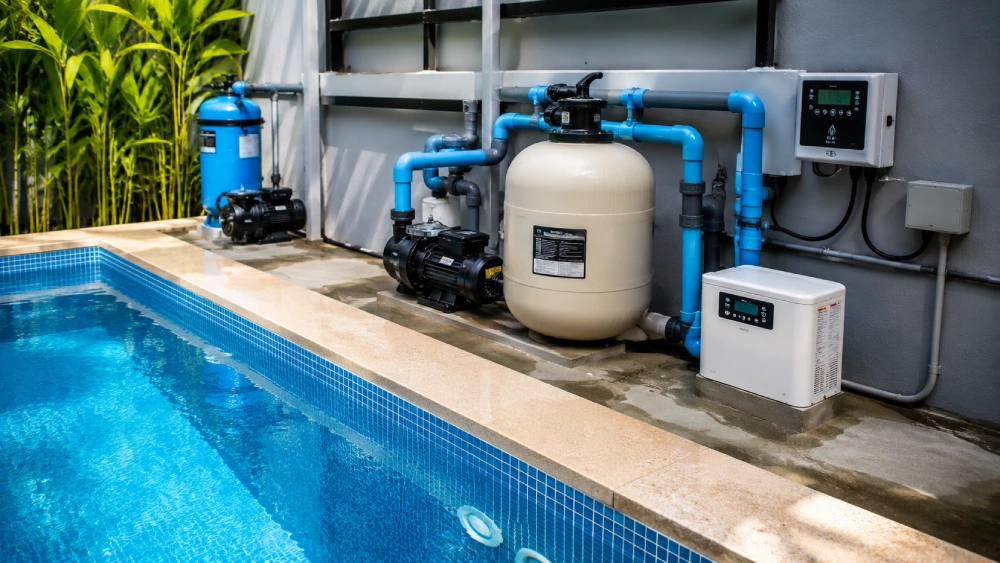
Equipment upgrades should solve a recorded operating problem. A new pump, controller, filter, salt cell, or dosing unit should not be recommended until the existing system, flow, pressure, pool volume, electrical supply, and fault history have been checked.
Pool Equipment Upgrade Decisions
| Equipment area | Existing problem to confirm | Upgrade evidence required | Completion check |
| Pool pump | Weak flow, noise, overheating or high consumption | Flow condition, motor details, system demand and repair assessment | Priming, flow, pressure, noise and leakage |
| Filter | Repeated pressure rise, damaged media or poor clarity | Clean baseline pressure, media condition and filter capacity | Pressure and flow after installation |
| Salt chlorinator | Low output, cell scaling or repeated errors | Salt reading, cell condition, flow and controller history | Chlorine production and error-free operation |
| Automation | Missed schedules, stale readings or failed commands | Physical comparison between commands and equipment response | Full programmed operating cycle |
| Dosing system | Unstable dosing or sensor errors | Calibration record, probe condition and chemical history | Verified readings and measured output |
| Pool heater | Poor temperature rise, errors or leakage | Flow, electrical supply, fault code and condition report | Temperature performance and leak check |
| Underwater lighting | Tripping, moisture or failed fittings | Electrical inspection and component identification | Safe operation by a qualified person |
| Balance tank | Overflow, level loss or unstable circulation | Water-level history, valves, top-up system and leak inspection | Stable level and normal overflow operation |
| Plant room | Flooding, corrosion or excessive heat | Drainage, ventilation, moisture and electrical inspection | Dry, accessible and safely arranged equipment |
Record the Existing Pool System First
An upgrade decision becomes unreliable when the property does not have an equipment register. The register should identify every component and connect it with previous servicing, replacement parts, warranties, normal settings, and unresolved faults.
Record:
- Manufacturer and model
- Serial number
- Installation date where known
- Pump power and intended duty
- Filter type and capacity
- Salt-cell or dosing-unit model
- Heater and water-feature equipment
- Controller and timer details
- Valve positions
- Balance-tank arrangement
- Electrical rating
- Normal operating schedule
- Previous repairs
- Available warranties
Owners using villa management & maintenance in phuket should be able to see this information without asking several contractors to identify the system again.
The Phuket villa support for overseas owners should also preserve equipment photographs, manuals, quotations, approvals, and completed repair reports in the property record.
Match the Pump to the Actual System
Replacing a pump with a larger unit does not automatically improve circulation. The pipe size, filter capacity, valve arrangement, pool volume, balance tank, water features, and required turnover all affect system performance.
An upgrade assessment should check:
- Whether the existing pump remains primed
- Actual return flow
- Suction condition
- Filter pressure
- Valve positions
- Pipe restrictions
- Air entering the system
- Pump noise and heat
- Water-feature demand
- Salt-system operating requirements
A pump can run and consume power while producing poor flow. Motor noise alone does not prove that the circulation system is working.
The Phuket pool-villa management need includes checking whether a technical recommendation suits that particular pool rather than copying an equipment choice from another villa.
Verify Automation Against Physical Operation
Automatic pool systems can schedule pumps, valves, lighting, heating, chlorination, and dosing. They can also display a command that the equipment failed to complete.
A reliable automation check compares the screen or controller with physical operation:
- Confirm that the pump starts.
- Check that the correct valve moves.
- Confirm water flow.
- Check the chlorinator or dosing response.
- Test heater operation where fitted.
- Confirm that lights and water features respond.
- Review error messages.
- Run the complete programmed cycle.
Remote dashboards may be useful for monitoring, but they should not replace an on-site inspection. A dirty sensor, failed relay, stuck valve, or disconnected component can make the displayed status misleading.
The property management performance tracking process should record failed commands, repeated errors, equipment downtime, repair response, and whether the same automation fault returns.
Inspect Salt Cells Before Replacing Them
A salt chlorinator may produce less sanitiser because of scale, poor flow, an incorrect setting, limited operating time, sensor problems, water conditions, or cell wear.
Before recommending replacement, record:
- Salt reading
- Free-chlorine output
- Cell condition
- Scale or deposits
- Flow status
- Controller setting
- Operating time
- Error messages
- Cleaning history
- Installation age where known
The cell should be tested after cleaning or adjustment. Aggressive or unnecessary cleaning can also reduce component life, so the decision should follow the equipment instructions and the observed condition.
Upgrade Filters From Evidence
Filter servicing and replacement should respond to pressure, flow, media condition, housing condition, and water clarity. One fixed age cannot decide whether every cartridge or sand filter needs replacement.
The clean baseline pressure gives the management team a reference. Without it, a current pressure reading has little context.
A filter record should show:
- Clean starting pressure
- Pressure before servicing
- Flow condition
- Cleaning or backwashing date
- Media or cartridge condition
- Housing and seal condition
- Pressure after servicing
- Whether normal flow returned
A damaged gauge should be repaired because it can hide a restriction. Repeated rapid pressure increases may indicate heavy debris, damaged media, algae recovery, circulation faults, or another problem that requires diagnosis.
Protect Plant-Room Equipment
Plant-room upgrades may be more important than replacing the pump itself. Poor drainage, standing water, excessive heat, restricted access, and exposed electrical components can shorten equipment life and create safety risks.
The Phuket rainy-season villa maintenance plan should include:
- Floor drainage
- Water entry through walls or doors
- Equipment elevation
- Ventilation
- Electrical separation
- Corrosion
- Chemical storage
- Access
- Lighting
- Standing-water inspections after storms
An irrigation system repair service in phuket should also report irrigation leaks or runoff that reaches the plant room, balance tank, pool edge, or visible pipework.
Account for Beachfront Exposure
Beachfront properties may receive more sand, wind-blown debris, moisture, and salt deposits around exposed components. This does not prove that every beachfront pump will fail early, but it supports closer condition-based inspection.
The Phuket beachfront villa management operations should check:
- Metal fasteners and brackets
- Electrical terminals
- Control-panel housings
- Pump and heater surfaces
- Outdoor pipe fittings
- Ventilation openings
- Equipment coatings
- Sand entering baskets and filters
Corrosion should be investigated rather than painted over. The underlying component, connection, or electrical terminal may require repair.
The Phuket villa asset-protection controls should connect pool-equipment condition with the wider protection of the villa, plant room, electrical system, finishes, and guest facilities.
Pool Equipment Maintenance Management in Phuket: Failures
Tropical equipment failures often appear as weak flow, cloudy water, unexplained water loss, repeated chemical use, unusual noise, tripping circuits, or failed automation. The visible symptom must be traced through the connected system before replacement work begins.
Tropical Equipment Fault Guide
| Warning sign | Possible equipment areas | First checks | Do not assume |
| Weak return flow | Pump, basket, valve, filter or pipework | Priming, baskets, valve position, pressure and suction | The pump needs replacement |
| Rising filter pressure | Filter media, debris, valves or circulation | Baseline pressure, media condition and flow | More pump hours will solve it |
| Pump loses prime | Water level, suction leak, lid seal or pipework | Water level, lid, seals, fittings and air bubbles | The motor is faulty |
| Repeated manual chlorine | Salt cell, flow, run time or water demand | Cell output, salt, errors, flow and operating schedule | The salt cell is dead |
| Plant-room moisture | Drainage, pipe leak, rain entry or ventilation | Floor, walls, pipework, drains and equipment bases | Humidity is the only cause |
| Circuit tripping | Light, motor, panel, moisture or wiring | Isolate and obtain qualified inspection | Resetting is a repair |
| Pool loses water | Leak, overflow, backwashing or evaporation | Level history, weather, backwashing and visible leaks | One wet area proves the location |
| Abnormal noise | Bearings, obstruction, vibration or low flow | Basket, priming, mounting, flow and heat | The noise is harmless |
| Heater fails | Flow, controller, electrical supply or internal fault | Error code, flow, settings and leak check | A larger heater is required |
| Automation status is wrong | Sensor, relay, valve, communication or controller | Compare every command with physical operation | The dashboard is accurate |
Trace Weak Pump Flow
Weak return flow can begin with a blocked basket, low water level, air leak, dirty filter, partly closed valve, damaged impeller, or failing pump.
Check the system in sequence:
- Confirm the water level.
- Inspect skimmer baskets.
- Clear the pump basket.
- Check whether the pump remains primed.
- Look for air bubbles.
- Inspect lid and visible seals.
- Check valve positions.
- Record filter pressure.
- Check return flow.
- Listen for unusual noise.
- Check heat and vibration.
- Escalate unresolved faults.
An emergency property repair service in phuket becomes relevant when failed circulation, flooding, leakage, overheating, or electrical faults threaten the property or require the pool to close.
The Phuket property-management emergency response should define who isolates the equipment, restricts pool use, contacts the technician, approves urgent costs, and informs the owner or guests.
Investigate Repeat Filter Problems
A filter that becomes restricted soon after cleaning may be receiving a heavy debris load, fine material from runoff, algae, damaged media, or poor circulation.
The technician should compare:
- Clean pressure
- Current pressure
- Time since servicing
- Water clarity
- Recent storms
- Garden debris
- Algae treatment
- Valve position
- Pump flow
- Filter-media condition
Repeated cleaning without identifying the cause can hide a wider system problem.
The rental property inspection checklist can include pressure gauges, filter housings, unions, valves, plant-room drainage, visible pipework, pump noise, lighting, leaks, and equipment access.
Separate Leaks From Normal Water Loss
Water loss may be connected to evaporation, guest use, splash-out, backwashing, overflow, leaking seals, balance-tank faults, pipework, filters, or automatic top-up equipment.
A useful water-loss record includes:
- Normal operating level
- Daily or periodic level changes
- Rainfall
- Guest occupancy
- Backwashing
- Overflow events
- Automatic top-up activity
- Wet areas near equipment
- Balance-tank level
- Pump-seal condition
- Filter and union leaks
A wet plant-room floor does not automatically identify the leak. Water can travel along pipework or enter from rainfall and drainage faults.
The Phuket rental-home protection controls should investigate whether pool-system water is affecting walls, floors, electrical areas, foundations, neighbouring land, or other parts of the rental property.
Control Electrical and Moisture Faults
Timers, controllers, motors, underwater lights, relays, and electrical enclosures can be affected by water entry, corrosion, heat, damaged housings, and failing connections.
Warning signs include:
- Circuit tripping
- Intermittent timers
- Corrosion
- Unusual smells
- Heat around a panel
- Moisture inside a housing
- Failed underwater lights
- Repeated controller resets
- Motor starting problems
Routine staff should not open unsafe electrical equipment or repeatedly reset a tripping circuit. The system should be isolated where necessary and inspected by a suitably qualified person.
The property management repair responsibilities should clearly separate observation, emergency isolation, contractor access, technical diagnosis, repair approval, and completion testing.
Diagnose Before Ordering Parts
A quotation should explain the fault, not simply list a replacement.
A proper repair request should identify:
- Reported symptom
- Equipment model
- Inspection findings
- Tests completed
- Faulty component
- Repair option
- Replacement option
- Part number
- Labour
- Warranty
- Expected downtime
- Pool restrictions
- Post-repair test
This is particularly important when imported equipment or specialist parts are involved.
The Phuket remote villa-owner risks include paying for a complete pump, controller, or salt cell when the original fault was not documented.
The good Phuket property management standards should require diagnosis, approval, photographs where useful, completion evidence, warranty details, and confirmation that the fault was resolved.
Test Every Completed Repair
A repaired component must be tested under normal operating conditions.
After pump work, check:
- Starting
- Priming
- Return flow
- Pressure
- Noise
- Vibration
- Heat
- Leakage
After salt-system work, check:
- Flow
- Cell status
- Error messages
- Controller setting
- Chlorine production
After automation work, run the programmed cycle and confirm that each physical component responds.
After electrical work, obtain the required technical completion confirmation. A light switching on once does not prove that moisture, tripping, or connection problems have been resolved.
The property management company operating workflow should carry the fault from initial report through diagnosis, quotation, owner approval, repair, testing, invoicing, and final reporting.
Prepare Equipment Before Guest Arrival
A pool can look clean while a pump, heater, light, chlorinator, or water feature is unavailable.
A pre-arrival check should confirm:
- Pump operation
- Return flow
- Filter pressure
- Chlorinator status
- Water condition
- Heater operation where advertised
- Underwater lighting
- Water features
- Visible leaks
- Plant-room noise
- Pool access
- Current pool status
The Phuket short-term rental management operations should connect this technical check with the booking calendar and same-day turnaround schedule.
The airbnb property management responsibilities in phuket should also define how a pool closure, failed heater, noisy motor, or unavailable water feature is reported before check-in.
The Phuket Airbnb villa-owner support should provide the owner with the fault, expected downtime, repair status, and effect on the next booking.
Control Late Check-In Information
Guests arriving after normal working hours need a clear pool status. Check-in teams should not guess whether a recently repaired or treated pool is ready.
A 24 hour check-in service villa in phuket should receive one of these statuses:
- Open and checked
- Open with monitoring
- Equipment repair completed
- Closed pending technical test
- Closed pending water test
- Closed for electrical work
- Facility unavailable until a stated review
The Phuket villa guest-management importance becomes clear when an unreported breakdown affects a facility shown in the booking.
Pool Equipment Maintenance Management in Phuket: Toolset
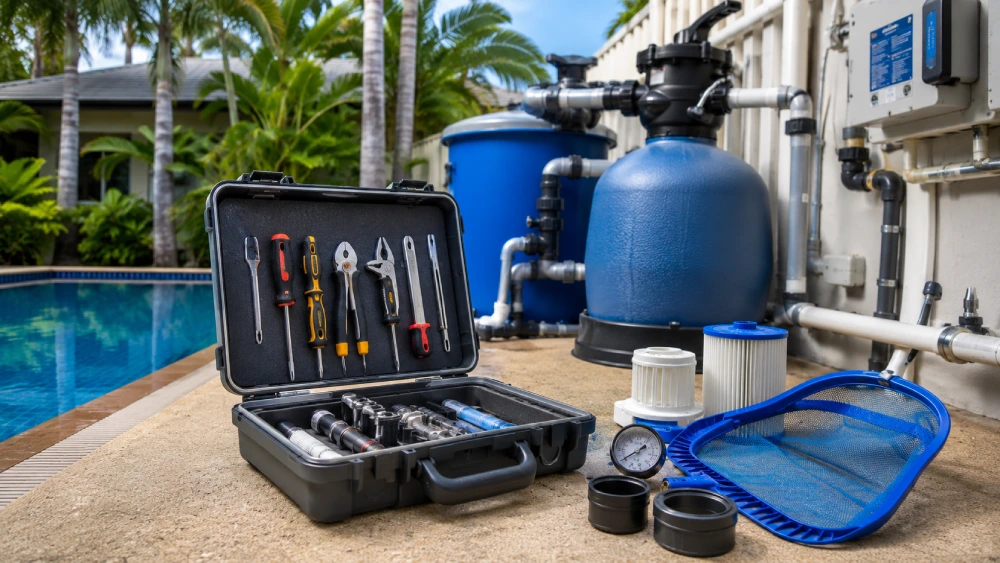
The essential toolset is mainly a controlled inspection and reporting system. Routine staff can observe, clean accessible baskets, record readings, and report faults. Electrical, plumbing, automation, pressurised, and major mechanical work requires suitable technical capability.
Safe Inspection and Record Tools
| Tool or record | Suitable use | Limit |
| Equipment register | Identifying components, models and warranties | Must be kept current |
| Service log | Recording visits, faults, repairs and tests | A visit entry does not prove work was completed |
| Camera | Recording leaks, corrosion, parts and completion | Photographs do not replace diagnosis |
| Torch | Viewing accessible plant-room areas | Do not open electrical enclosures |
| Pressure log | Comparing clean and current filter pressure | Requires a working gauge |
| Water-level record | Tracking loss, overflow and top-up | Does not locate a leak alone |
| Booking calendar | Scheduling pre-arrival equipment checks | Must be shared with the technical team |
| Fault checklist | Recording noise, heat, flow and error codes | Do not guess the cause |
| Warranty file | Checking repair and replacement cover | Confirm supplier conditions |
| Repair approval form | Recording scope, cost, part and downtime | Diagnosis should come first |
| Completion report | Confirming testing after repair | Should identify the original fault |
| Local specialist list | Escalating electrical, plumbing and automation work | Verify current capability and availability |
Define Routine Staff Limits
Routine pool staff may be able to:
- Inspect baskets
- Clear accessible debris
- Check visible flow
- Record pressure
- Note noise or vibration
- Record controller messages
- Photograph leaks
- Check visible plant-room moisture
- Report lighting or heater failure
- Confirm whether the system starts
They should not automatically:
- Open motors
- Work inside electrical panels
- Alter unsafe wiring
- Repair pressurised components
- dismantle automation equipment
- change unfamiliar valve arrangements
- apply temporary leak fixes without approval
- bypass safety systems
The distinction between villa specialists and property managers is important. The specialist diagnoses and repairs technical faults. The manager controls access, scheduling, owner approval, guest communication, records, costs, and completion evidence.
The Phuket property management responsibility scope should identify who receives the fault report and ensures that it reaches the correct technician.
Keep Maintenance and Repairs Separate
Pool-equipment records should classify work as:
- Routine inspection
- Preventive servicing
- Cleaning
- Adjustment
- Minor repair
- Major repair
- Emergency response
- Replacement
- Warranty work
- Completion test
This helps owners understand why an additional charge occurred.
A monthly visit should not automatically include every replacement part, emergency call-out, electrical repair, or leak investigation. The Phuket property management contract structure should define included work, approval limits, exclusions, warranties, and reporting.
Support Every Equipment Invoice
An equipment invoice should connect with:
- The original fault
- The equipment model
- The diagnosis
- The approved repair or replacement
- The part number
- Labour
- Warranty
- Completion evidence
- Post-repair testing
- Remaining risks
An invoice saying only “pool repair” does not show what failed or whether the repair worked.
The property management expense-reduction methods should focus on preventive checks, early leak repair, clean filters, correct pump operation, warranty use, and fewer repeat call-outs.
Connect Other Property Teams
Housekeeping teams may notice pool lights that fail at night, unusual pump noise, standing water, cloudy water, damaged pool gates, or guest complaints.
Professional housekeeping services in phuket should report these signs through the maintenance system rather than attempt technical repairs.
Garden work may introduce leaves, soil, irrigation runoff, or cut material into the pool. The pool and garden schedules should be coordinated so that debris does not remain in baskets or filters after the technician has left.
For shared residential facilities, condominium property management services in phuket may need to coordinate technical work with building access, shared systems, contractor rules, juristic management, and resident notices.
For intermittently occupied houses, house management services in phuket should maintain inspections during vacancy rather than waiting until the owner or tenant returns.
Adjust Checks to the Property
A private villa with one pump differs from a luxury property with multiple pumps, a heated pool, water features, automation, an infinity edge, and a large balance tank.
The luxury villa management inclusions may require:
- Separate equipment records
- Water-feature checks
- Heater servicing
- Automation testing
- Night-light inspections
- Balance-tank controls
- Specialist part sourcing
- Stronger pre-arrival checks
Pool equipment maintenance management in Phuket should therefore use a property-specific plan. One checklist can organise the work, but the equipment, operating conditions, and failure risks determine the final inspection scope.
Phuket Equipment-Service Coverage
Equipment inspections and repair coordination can be arranged across Phuket’s main villa and rental areas.
West coast: Bang Tao, Surin, Kamala, Patong, Kata and Karon.
South Phuket: Rawai, Nai Harn, Ya Nui, Friendship Beach, Chalong and Saiyuan.
North and central Phuket: Mai Khao, Laguna Phuket, Kathu, Thalang, Cherng Talay and Choeng Thale.
Service planning should consider property access, travel time, weather, plant-room location, technician availability, replacement-part delivery, and the next guest arrival. Island-wide coverage does not mean every property needs the same equipment or service schedule.
Fix the Fault Before It Stops the Pool
Repeated resets, extra chemicals, and temporary adjustments do not solve a pump, filter, salt-cell, electrical, or automation fault. PEARL Phuket Property can coordinate a pool equipment repair company in phuket with recorded diagnosis, owner approval, repair follow-up, and guest-status updates. The system should return to normal operation only after the original fault has been tested. We manage. You relax.
FAQs
What Should a Pool Equipment Handover Include?
A pool equipment handover should include the component register, pump and filter details, valve positions, salt-system information, controller settings, manuals, warranties, recent faults, previous repairs, spare parts, and current operating status. The incoming provider should inspect the physical system and compare it with the records. Copying old timer settings or maintenance routines without verification may continue an existing flow, pressure, electrical, or automation problem.
Can Pump Repair Records Support an Invoice?
Detailed pump repair records can show whether the charge was connected to a diagnosed fault. The file should identify the symptom, pump model, tests completed, failed component, repair option, replacement option, part number, labour, approval, warranty, and completion test. An invoice stating only “pump repair” does not confirm what failed, whether the whole pump required replacement, or whether normal flow returned.
How Is Pool Machinery Checked During Vacancy?
Pool machinery during vacancy still needs scheduled observation because pumps, filters, timers, salt cells, top-up systems, pipework, and electrical components continue operating without guests. Rain, blocked baskets, leaks, insects, power interruptions, or failed automation can create problems between visits. The vacancy plan should record system status, visible flow, pressure, water level, error messages, plant-room condition, and any required escalation.
Should Villas Keep Pool Equipment Spare Parts?
Keeping selected pool equipment spare parts may reduce downtime when a property uses imported, uncommon, or slow-to-source components. The decision should follow the equipment history, supplier availability, storage conditions, warranty terms, and the effect of failure on bookings. Parts should be labelled by component and model. Owners should avoid buying expensive spares without confirming compatibility and the likelihood that they will be required.
How Should Repeat Filter Faults Be Investigated?
A repeat filter fault should be reviewed against clean pressure, current pressure, media condition, water clarity, pump flow, recent storms, garden debris, algae treatment, and previous servicing. Repeated backwashing or cartridge cleaning may provide temporary improvement without correcting the cause. The report should explain why the filter became restricted again and whether the issue involves debris load, circulation, damaged media, or another connected component.
Who Should Sign Off Pool Electrical Work?
Pool electrical work should be completed and signed off by a person with the appropriate technical capability for the task. The property record should identify the original fault, isolated equipment, components repaired, tests completed, and any remaining restriction. Routine cleaning, housekeeping, gardening, or check-in staff should not open panels, alter wiring, or repeatedly reset a circuit that continues to trip.
Can Remote Monitoring Replace Equipment Inspections?
Remote pool monitoring can provide alerts, schedules, readings, and controller status, but it cannot confirm every physical condition. A screen may show that a pump was commanded to start while a blocked basket, failed relay, stuck valve, air leak, or motor problem prevents normal flow. Remote data works best when it is compared with scheduled on-site checks of pressure, circulation, noise, leakage, corrosion, and plant-room condition.