Who Pays For Guest Damage At An Airbnb Villa In Phuket? When a guest breaks furniture, damages equipment, stains upholstery, or causes another problem during an Airbnb reservation, determining who pays is not always straightforward. The guest may be responsible for damage beyond normal wear and tear, but reimbursement depends on evidence, Airbnb’s claims procedures, and the circumstances of the incident. Owners must also distinguish accidental guest damage from maintenance failures, existing defects, and ordinary deterioration.
Pearl Property Management Company helps Phuket villa owners coordinate property inspections, guest communication, damage documentation, and approved repair follow-up. These activities are particularly important when owners live overseas or have another reservation approaching. This guide explains guest payment responsibility, Airbnb’s Host Damage Protection, security deposit restrictions, reimbursement deadlines, repair arrangements, and the records owners should keep.
Quick Check: If your Phuket villa has been damaged during a guest reservation, review the evidence, booking details, repair requirements, and available Airbnb guest issue management services in Phuket with Pearl Property Management Company.
Who Pays For Guest Damage At An Airbnb Villa In Phuket? Key Facts
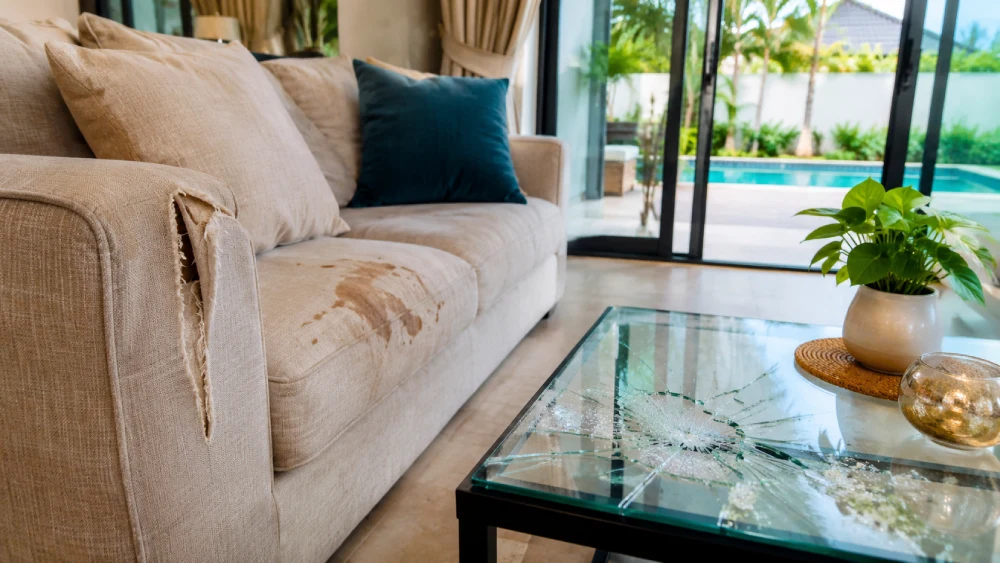
A guest who is responsible for damage beyond normal wear and tear may be required to reimburse the host. The host should first document the loss and seek an appropriate resolution through Airbnb’s Resolution Center. If the guest does not pay, Airbnb’s Host Damage Protection may reimburse certain eligible losses, subject to its terms and evidence requirements.
The property owner generally remains responsible for keeping the villa operational, arranging necessary repairs, and managing expenses that are not recovered from the guest or another eligible source. A property manager may coordinate inspections, communication, and contractor work, but does not automatically become financially responsible for damage caused by guests.
The villa check-in condition and damage evidence procedure explains how accurate condition records can help distinguish new damage from pre-existing defects.
Airbnb Villa Damage Responsibility Comparison
| Situation | Who May Pay? | What Must Be Checked |
| Guest breaks furniture | Responsible guest; eligible Airbnb reimbursement if unpaid | Evidence and repair or replacement value |
| Guest causes unusual staining | Guest or eligible damage protection | Cleaning records and eligibility |
| Normal furniture wear | Generally property owner | Age, use, and condition |
| Appliance fails from age | Generally property owner | Maintenance history |
| Guest damages pool equipment | Responsible guest if causation is established | Technician findings and claim evidence |
| Existing roof leak | Usually owner or another responsible party | Cause, insurance, and maintenance records |
| Manager fails a contractual duty | Depends on agreement and applicable law | Contract, causation, and documented loss |
| Covered insured damage | Insurer subject to policy terms | Coverage, exclusions, and claims procedure |
| Emergency repair before reimbursement | Usually funded initially through authorised arrangements | Spending authority and later recovery |
Pearl Property Management Company helps organise the practical information needed to establish what happened and which party should be contacted. Financial responsibility should be determined from documented facts rather than assumed simply because damage was discovered after checkout.
What Counts As Guest Damage On Airbnb?
Guest damage generally means physical loss or harm attributable to a guest, their invitees, or their pets during a reservation. Examples may include broken furniture, damaged doors, cracked fixtures, missing household items, or unusual contamination requiring additional cleaning.
The central question is whether the condition represents new damage rather than normal use or an existing problem. A guest should not automatically be charged because an item stops functioning during their stay. The item’s prior condition, age, maintenance history, and the available evidence all matter.
The villa inspection observations and defect classification checklist provides supporting context for recording visible property conditions.
Pearl Property Management Company can help owners coordinate inspection findings and supporting documentation. The goal is to identify the cause and extent of a problem before assigning financial responsibility.
Is The Guest Responsible For Accidental Damage?
An accident does not automatically remove a guest’s responsibility. Airbnb expects guests to work with hosts to address damage they or their invitees cause, including accidental damage that goes beyond normal wear and tear.
For example, a guest may accidentally break a glass tabletop, damage a door, or spill a substance that causes a permanent stain. The host should explain the incident, document the actual loss, and request a reasonable amount supported by relevant evidence.
However, a guest should not be charged an arbitrary penalty or automatically required to pay the full price of replacing an older item. Airbnb may consider the damaged property’s condition, supporting documents, and the circumstances when reviewing a reimbursement request.
The guest incident communication and evidence collection stages explain why prompt, factual communication is important.
Pearl Property Management Company can help coordinate local incident documentation and repair assessments while the owner or authorised host follows the applicable claim process.
What Is Normal Wear And Tear?
Normal wear and tear is the gradual deterioration that occurs through ordinary property use. It differs from an identifiable incident that causes damage beyond reasonable usage.
For instance, furniture upholstery becoming worn over time, ageing appliance components, and minor deterioration of frequently used fittings should not automatically be treated as guest misconduct.
Airbnb’s Host Damage Protection expressly excludes normal wear and tear. Owners should therefore maintain routine property condition records and avoid presenting long-standing defects as damage caused by a particular reservation.
Normal Wear Versus Guest Damage
| Property Condition | Likely Classification | Recommended Action |
| Upholstery gradually fading | Ordinary deterioration | Maintenance or replacement planning |
| Sofa leg broken during a stay | Potential guest damage | Document cause and repair cost |
| Air-conditioner fails from ageing | Maintenance issue | Arrange technical assessment |
| Door damaged by a documented impact | Potential guest damage | Preserve evidence |
| Towels worn after repeated use | Ordinary operating expense | Replace through housekeeping budget |
| Large permanent fabric stain after a stay | Potential damage or exceptional cleaning | Compare condition records |
| Existing water leak worsens during rain | Requires technical investigation | Determine cause before assigning liability |
The villa asset protection and condition monitoring methods explain how ongoing property records can support decisions about maintenance and asset preservation.
Pearl Property Management Company can coordinate condition checks so owners have a clearer distinction between expected maintenance costs and genuine guest-related incidents.
Does Airbnb Pay For Guest Damage?
Airbnb offers Host Damage Protection as part of AirCover for Hosts. The programme provides reimbursement for certain eligible damage caused by guests, their invitees, or their pets when the responsible guest does not pay.
Airbnb currently advertises protection of up to US$3 million, but this is a programme limit, not a guaranteed payment for every claim. The actual amount depends on eligibility, evidence, applicable exclusions, valuation, and the programme’s terms.
Eligible categories can include certain damage to buildings, furnishings, belongings, and additional cleaning expenses. Some qualifying lost booking income resulting from guest damage may also be considered.
Host Damage Protection is not an insurance policy. Owners should not rely on it as a substitute for appropriate property insurance.
The rental property incident prevention and documentation framework provides additional context for limiting exposure through inspections and reliable records.
What Damage Does Airbnb AirCover Exclude?
Airbnb’s Host Damage Protection has exclusions that matter when evaluating whether a claim is likely to qualify. Normal wear and tear, damage caused by certain natural events, and losses resulting from inadequate maintenance are not automatically eligible.
The programme also distinguishes ordinary checkout cleaning from certain extraordinary cleaning costs. Standard laundry, rubbish disposal, and routine property preparation are not guest damage claims merely because the work takes place after a reservation.
Airbnb Damage Protection: General Coverage
| Type Of Loss | General Treatment |
| Guest-caused furniture damage | Potentially eligible |
| Guest-caused structural or fixture damage | Potentially eligible |
| Certain pet-related damage | Potentially eligible |
| Qualifying exceptional cleaning | Potentially eligible |
| Certain lost income from cancelled confirmed Airbnb bookings | Potentially eligible |
| Normal wear and tear | Excluded |
| Ordinary checkout cleaning | Excluded |
| Natural disaster damage | Excluded |
| Damage due to ageing or maintenance failure | Generally excluded |
| Guest injury or third-party liability | Separate liability considerations |
Coverage depends on the detailed policy terms and the evidence submitted. An owner should not assume that an incident is covered simply because it appears in a general category.
Pearl Property Management Company can help owners organise inspection findings and contractor documentation, while Airbnb determines whether a reimbursement request satisfies its programme conditions.
How Do You Claim Airbnb Guest Damage?
A damage claim should begin with preserving evidence and determining the reasonable cost of repair, replacement, or qualifying cleaning. Airbnb directs hosts to use its Resolution Center to request reimbursement from the responsible guest.
If the guest does not pay, the host may escalate the matter for consideration under Host Damage Protection, provided the applicable procedures and deadlines are met.
Airbnb Damage Claim Process
- Inspect the damaged item or affected area when safe.
- Take clear photographs or videos before repairs or disposal.
- Record the reservation reference and discovery date.
- Compare the condition with available earlier records.
- Obtain a reasonable repair estimate or supporting invoice.
- Submit a reimbursement request through Airbnb’s Resolution Center.
- Explain the reason for requesting payment from the guest.
- Monitor the guest’s response and keep communication factual.
- If necessary, request Airbnb’s review within the applicable deadline.
- Retain the decision, payment record, and final repair invoice.
Airbnb’s published guidance requires the initial guest reimbursement request for Host Damage Protection to be made within 14 days of the responsible guest’s checkout. Its programme terms also specify a 30-day deadline for completing the Host Damage Protection payment request and submitting supporting evidence.
Owners should act promptly rather than assume the general Resolution Center time limit applies to damage claims.
Pearl Property Management Company can help coordinate property access, damage records, and repair estimates under the agreed management arrangement.
What Evidence Does Airbnb Require For Damage Claims?
Evidence should establish the existence of the damage, its connection to the relevant reservation, and the amount requested. Airbnb may review photographs, videos, receipts, replacement information, repair quotations, guest messages, and other verifiable documentation.
A photograph taken after checkout is helpful, but it may not conclusively establish when the damage occurred. Earlier condition records, cleaning reports, and maintenance histories can provide important context.
Airbnb Damage Evidence Checklist
| Evidence | Purpose |
| Reservation details | Identifies relevant guest stay |
| Pre-arrival condition photos | Establishes earlier condition |
| Post-checkout photos | Documents reported damage |
| Date and time records | Supports incident timeline |
| Guest correspondence | Records notifications and explanations |
| Repair quotation | Supports expected repair cost |
| Final repair invoice | Confirms actual expenditure |
| Original purchase details | Helps assess item age and value |
| Technician report | Establishes technical cause |
| Housekeeping inspection | Records discovery and property condition |
| Resolution Center record | Tracks claim and decision |
The housekeeping inspection sign-off and defect reporting workflow provides related context for identifying problems during property preparation.
Pearl Property Management Company can help coordinate the collection of these materials so owners are not attempting to reconstruct the incident after the property has already been repaired.
How Long Does An Airbnb Damage Claim Take?
Airbnb gives the responsible guest 24 hours to respond to a host’s damage reimbursement request before the host can involve Airbnb under the relevant process.
The guest may pay the full amount, offer a different amount, decline, or fail to respond. If the matter is escalated, Airbnb reviews the available evidence and determines whether the request satisfies its applicable rules.
There is no universal guaranteed settlement date. More complex claims may require additional documents, valuation information, or clarification about the cause of the damage.
Owners should therefore avoid planning urgent repair work around an assumed reimbursement date. Essential repairs may need to be authorised and paid for before the claim is resolved.
Pearl Property Management Company can help coordinate the operational response and maintain records of expenses while the reimbursement process remains open.
Can Airbnb Hosts Collect A Security Deposit?
Most Airbnb home hosts are not permitted to collect a separate security deposit or place a guest’s payment card on hold for incidentals.
Airbnb allows limited exceptions, including certain eligible software-connected hosts and hotel listings that meet its disclosure and collection requirements. These exceptions should not be assumed to apply to an ordinary private villa.
A villa owner should not demand an undisclosed cash deposit at check-in simply because the property contains expensive furniture or equipment.
The property handover condition and deposit documentation principles explain why condition verification remains important even when the host cannot collect a separate security deposit.
Pearl Property Management Company can coordinate check-in records and guest instructions, but any deposit arrangements must comply with Airbnb’s current policies and applicable legal requirements.
Who Pays If A Guest Damages Villa Furniture?
Furniture damage should be assessed using evidence of the incident and a reasonable repair or replacement calculation.
A damaged chair, table, sofa, or decorative item may justify reimbursement when the guest’s responsibility is established. However, the owner should consider whether the item can be repaired and whether age or previous deterioration affects the amount requested.
A professional repair assessment may provide stronger support than automatically demanding the original purchase price of a damaged item.
The guest checkout inspection and room condition comparison helps explain how damage can be discovered and documented during the transition between reservations.
Pearl Property Management Company can help arrange inspection and authorised repair follow-up, ensuring the owner has documentation of the work required.
Who Pays For Damaged Towels And Linen?
The financial treatment depends on the condition and cause of the damage. Ordinary wear, fading, or gradual deterioration of bedding and towels is part of operating a rental property.
If a guest causes unusual permanent staining, burns, or other identifiable damage, the owner may have grounds to seek reimbursement. However, Airbnb’s programme terms contain limitations for household linen, and not every stain or replacement expense qualifies.
Owners should review the evidence and the relevant programme terms rather than assume that replacing a towel automatically creates an eligible claim.
The linen condition assessment and replacement recordkeeping process provides context for documenting fabric condition and laundry-related expenses.
Pearl Property Management Company can help organise housekeeping and replacement records, allowing normal operating costs to remain separate from genuine damage claims.
Who Pays For Guest Damage To A Swimming Pool?
Damage involving a swimming pool requires technical assessment because the cause may not be obvious.
A guest might break a pool fitting, damage equipment through identifiable misuse, or cause another incident beyond ordinary operation. In those circumstances, guest responsibility may be considered if supported by appropriate evidence.
However, equipment failure due to age, corrosion, inadequate maintenance, or ordinary deterioration should not automatically be attributed to the guest.
The swimming pool equipment failure diagnosis and maintenance records provide a relevant framework for identifying mechanical problems.
Pearl Property Management Company can coordinate inspections and specialist follow-up where pool equipment or facilities are affected. Qualified technicians should determine the technical cause before the owner submits a financial claim.
Who Pays For Excessive Cleaning After Guest Damage?
Routine guest turnover cleaning is an operating expense. Additional cleaning may qualify as a damage-related expense when a guest causes conditions substantially beyond ordinary use.
Examples can include serious staining, certain pet accidents, or smoke-related contamination requiring additional specialist cleaning.
The owner should keep photographs, cleaning records, and itemised invoices. Charges should reflect the actual work required rather than arbitrary penalties for failing to complete normal checkout tasks.
The housekeeping materials and replacement supply records help explain how cleaning supplies and replacement purchases can be documented separately.
Pearl Property Management Company can coordinate additional cleaning and recordkeeping, while Airbnb determines whether a reimbursement request qualifies under the applicable programme.
What If The Guest Denies Causing The Damage?
A guest may disagree with the cause of an incident, the amount requested, or whether the damage existed before arrival.
In that situation, the host should present factual information and avoid escalating the dispute through unsupported accusations. Airbnb’s Resolution Center allows the guest to respond to a reimbursement request, including by declining or proposing a different amount.
If the dispute is escalated, Airbnb may review evidence from both parties before determining the outcome.
The guest communication procedures for disputed incidents provide useful context for keeping communication consistent when a problem occurs.
Pearl Property Management Company can help owners organise relevant operational documents and guest correspondence, but it should not promise that Airbnb will approve a claim when responsibility remains disputed.
Who Pays For Emergency Repairs During A Guest Stay?
Emergency repair costs may need to be addressed before responsibility for the damage is resolved.
If a broken door creates a security risk, a leaking pipe threatens the property, or an electrical fault makes an area unsafe, the immediate priority is protecting people and preventing further damage.
The manager should follow the agreed emergency procedures, including contacting qualified providers, documenting the condition, and seeking owner approval when required.
The urgent property incident assessment and contractor contact sequence provides further context for organising time-sensitive responses.
Pearl Property Management Company supports guest repair coordination within the agreed scope, helping owners arrange relevant inspections and repair follow-up.
The fact that an owner initially authorises a repair does not itself determine who ultimately bears the cost. Any recovery must follow the evidence, contractual arrangements, and applicable claims procedures.
What Repairs Should A Property Manager Arrange?
A property manager may be appointed to identify damage, obtain quotations, coordinate contractor access, supervise authorised repairs, and confirm that work has been completed.
The precise authority depends on the management contract. A manager should not automatically approve substantial replacement expenditure without confirming the relevant spending limits.
The contractor repair scheduling and completion verification steps explain how a manager can coordinate repairs without necessarily performing the technical work personally.
Pearl Property Management Company supports villa repair supervision where property damage requires appropriate contractor coordination and owner reporting.
Specialist work involving electricity, pool equipment, roofing, or structural repairs should be carried out by qualified providers.
Is A Property Manager Liable For Guest Damage?
A property manager is not automatically responsible for every loss that occurs during a guest’s stay.
The manager’s potential responsibility depends on the agreed services, applicable law, the manager’s actions or omissions, and whether any alleged breach caused the loss. For example, a claim involving failure to carry out a specifically contracted inspection may require different analysis from damage caused unexpectedly by a guest.
Owners should examine the management agreement and available evidence before asserting financial liability.
The management contract provisions for damage reporting and approvals explain why responsibilities, spending authority, and reporting duties should be documented in advance.
Pearl Property Management Company can help owners establish clear procedures for inspections, maintenance coordination, guest issues, and financial reporting. Any contractual dispute should be reviewed according to its actual terms and appropriate professional advice.
Does Property Insurance Cover Airbnb Guest Damage?
Property insurance may cover certain guest-related losses depending on the insurer, policy wording, coverage limits, and exclusions.
A standard residential policy should not automatically be assumed to cover short-term rental operations. Owners should disclose the property’s intended use to their insurer and confirm whether guest-caused damage, accidental damage, theft, liability, and loss of rental income are covered.
Airbnb expressly states that Host Damage Protection is not a substitute for personal property insurance.
An owner may need to investigate whether a loss falls under Airbnb’s reimbursement programme, the property’s insurance policy, another contractual arrangement, or the owner’s own operating expenses.
Pearl Property Management Company can assist with gathering property records and contractor information but does not determine insurance coverage or claim eligibility.
How Should Guest Damage Appear In Owner Statements?
A monthly owner statement should distinguish damage-related expenses from ordinary maintenance and record any reimbursement separately from the original cost.
For example, if an owner pays for a damaged door to be repaired and later receives a reimbursement, both transactions should be recorded appropriately. The expense should not disappear simply because reimbursement was received.
The rental expense ledger and reimbursement reconciliation procedure explains how supporting documents can help owners understand financial movements.
Guest Damage Financial Reporting
| Reporting Field | What To Record |
| Reservation reference | Relevant guest booking |
| Incident date | When damage occurred or was discovered |
| Damaged item | Description and condition |
| Repair estimate | Proposed cost |
| Final repair invoice | Actual expense |
| Owner payment | Funds used to settle repair |
| Guest reimbursement request | Amount requested |
| Airbnb claim status | Pending, approved, or declined |
| Reimbursement received | Actual payment |
| Unrecovered expense | Amount remaining after recovery |
| Supporting documents | Photos, invoices, and correspondence |
Pearl Property Management Company can coordinate these records under the agreed management scope, helping owners avoid treating an unresolved claim as money already received.
How Can Overseas Owners Manage Guest Damage?
Overseas owners may not be available to inspect a damaged villa, meet contractors, or photograph an incident before the next reservation.
For these owners, local coordination should include clear instructions for inspections, urgent repairs, owner notification, contractor approval, and secure storage of supporting documents.
The remote villa owner incident oversight and approval arrangements provides additional context for maintaining property oversight from abroad.
Pearl Property Management Company can help coordinate relevant inspections, contractor communication, and owner reporting, subject to the agreed service scope.
A reliable process allows the owner to understand the damage and authorise necessary work without assuming that a remote discussion alone establishes the cause or payment responsibility.
How Can Owners Reduce Guest Damage Risks?
Damage prevention cannot eliminate every accident, but clear house rules and consistent property inspections can reduce uncertainty about expected behaviour and property condition.
Owners should provide accurate instructions for appliances, swimming pools, outdoor equipment, access systems, and other facilities that guests may not know how to operate.
They should also establish how damage is reported and which conditions require immediate attention.
The villa operating procedures and service inspection standards provides context for maintaining consistent oversight.
Pearl Property Management Company can help organise property preparation, guest communication, inspections, and maintenance follow-up. These activities support better records and faster identification of problems without guaranteeing that damage will never occur.
Guest Damage Response Checklist
Before closing a guest damage incident, owners should confirm the nature of the loss, the supporting evidence, the repair requirement, and the status of any reimbursement request.
Airbnb Villa Damage Checklist
| Stage | Required Action |
| Discovery | Record the problem and check immediate safety |
| Initial documentation | Photograph the affected area |
| Condition comparison | Review earlier inspection records |
| Guest communication | Explain the concern factually |
| Repair assessment | Obtain appropriate technical advice |
| Expense approval | Confirm authorised spending |
| Airbnb request | Submit within the applicable deadline |
| Claim escalation | Follow Host Damage Protection requirements |
| Repair completion | Verify and document work |
| Financial reporting | Record actual costs and reimbursements |
| Final review | Identify unrecovered amounts and follow-up |
The checklist should be adjusted to the actual incident. An urgent safety hazard may require immediate action before the evidence-gathering process is complete, provided evidence is preserved where safely possible.
Who Pays For Guest Damage At An Airbnb Villa In Phuket Area Coverage
Across Bang Tao, Laguna Phuket, Cherng Talay or Choeng Thale, Surin, and Kamala, Airbnb villa owners should maintain detailed records of furnishings, appliances, swimming pool equipment, and outdoor property features. Where a guest damages an item, earlier inspection photographs and repair estimates can help establish the condition and extent of the loss. Owners should also clarify who coordinates authorised repairs and how the expenses will be reported while any Airbnb reimbursement request remains unresolved.
In Patong, Kata, Karon, Chalong, and Kathu, guest damage procedures should account for reservation turnover, housekeeping inspections, and the timing of the next arrival. Damage may only become visible when cleaners enter after checkout, making prompt documentation important. Managers should distinguish accidental guest damage from routine maintenance needs and arrange suitable repairs without assuming that every broken item automatically qualifies for reimbursement.
For villas in Rawai, Nai Harn, Ya Nui, Friendship Beach, and Saiyuan, owners should review the condition of indoor furniture, access doors, outdoor facilities, and pool equipment before and after relevant reservations. Where guests report an incident, clear communication and appropriate contractor assessments can help establish the repair requirements. Overseas owners should receive supporting photographs, invoices, and updates on any guest payment request or outstanding insurance matter.
Pearl Property Management Company’s coverage also includes Mai Khao, Thalang, and surrounding Phuket areas. Its Airbnb and villa management arrangements can help owners coordinate damage inspections, guest correspondence, contractor access, repair follow-up, and operating expense records within the agreed scope. The appropriate response should reflect documented guest responsibility, existing property condition, repair urgency, Airbnb claim deadlines, insurance coverage, owner approval authority, and reimbursement status, rather than assuming every damage incident has the same financial outcome.
Final Advice On Airbnb Guest Damage
Who Pays For Guest Damage At An Airbnb Villa In Phuket depends on the cause of the incident, the available evidence, and the applicable booking and reimbursement rules. Responsible guests may be required to reimburse damage beyond normal wear and tear, while Airbnb’s Host Damage Protection may cover certain eligible unpaid losses. Routine maintenance, excluded damage, and unrecovered expenses may remain the owner’s responsibility.
Pearl Property Management Company helps Phuket villa owners coordinate inspections, guest communication, repair arrangements, and financial documentation through its Airbnb guest issue management services in Phuket. A clear response process helps owners act within Airbnb’s claim deadlines, arrange necessary work, and maintain accurate records without assuming that reimbursement is guaranteed.
FAQs
Who Pays For Guest Damage At An Airbnb Villa In Phuket?
A guest who is responsible for damage beyond normal wear and tear may be required to reimburse the owner. If the guest does not pay, certain eligible losses may qualify for Airbnb’s Host Damage Protection. The owner remains responsible for managing the property and addressing expenses that cannot be recovered from another responsible party.
Does Airbnb Pay For Damage Caused By Guests?
Airbnb’s Host Damage Protection may reimburse certain eligible losses caused by guests, invitees, or pets when the responsible guest does not pay. Coverage is subject to exclusions, documentation requirements, and claim deadlines. It is not a guarantee that every repair or replacement expense will be reimbursed.
How Much Damage Protection Does Airbnb Provide?
Airbnb advertises Host Damage Protection of up to US$3 million. This is the programme’s maximum protection amount, not an automatic entitlement. The approved reimbursement depends on the circumstances, evidence, eligibility rules, and applicable limitations.
How Long Do Hosts Have To Report Airbnb Damage?
Airbnb’s Host Damage Protection procedure requires hosts to request reimbursement from the responsible guest within 14 days after checkout. The programme terms also specify a 30-day deadline to complete the Host Damage Protection request and provide supporting evidence. Owners should not rely on the longer general Resolution Center window for damage claims.
What Happens If A Guest Refuses To Pay?
The host may ask Airbnb to review the reimbursement request through the Resolution Center. The guest generally has 24 hours to respond before escalation. Airbnb can assess evidence from both parties and decide whether the guest is responsible and whether the requested amount qualifies for reimbursement.
Can Airbnb Hosts Collect A Damage Deposit?
Most Airbnb home hosts cannot collect a separate security deposit. Limited exceptions exist for certain eligible software-connected listings and hotels with appropriate disclosure. An ordinary Phuket villa owner should not assume that a cash deposit is permitted simply because the property contains expensive furnishings.
Does Airbnb Cover Broken Furniture?
Guest-caused furniture damage may qualify for reimbursement under Host Damage Protection, subject to the terms and evidence requirements. Owners should document the damage, establish the item’s previous condition, and obtain a reasonable repair or replacement assessment.
Does Airbnb Cover Damaged Pool Equipment?
Potentially, if an eligible guest-caused incident is established. However, mechanical failure, deterioration, or lack of maintenance may not qualify. Owners should obtain a suitable technical assessment before attributing pool equipment problems to a guest.
Who Pays For Normal Wear And Tear?
The property owner generally bears the costs associated with ordinary deterioration and maintenance. Airbnb’s Host Damage Protection excludes normal wear and tear. Owners should maintain condition records to avoid confusing gradual ageing with a specific guest-caused incident.
Can Guests Be Charged For Excessive Cleaning?
Guests may be responsible for qualifying unexpected cleaning costs beyond ordinary property preparation. Claims should be supported by photographs, invoices, and relevant evidence. Routine cleaning and arbitrary penalties for failing to complete checkout chores are not automatically chargeable as damage.
Does AirCover Replace Property Insurance?
No. Airbnb states that Host Damage Protection is not insurance and is not a substitute for appropriate personal property coverage. Owners should confirm that their insurance arrangements reflect the property’s short-term rental use and relevant risks.
Can Pearl Property Management Company Handle Guest Damage?
Pearl Property Management Company can help coordinate property inspections, incident records, guest communication, approved contractor access, repair follow-up, and financial reporting within the agreed management scope. Airbnb remains responsible for assessing claims under its Host Damage Protection programme, while financial liability depends on the actual circumstances and applicable agreements.